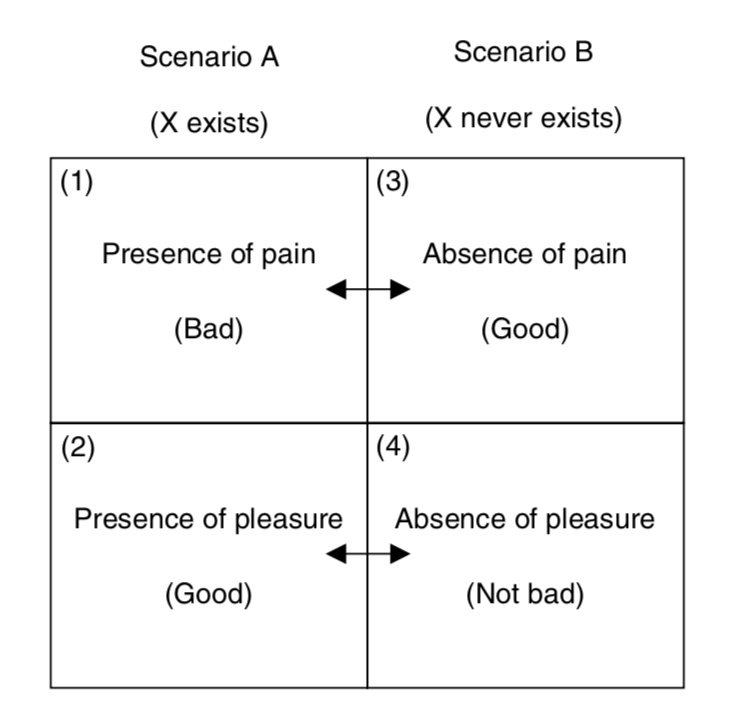
When you exist, you need to constantly chase relief in order to avoid suffering, you need/want/desire. Eat or hunger, drink or thirst, defecate or constipate, masturbation or sexual frustration, breathing or suffocation.
You obtain relief, or you are forced to keep suffering, that is the fundamental mechanism. When you never come into existence, you don’t obtain any relief from your suffering, but I would say that that’s not a problem, because you never exist, so you won’t feel bad about it.
By not reproducing any conscious lifeforms, we prevent all harm/suffering, all relief/pleasure as well, but again, also all harm/suffering, so there would be no one to feel bad about not eating favorite dish anymore when they don’t exist.
What comes up in these discussions is sometimes the question of promortalism. If this reasoning is used to justify not giving birth, doesn’t it also justify killing someone to put them out of their misery?
- ”If life is so bad, aren’t we all just better off dead then, doesn’t this justify killing everyone?”
The answer is in principle – yes, in practice – no.
- In principle:
As long as a sentient organism lives, it experiences suffering, that is bad.
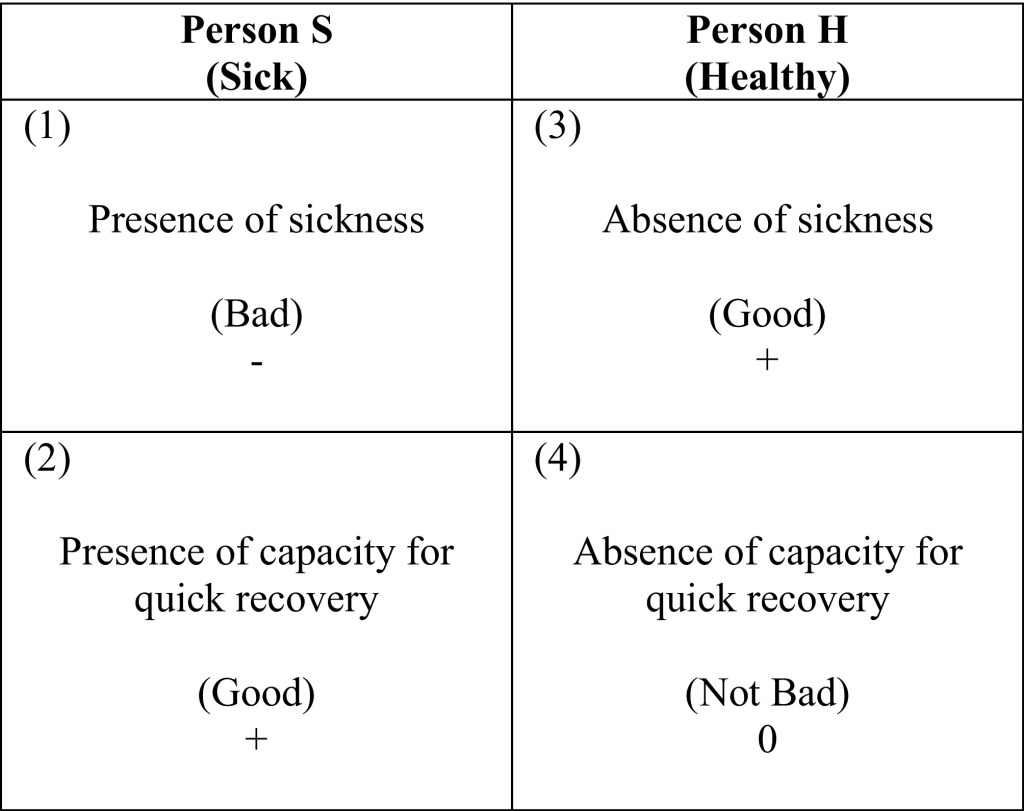
If you never exist, you don’t feel pleasure, but you also don’t suffer, so it’s no problem. If you die now, you won’t feel pleasure once you’re dead, but you also won’t suffer, so it’s no problem, unless you felt suffering in the process of dying.
By obtaining any given pleasure, you’re always minimizing a greater loss/negative, no neutral point in between. If you don’t eat, you’ll suffer hunger, if you don’t drink, you’ll suffer thirst. No pleasure, then suffering. But just like never being born in the first place would solve this problem perfectly, dying as soon as possible would solve this problem of needing constant gratification for you as well.
So as long as the dying process is entirely suffering-free, let’s say in your deepest sleep, I simply painlessly lethally inject you with a substance that of course also causes no distress in any way, then I would say there’s no intrinsic harm – you didn’t see it coming and you didn’t feel it when it happened.
Your departure was painless, I prevented all future suffering, you are not going to wake up later on as a ghost in non-existence and lament that you still needed to do x (just like you didn’t before coming into existence), but now you are being deprived of life because you are dead.
Even if you say you can rationally recognize that this isn’t the case, you’re not going to be a ghost afterwards, you can still feel threatened by something even if you know it’s not going to harm you later on, just like I could feel scared by a spider even if I know it’s not going to attack me. As as long as you’re sentient, the alternative to not obtaining pleasure, the relief of suffering, is suffering, you might still have a stupid intuition that you’re going to suffer from not obtaining pleasure once you’re dead – could be. I think people often don’t think of death as the end, they think of it as some kind of second life where they feel tormented over missing out on their life.
Dying may be bad, but death, non-existence is the absence of all badness, the absence of all needs that even demand to be fulfilled, the thing we call wellbeing is no longer needed once you’re dead, so you can’t conclude rationally that death is a problem because it lacks wellbeing any more than to conclude that never being born in the first place is bad because it lacks wellbeing. The underlying philosophical idea here is antifrustrationism, and from that follows both global antinatalism and promortalism in principle, not fulfilling a need isn’t a problem if the need doesn’t even exist. Feed the hungry, but don’t make the hungry to feed them.
- In practice:
There are some factors that complicate just killing yourself or someone else, it isn’t too easy to just kill someone entirely painlessly without them noticing it.
- By killing yourself, you may cause more suffering to yourself or others than you would experience from staying alive.
- By killing someone else painlessly in their sleep, you may cause more suffering to others than you would prevent by ending their existence.
I would not be too sure that it does always cause more suffering to end life though, right now, even terminally ill individuals are denied the right to die to maintain the delusion of religious idiots that life is always good even when you’re being tortured 24/7, because it’s life, so it must be good.
Equally, many do nothing but cause harm to others, you’d likely save a million farmed animals from being tortured by euthanizing some people painlessly, so I don’t particularly always trust their evaluations of how horrible it would be to end a life.
Arguably, the strongest argument against just ending life is that once a sentient organism exists, there is the potential for them to reduce and most importantly prevent suffering for other sentient organisms. So whilst being alive is worse than not being alive, it is currently instrumental to achieving the reduction or prevention of suffering, we have extrinsic value to that goal.
The cessation of anyone’s, of any suffering, negative sensation whatsoever is obviously a good idea, but in our current world, being alive is instrumental to convincing others of the fact that life is fundamentally flawed, so you can try to prevent more suffering than by just preventing your suffering by killing yourself, it would be even better than just ending your suffering.
So see it like this – if you’re in a senseless war, you don’t end the war by just killing yourself, there is more utility to staying alive and stopping the radicalization of more soldiers, so that as many as possible other soldiers stop thinking there’s some kind of greater good to all this suffering, and as such minimize harm/cruelty caused in the war by other soldiers, perhaps the soldier can even go back home at some point and start writing books about why exactly they disagree with the cause of those that initiated said war and try to convince people that it’s a bad idea, dedicate life to becoming an anti-war activist.
Whilst you are alive, you can convince others of the idea that sentient life should be brought to an end on a global, not just individual scale, and prevent other harms from befalling the other organisms around you, chances are there’s always a problem to solve. But you only need to do that because they exist in the first place, so this is not an argument for making new life, only for staying here whilst you’re already here.
If we were already all convinced that life is a failure, we’ve already managed to sterilize or painlessly euthanize the other animals, then indeed it would be questionable why we should stay alive, at that point I’d simply say it depends, will committing suicide cause you more suffering in a single instant than you will experience from staying alive and needing, desiring, wanting until dead?
You being dead certainly wouldn’t be a problem anymore, if everything is fixed, there needs to be no problem fixer anymore, because there is no problem left, except you.
So if I could painlessly evaporate all life by snapping fingers on my left hand and my life by snapping fingers on my right hand, there’d be no reason not to snap the fingers on my right hand after I’ve snapped fingers on my left hand.
In conclusion, as stated before, I think life can be worth living in practice, but not in principle.
Now let’s also address what the pro-natalist asking this question ”why not just kill yourself?” could mean as an argument against antinatalism and demonstrate how those arguments fail.
- ”Because everyone has the option to commit suicide, it is totally fair to bring a child into existence, they can just kill themselves if they want to! You can always opt out! It’s a perfectly fair deal, take it or leave it!”
Giving someone the chance to commit suicide doesn’t diminish the harm you caused them, if they want to kill themselves, it’s already too late, you already fucked them over.
The underlying logical structure of this argument is essentially:
- ”If the subject has the ability to free themselves from x harmful circumstance, it is justifiable to impose x harm circumstance onto the subject.”
By this standard, if a rapist locked a girl into his basement and raped her every day, he should walk free just as long as he gave her a rope to hang herself with, the judge would have to say:
- ”Well, you could have committed suicide, so therefore, as long as your rapist gave you a rope, it’s all your fault pretty much anyway. Free the offender, forcing girls to suck your dick at gunpoint is fine because they can just choose to die if they don’t want to suck your dick, that seems sensible!”.
This is exactly the attitude the natalist is demonstrating in this scenario, it’s ok to cause potentially severe harm, because after all, your victim can still commit suicide if they don’t like it.
This can be applied to every single harm that anyone could take issue with. Don’t like being sexually harassed? Just kill yourself. Don’t like not having certain freedoms in life? Just kill yourself. Don’t like being hit by me drunk driving? Just kill yourself, I’m never going to stop!
Just like any other harm causer, natalists sometimes excuse the pain they cause by pretending that if the victim did not commit suicide yet, that proves that they actually secretly enjoyed getting raped repeatedly. If they really didn’t like it, they would have killed themselves by now.
Considering that life supporters frequently also oppose the right to die, the right for victims of their imposition to escape, we have to add even another factor in: she has to commit suicide at a time when the rapist isn’t in the house to monitor what she’s doing, otherwise he’ll lock her in a cage and take away her ability to free herself from the circumstance until she pretends to enjoy the rape.
- ”You’re a hypocrite for not killing yourself immediately if life is so bad, therefore, antinatalism is wrong, only consistent antinatalist is a dead one!”
This again fails to take into account that life itself is correctly identified as the problem and cause of all harm, not just one life.
The underlying logical structure of this argument is essentially:
- ”If you dislike/disagree with x circumstance, it follows that you therefore would immediately try to escape from x circumstance.”
Which is simply untrue. You can dislike the circumstance of drowning in a swamp, but still think it’s worth getting in there again to save two drowning children from it, you can be repulsed by life, and still think it’s worth staying in it to prevent more life from being created.
This does not in any way imply or mean you support life any more than thinking it’s good to jump into the swamp again to save the children means you think drowning in a swamp is a good thing, and we should throw more children into the swamp.
To go back to the basement rapist example, it would be like the rapist has three girls in his basement, and one managed to escape, then went back to the house to save the other two, and then the rapist concludes that this means she secretly thinks his basement is really cool and rape isn’t a big deal, because she returned to the basement, but that is only because the rapist is too selfish and myopic to understand that others can understand that not everything is about them.
This wondering about why someone wouldn’t just commit suicide likely follows from a myopic delusion that only one’s own suffering is bad and thus worth preventing, not understanding that it isn’t only about your suffering but suffering in general, it’s the same thing, it’s no better in someone else, so obviously you can do better by saving more than just yourself.
It’s also just an appeal to hypocrisy, similar to saying that a drug isn’t harmful because the person who points out that the drug is harmful is taking the drug as well.
- Just replace ”life” with ”crack” for a moment.
Let’s say some crack addict is forcing children to smoke crack, another addict points out that crack addiction can be harmful. Is ”but you smoke crack yourself, if it’s so bad, then why don’t you just quit?” a good counterargument?
No, because that doesn’t diminish any of the negative effects of crack, you don’t have to quit crack yourself in order to know that your addiction has negative side effects, it’s perfectly fair to point out that forcing others to smoke crack is a bad idea.
Similarly, antinatalists are still correct for pointing out that life is harmful, even if they themselves are on some level addicted to it, the pro-natalist is simply trying to distract from their bad behavior of forcing life addiction onto other organisms.
Whether or not I quit life has nothing to do with whether or not it is a bad idea to start it, ”starting smoking is a bad idea” is a perfectly fair statement to make, even if you’re smoking cigarettes yourself.





 Counterintuitive conclusions