Natalist/pro-lifer ad hominem attacks.

Something that is particularly idiotic is when natalists, pro-lifers, life apologists try to defeat antinatalists in an argument by presupposing that the only reason why one becomes an antinatalist in the first place is because their own life sucks.

You point out that by creating sentient life, you are creating need/want/desire, life is fundamentally so that one must obtain relief or one will be subjected to suffering. Eat or hunger, drink or thirst, breathe or suffocate, sleep or fatigue/other health consequences.

In short, fulfill need/want/desire or be subjected to harm. Prior to procreating, there is no guarantee that relief from suffering will be obtained, you can create needs/wants/desires that go unfulfilled and torment the victim continuously – which means the act of procreating is an act of recklessness and irresponsibility similar to gambling with another person’s money, drunk driving, surprise anal sex, putting drugs in someone’s drink and risking them having a bad trip. 

But even if the victim of procreation somehow managed to fulfill all needs/wants/desires just in time, they always manage to stave off increasing bouts of suffering just in time (and I think this is a minority of lucky outliers), they still wouldn’t miss that fulfillment if they were never born in the first place, and this is also an additional important point.

Person A has great life, person B has horrible shit life (by procreating we risk either), person A would not miss great life if they never existed in the first place, so I don’t think person B is justified, because there is no problem/emergency in pleasure just not existing, poor person A not getting their pleasure fix by never being born is as big of a problem as a tree or a rock not experiencing an orgasm. A tree or a rock don’t miss an orgasm, there is no need/want/desire for it, so who cares. 

So once in a while the natalist then responds with some imbecilic character attack like:

 ”But you only think that way because you have a shitty life yourself, your life sucks and that’s why you’re an antinatalist, so your opinion is not to be taken seriously.”

This is extremely absurd, because the whole point is that it’s reckless and irresponsible and harmful to procreate because it may result in someone having a very shitty life, so this is like saying:

”But you only think that gambling with someone else’s money is wrong because when I took your money and gambled with it, I lost it all, the people for which I won are all happy, so your opinion on gambling with someone else’s money is not to be taken seriously, you’re just a loser.”

”But you only think that drunk driving is wrong because you got hit by a drunk driver, so I don’t care about your opinion on drunk driving, I only want to hear from people that never got hit by a drunk driver.”

”But you only think that rape is a problem at all because you’re a dumb rape victim yourself, I only listen to views on rape by people who weren’t raped.”

You were victimized by the irresponsible gamble that creating a conscious lifeform involves, so therefore your views are to be immediately dismissed by the life apologist cult, no right to object.

Another one that pops up sometimes is this whole incel accusation.

Incel=involuntary celibate, so someone that can’t get laid is what it meant originally essentially, at this point it’s just kind of become a buzzword that dumb bitches use whenever they want to slander and censor someone, paint someone as a sexist.

And again, my response is similar, why would someone being an incel (by original definition) be an automatic disqualification for being taken seriously? This is insane, an incel is obviously a tormented victim of reckless reproduction, they were injected with romantic and sexual desires and suffer as a result of not being able to meet them.

Evolution is an asshole and made it so that male animals have to shoot their jizz or they may experience excruciating suffering/despondency, because evolution favors what results in survival, and that results in survival, coupled with intelligence low enough to not understand what contraception is.

Now the incel supposedly says ”hey life apologist cunt, stop injecting everyone with desire poison, I’m suffering because of you” and is dismissed by the life apologist cult with ”but you’re only mad about life because our people gave you a shit life”. Well no shit you retarded idiot, that’s the whole point.

I throw my TV out of the window, you get hit by it, you’re mad, but you’re only mad about people throwing TVs out of windows because you got hit by one, so fuck off.

That’s the whole point – procreation carries the risk of creating a chronic harm/suffering.

My thoughts on obligation to avoid harm vs. obligation to create pleasure in antinatalism context.

Some argue that antinatalism can simply follow from the idea that we have no obligation to create pleasure, but we have an obligation to avoid harming others, so therefore having children is wrong by definition because creating their pleasurable future experiences is unnecessary, but it is our obligation to prevent them from being harmed.

My problem with that as an argument for AN is that I think pleasure and suffering as inherently connected.

Hunger is a form of suffering, satiation is a form of pleasure/relief from that suffering called hunger.

So if you experience a little bit more suffering, you experience a little bit less pleasure.

And likewise if you experience a little bit more pleasure, you experience a little bit less suffering.

More hunger – less satiation. More satiation – less hunger.

More sexual frustration – less sexual satisfaction. More sexual satisfaction – less sexual frustration.

It’s inherently connected, you can’t cause pleasure without preventing suffering or cause suffering without preventing pleasure.

So what I like much more at this point to argue for AN is simply pointing to inanimate objects like chairs and their incapacity to experience pleasures, and how I don’t think it’s a problem that my chair is not experiencing the taste of chocolate cake, because my chair is incapable of experiencing appetite, how I don’t think it’s a problem that my chair is not experiencing an orgasm, because my chair is incapable of experiencing any kind of negative mental state that would make not getting an orgasm problematic.

And then just point out that we can look at the non-existent the same way. A procreator wants to open the door to the chance of being harmed…but the non-existent child doesn’t miss life’s great pleasures, so why take that risk of traumatizing them with a potentially bad life? 

Pleasure not existing isn’t a big deal if no capacity to suffer exists, preventing suffering on the other hand is always important – back to the chair example, if someone actually invented a serum that if they injected it into the chair would generate the experience of a torture victim being raped to death, I would totally be against injecting it into the chair, that should be a crime, even though the chair didn’t experience anything prior to that experience. 

Let’s say it’s more of a gamble, the same as procreation. If a mad scientist invented a serum that if injected into inanimate objects would cause them to become sentient and then either 1. cause intense pleasure or 2. cause intense torture, would it be our obligation to inject all the objects around us in order to give them a chance of experiencing pleasure? I would say no, they have no need for pleasure, all that matters is that we prevent the harm.

Do we have to find a pleasure program to install on a computer to make sure the computer is happy? No. But if someone invented a torture program that would result in the computer becoming sentient and being tortured, would it be problematic? Yes.

If you agree with that, you essentially agree with Benatar’s asymmetry – you hold the prevention of the suffering is important, even though it did not destroy any previously existing happiness (because no one exised to feel anything), but you don’t think that the creation of happiness is important, unless it solved the problem of previously existing suffering.

A possible natalist response to the addict metaphor.

Sometimes I use the analogy of making someone addicted to drugs to describe why I think procreation is unethical, i.e by procreating, you create desire, sentient organisms are desire machines, they have to chase relief/fulfillment of desire, or else will be subjected to continued suffering/unfulfillment. Eat or hunger, drink or thirst, breathe or suffocate, shit or constipate, etc.

Fulfill needs/wants/desires or suffer – and before procreating, there is no guarantee that the needs will be fulfilled.You can have needs/wants/desires that may not be fulfilled in life, or you could have needs/wants/desires that would require harming someone else in order to fulfill, it’s a risk taking behavior on someone else’s behalf, like gambling with stolen money.

So I sometimes I also said it’s like creating an addict, maybe like making someone addicted to heroin and then having them search for more heroin in your basement labyrinth – no guarantee they’ll get their fix, thus possibly exposed to intense suffering as a result of your influence.

One response to that I could see/think I have heard before would be that life is distinct from the concept of addiction, because drugs also make you sick on the other hand, so that’s something negative, but with life and needs/wants/desires, this is not the case, continually chasing the fulfillment of needs/wants/desires has no negative health consequences, continuing to take drugs on the other hand is very likely to make you sick.

But this kind of misses the point, it’s just about the fact that you make it so that someone will experience suffering if they don’t obtain their fix, that’s bad enough. And if the hallmark of addiction is feeling bad if you don’t get your fix, then yes, sentient life is fair to describe as addiction, fundamentally it seems we must obtain pleasure or suffer instead.

So let’s say we have a drug that does not cause any negative health consequences except for the fact that you’ll feel like shit if you don’t keep taking it, let’s call it…happiness.

So we have little happiness rocks, I powder one of these things and put it in your food, from now on you need to keep snorting this stuff, or else negative emotional experiences will be generated inside of you, like the feeling of ”my dog just died” pops up or ”I feel disrespected” pops up, whatever it may be.

It is not guaranteed you’ll find one of these rocks all the time, it’s up to luck, so to speak, maybe

you’ll find one here and there.

Wouldn’t I still be an asshole for doing this? And how is this not identical to the mechanics of sentient life itself? When you do not obtain relief/pleasure, you fail to fulfill a need/want/desire, you experience increasing bouts of suffering, and the reason this is happening is because your procreators manufactured this suffering engine that is you, that’s sentient life: fulfill a need (e.g. hunger) and then it either becomes unfulfilled again and you’ll have to chase more satisfaction to avoid the dissatisfaction, or a new need pops up (e.g. appetite) and now you have to chase a new type of satisfaction to avoid the dissatisfaction of not having it, again and again.

How the antinatalist view influences other views of mine.

My view on procreation:

I think procreation is a harmful act, it forces an individual into a position of having to chase relief in order to avoid harm 24/7. You must eat to avoid the suffering of hunger, you must drink to avoid the suffering of thirst, you must shit to avoid the suffering of constipation, so on and so forth.

Put simply – you must chase relief or you are subjected to harm/suffering, you work to fulfill your desires or you end up unfulfilled.

Prior to procreating, the procreators have no guarantee that the sentient organism they create will be capable of obtaining relief, which desires it will have and if those will be fulfilled, so it is irresponsible, similar to making someone addicted to drugs, you must the pleasure/relief addict may not find pleasure/relief and ends up suffering horribly as a result of it.

Addicted to the pleasure/relief of movement/athletic performance, accidentally hit by a bus, crippled and suffering as a result of no longer achieving the same pleasure/relief. Addicted to pleasure/relief, not geting whatever they desire, ending up smoking to fill the void, getting lung cancer and failing to satisfy your addiction to air. Just some examples.

Picture this hypothetical scenario: I have a fountain spewing a liquid that contains any possible, imaginable desire. From simplistic desires like eating a certain meal to things that are hard to achieve (e.g. I want to have a completely different/modified body or turn into a different species of animal) to harmful things (e.g. wanting to torture/rape others).

I put that liquid in a syringe and inject people with it in their sleep, tomorrow the cripple wakes up and strongly desires to be a runner/athlete. If this is unethical, why is it not unethical to procreate in general? Similarly it is the creation of desire without guarantee of fulfillment, your child could very well be the cripple that wants to be the runner.

Even if one of the desire monsters created actually perfectly always fulfilled all its desires just in time – they still would not miss their fulfillment in life if they never came into life in the first place, which in my view makes potentially creating unhappiness not worthwhile.

As in – child A and child B both desire celebrating christmas and seeing santa and receiving lots of gifts. Child A manages to do so, child B dies of cancer. Considering that if we never gambled with the opportunity of creating either of them, child A would not be trapped in an unborn purgatory and miss their happy christmas adventure to any degree whatsoever, therefore I do not child B’s suffering can be justified, it is creating torture for someone to obtain pleasure that they would never be able to miss anyway.

How this also affects other views of mine as compared to the mainstream views:

The idea of gratitude towards parents for taking care of children:

Society generally takes the misguided view that somehow children are supposed to be grateful towards their parents for taking care of them, but obviously the parents are responsible for the existence of every need/want/desire the child is ever going to experience.

”But I fed you!”

Yes, after creating the child’s hunger. Had you aborted the child instead, the child would have never experienced hunger.

”But I put a roof over your head!”

After creating the child’s need to avoid freezing to death on the streets. Had you aborted the child instead, the child would have never experienced said need.

Let’s say I set your house on fire and extinguish (some of) it again, do you owe me gratitude?

And I’m not talking about accidentally setting it on fire, I’m talking about intentionally setting it on fire because I get off on coming to the rescue and playing fireman for everyone to see, I’m such a hero.

Is that a noble action? Incompletely fixing a problem you intentionally created? It’s better than not doing so for sure, but it seems like a reasonable expectation if you agree that you want to partake in creating a problem for someone.

That is what breeders are guilty of, they create needs in a non-sentient flesh pile when they could have aborted it, and then expect that the kid is grateful they incompletely managed to fulfill some of their needs. They pay off the debt they made, and now expect to be paid in return.

Suicide:

Mainstream society essentially uses circular reasoning to label anyone who wants to make use of the right to die as delusional and irrational.

You’re irrational because you want to end life, and you want to end life because you are irrational, this is about as idiotic as saying your tastebuds are deficient because you don’t enjoy x food, and the reason why you don’t enjoy x food is because your tastebuds are deficient, so you need to be fed that food to become healthy again – it’s just circular.

Even before knowing about antinatalism/promortalism, the common points made against suicide never made much sense to me, such as: ”but then you’re going to miss out on potential future happiness! What if something good happens???”

Who cares? You’re not going to be around to miss it.

If you think that the lack of future pleasure is problematic, even despite there being no one to miss or lament the absence of said pleasure because they’re dead, do you also think that inanimate objects like chairs not experiencing pleasure is a big problem? Do we need to come up with a solution to this, invent some kind of serum we can inject into inanimate objects to make them become conscious and experience pleasure?

The ”state” a dead person is in is the same ”state” a chair is in – it is utterly benign.

Do we need to create as many humans or animals as possible, as the planet allows, because otherwise there will be a lack of pleasure? Isn’t it enough to just prevent the suffering?

I want to point out that of course there are some delusional people who are misinformed about their circumstances (maybe they have a schizophrenic delusion, maybe they aren’t aware of things they could do for their health, etc) and that is why they would go for death, however, I don’t accept the idea that just choosing death itself is irrationality, I think this is a coping mechanism people employ to feel better about life – they convince themselves that life is fundamentally fair and good, so if someone kills themselves, they must convince themselves that that person is deluded, otherwise they have to admit life’s imperfection.

Also interesting question just on the side: if you are against euthanizing someone who is delusional and only wants to die because they think staying alive will result in them getting raped by a demon, would you also be for euthanizing someone who only wants to stay alive because they are delusional and think that refusing to continue living will result in them being raped by a demon in afterlife hell?

Killing and death in general, is death even a harm?:

I think even arguing that death is a harm is technically wrong, even if you are killed without agreeing to it, it is not the actual ”state” of being dead that is the problem.

The ”state” you are in when you are dead is the same you ”experienced” before you were born, so unless not being born is something we should think of as horribly harmful, I don’t see why being dead would be harmful to someone.

You could say ”they wish to be alive, that’s the difference”, but they don’t wish for that when they are dead. Wishing if anything is a harm, it implies frustration with a circumstance, you’re experiencing urges, being dead means being free from that.

You could argue there are practical factors that may make killing unethical in practice, but ultimately I fail to see why it would be unethical in principle.

  • You may traumatize family members and friends.
  • By legalizing murder, people would be scared before it even happens.
  • Perhaps you stop a productive person (like a scientist working on the cure for some disease) from reducing harm in the world.
  • Pain caused in the dying process.

So consider the red button thought experiment: you hit the red button and everyone immediately dies painlessly somehow under one second.

  • No families and friends traumatized.
  • No fears because no one will exist.
  • No need for the cure for any disease because diseases no longer have the ability to cause suffering.

So why not push it? In that case, you just solved all problems. Pleasure won’t exist anymore either, but again, is this problematic? Then why isn’t never being born a problem? Why isn’t my chair or a potato not experiencing an orgasm also a problem?

Animal experiments:

Without commenting on how necessary or unnecessary certain experiments for medical research are (I’m not an expert on that), even if you were to argue that it is absolutely necessary to perform an animal experiment to save lots of humans, it is only necessary because these humans exist in the first place, had they not been born there would be no problem.

If a mad scientist produced a new alien species in his laboratory and it turned out that it is quite beneficial to test on humans to predict how the aliens will be effected by the medicine/vaccines they need, the immediate question everyone would probably jump to would be ”why do these aliens have to exist in the first place?”.

I would argue (just as with any other species though whether it is humans or hyenas or aliens) that if this species never comes into existence, it would not miss life’s great pleasures, so it’s irrelevant, they don’t have to exist. So especially if their existence will necessitate so much suffering, it would be wise for the mad scientist not to breed these aliens.

The incel/male sexlessness problem:

When it comes to any man ever complaining about lack of sexual success, perhaps pointing out socially inappropriate truths like ”I’m rejected by shallow sluts because I’m a balding 5’4 midget” they often get shut down by feminists/female supremacists who immediately accuse them of supporting rape.

”YOU’RE NOT ENTITLED TO SEX!” the immediate instinctive response females have to seeing someone experience sexual frustration and loneliness, experiencing lots of suffering, negative sensation.

My take on this problem is that while we can say that you’re not entitled to rape anyone, I think you are entitled to use other outlets like prostitution and porn (that these puritan feminists who act this way are usually opposed to) and you are entitled not to crave sex/companionship in the first place.

Romantic/sexual desire, like any desire, is also just another effect of creating a desire machine. It is one of those desires where you may get lucky and always stave off suffering just in time, or you experience long bouts of suffering, the only responsible thing to do, again, is to just abort everything before it starts desiring, creating desires is irresponsible if you know that they can go unfulfilled.

You may not be entitled to rape anyone, but you certainly are entitled not to be subjected to this piss poor tormenting state of desperately craving companionship/sexual expression but not being able to experience it.

And here I differ from the feminists/female supremacists – we agree that rape is bad, but they don’t agree that sexlessness and loneliness can be torturous, and that it would be the responsible thing to do to stop breeding to prevent the chance of unfulfilled need/want/desire, they mostly think male loneliness is a joke and women have the right to play a gambling game with someone else’s welfare (i.e pro-choice).

Look at it this way: it’s one thing to say ”you’re not entitled to me funding your heroin addiction”, but if you’re some asshole who deliberately straps people to a table and injects them with heroin periodically until they become addicted to it, you’re a piece of shit.

If you are a breeder or you are ok with breeding (like feminists/female supremacists are, they think gambling with someone else’s life is a personal choice, they are pro-choice) and tell people ”you’re not entitled to have your desires fulfilled”, you ARE that asshole that injects people with heroin and then tells them they aren’t entitled to heroin, breeding is what resulted in the creation of the various desires that may torment someone, whether that is sexual, romantic or whatever other desire.

Crime and violence:

I apply the same prior reasoning in the case of crimes. Are some crimes pretty bad? Yes, but what is also bad is if the criminal didn’t commit the crime, they would be experiencing suffering, some kind of pleasure deficiency.

Had the desire machine never been created in the first place, it would not need to commit any crimes to feel better, the breeders gambled with that opportunity.

Serial killings are bad, but it would also be bad to be in the skin of someone who needs to commit rape and murder people in order to be able to bust a nut, and I think the best way to avoid someone ending up in a spot where they have a desire that torments them (but fulfilling it would include severely harming others) is to not bring anyone into existence, so in a sense I’m still pointing the finger at the breeders even when it comes to extreme crimes.
”Life’s not fair.”

”Life’s not fair.”

Then why is it justified to produce it? Shouldn’t we ban unfair deals that harm others? Aren’t you just saying you are a supporter of unfairness then, trying to shift the blame to life? Why are you all in support of it or don’t mind it? Life does not just happen, it is created by humans with deliberation.

Especially when procreators tell this to their children whenever the child is frustrated about something it is particularly absurd and irritating.

”Life’s not fair” – you produced said life, so all you’re telling the child in response to their pain is ”I’m unfair”.

”I’m suffering from x circumstance”

”I know, circumstance x is not fair…and I created circumstance x”

If life is so unfair, why make it?

The sadistic breeder.

Why do humans reproduce? In general I think they are just naive/delusional and not seeing how reproduction is a harmful activity.

When you don’t exist, you don’t need constant relief from suffering, there is no addiction. Creating sentient life means you make it so that relief must constantly be obtained, because otherwise they’ll suffer, now we have an addiction problem.

You must eat or you get hungry.

You must drink or you get thirsty.

You must breathe or you suffocate.

You must fulfill your needs/wants/desires or you are unfulfilled, face suffering. You fulfill a need/want/desire, and then either a new one pops up, like appetite after hunger, or the old one, hunger, simply comes back in time – this way you’re stuck your entire life.

It is fair to say that before procreating, the procreator has no guarantee that relief can be obtained, it is possible in life to face needs/wants/desires that cannot be met, you can have the need to move yourself by engaging in sports, but suddenly you get hit by a bus and become a cripple, no longer able to find relief, now you are tormented.

So breeding in anything short of a utopia, creating need (that may not be fulfilled) where there was no need beforehand (because they didn’t exist) I see as an irresponsible act.

In general, I would say that most people don’t think about it to that degree, they are simply deluded optimists and think everything will turn out alright, but I would argue that there is a subtype of breeder who does act out of enjoyment of the child’s suffering.

The sadistic/narcissistic breeder.

What I mean by this is that a child presents a perfect opportunity for someone with the urge to dominate and degrade others to live out their fantasy under the guise of doing good in a socially acceptable manner.

Young children due to their lack of intelligence and maturity may sometimes want to do things that are harmful to them, like eating crayon or refusing to get vaccinated.

The sadistic breeders use this as a great pretense to make the child feel like shit.

”Ha, see, here I videotaped that little faggot when I told him he can’t eat any more crayon! He had a nervous mental breakdown! Haha, what an idiot!”

Eating crayon might give the child a stomach ache, so of course, they feel completely justified in how they acted, they must protect the child, even if it causes the child extreme distress…but if they were honest with themselves, they’d admit that the main reason why they do it is simply because they get enjoyment out of causing someone pain.

And that suffering is bad, I can acknowledge that regardless of whether or not it was necessary in that moment to stop the child from doing something or forcing them to do something.

The child may need you to protect them from certain dangers, and in protecting them from these dangers, you may cause them extreme emotional distress because they don’t understand why that danger is a danger, but the child wouldn’t have needed any of this if you simply never brought them into existence in the first place, so you deliberately created someone who you know won’t understand why you’re acting this way towards them, because you get enjoyment from causing them distress and you can mask it as just doing the right thing.

It would be somewhat like I give you a pill that makes you retarded, and then no longer understand why you need to stop eating crayon or why you need to get vaccinated, and I do this so that I can get enjoyment out of playing the mature adult hero who stops you from eating crayon and forcing you to get vaccinated, causing you great distress.

Look what a hero I am, but in reality I of course only give you that pill to fuel my sadism and domination fantasies, so I can have someone to control and exert power over.

Your state of retardation that you need rescuing from would not have existed if I didn’t give you the pill, and the state of the child’s retardation that they need rescuing from would have not existed either if the breeder didn’t create them in the first place.

While definitely not all breeders act based on this urge, I’m sure some do because the child simply presents the perfect opportunity to live out that need to dominate and subjugate others in the name of doing good ”I’m just toughening them up for later in life!” (but why do they need to be toughened up for later in life – they only need that because you forced them to be alive in the first place).

This type of breeder likely also enjoys guilt-tripping the child, the typical ”I took care of you so you have to be grateful and do whatever I want!” – which is idiotic of course, because they are at fault for having created every need/want/desire that the child has.

You gave the child food and shelter – after creating the child’s need for food and shelter by creating the child instead of simply aborting it, and now you expect the child to be obligated to you for having caused them harm and having tried to fix it (most likely incompletely at best).

This is like I pay back my debt and then expect the bank to pay me back because I paid off the debt I created, or expecting a girl to have sex with me because I rescued her from her burning house that I deliberately set on fire so I can come to the rescue and play the hero.

Not all breeders are this malicious, but some use the child as a tool to live out their fantasies of control and domination with the pretense of it being necessary and for the child’s benefit.

Taking a risk in existence vs. taking a risk by making a new existence.

One point natalists/pro-lifers sometimes bring up against antinatalism is this idea that 100% risk aversion is stupid, it is ridiculous to never take risks.

So when you say you shouldn’t create life because you risk creating extreme suffering, they might say something along the lines of:

”But so what, everything in life involves risks. You get in the car, you might get into an accident. You sit in the sun, you might get skin cancer.”

In life – that’s the important distinction here in my view that they are not taking into account.

There’s a difference between the scenario of 1. no one exists, so no downside can be endured by them and 2. someone exists and a downside can be endured by them.

We think of 100% risk aversion as absurd in most cases because it results in exactly what you are trying to prevent – pain/harm/suffering.

You don’t cross the street to get to the supermarket and doctor’s office to avoid the harm of being hit by a car? Then you experience the harm of not having the groceries you need for your meal this evening and your medical problem goes unfixed – that’s a problem.

So you avoided taking a risk, but you still ended up suffering as a result of it, so we take some risks in life in order to avoid that fate.

  • But the thing is, people that don’t exist don’t have any needs, they don’t need to go to the supermarket, they don’t need a doctor’s appointment.

If you don’t take the risk that your child will die of cancer by bringing them into existence, the child will not be trapped in some other place, like some kind of unborn purgatory where they miss their life and are frustrated by the fact that you didn’t take a risk for them.

So there is a difference between taking a risk once in existence and presumably detrermined to keep living vs. taking a risk by making a new existence from scratch.

So in that case, absolutist risk aversion makes perfect sense. Why not? There would be no harm/downside to not taking the risk for the non-exister, non-existers don’t exist, they don’t need to risk anything to gain anything that would then alleviate their suffering.

It’s hard to find an example for this, but let’s say you would actually not be disadvantaged at all by no longer using a car/vehicle of any kind.

There would be absolutely zero reduction in your pleasure, you would not suffer any more than you are now as a result of never driving a car again.

Yes, at that point I would say it’s just unnecessary risk taking. You risk hitting someone with that car, and we know that you wouldn’t suffer any more without the car. Why don’t you do something else then that doesn’t endanger everyone?

Organisms that don’t exist yet have no needs to be alleviated, so they don’t need to take risks in order to avoid suffering. You might need to take the risk of getting hit by a car to get to the doctor’s appointment to avoid a medical problem on the other hand, if you are actually going to live your life, but the unborn certainly don’t need that, so no need to take any risks for them.

You’re not entitled to get whatever you want, but you’re entitled not to want it.

A hypothetical thought experiment I often like to use to argue for antinatalism is that of desire serum.

Let’s say I had a liquid that contained any random desire you could possibly imagine, some just trivial, like the desire to eat a certain meal, some might be hard/unrealistic to fulfill, like the desire to time-travel or become someone you are not, some might require severely harm others in order to fulfill, like the desire to brutally rape them.

I inject that stuff into someone in their sleep, and the next day they wake up and might find themselves craving whatever it may be, who knows.

Maybe they’ll have an intense craving to live in a different country which causes them distress because they already established a life with other things that they also crave where they currently live, or maybe they won’t be able to get an orgasm anymore unless they torture kittens. Who knows.

I would argue that this is unethical, I should not be allowed to do that, injecting everyone with desire serum, not a good idea. And this is also why I think we should reject procreation, a conscious organism is ultimately nothing but a desire machine, a pleasure addict.

You must obtain pleasure/relief or you suffer, that’s how (conscious) life works. Eat or hunger, drink or thirst, shit or constipate, breathe or suffocate, socialize or become lonely, etc. Pleasure or else suffering. More pleasure of satiation, less suffering of hunger, more suffering of hunger, less pleasure of satiation.

You’re creating a desire machine with no knowledge of how tormenting the desires will be, how long lasting the fulfillment will be, if the desires are even realistic to fulfill, if the desires can only be fulfilled by harming someone else in the process. If that isn’t irresponsible, what is?

And even if one of the victims magically managed to always fulfill all desires just in time before it gets too painful without harming anyone else in the process, they still wouldn’t miss life if you didn’t create them in the first place, so I still don’t think that they justify the existence of the losers that don’t get to fulfill their desires.

Child A is happy getting christmas gifts, child B dies of cancer on christmas. If neither had been created, child A would not sit in some kind of pre-birth torture chamber missing their christmas gifts crying their non-existent eyes out, so I don’t think the existence of child B is justified.

  • We could also imagine that if I injected someone with the serum and they ended suffering through a desire that necessitates harming someone (like desire to torture people to get an orgasm perhaps), we would not allow them to fulfill that desire, but we would still blame me for injecting them with it in the first place.

And this is kind of the point I’m leading up to here – not all our desires ought to be fulfilled, because sometimes, that causes too much suffering, but it still sucks that that desire exists in the first place, and for that I blame reckless procreators, but that’s what people don’t get, they don’t blame the creator of the desire mechanism.

  • A good example of this is the debate surrounding incels/involuntary celibacy and feminists.

Whenever someone voices the sentiment that they are dissatisfied with not getting laid or the type of affection they want, they are accused of acting entitled and spoiled, which right away seems a little absurd to me, I wouldn’t do this if someone voiced their dissatisfaction with anything else like not having a parent or a friend either:

”Ah so you’re ”sad” that your siblings died? Huh? See, you’re a piece of shit, you think you have a right to hold a gun to everyone’s head and force them to pretend to be your siblings so you don’t feel lonely anymore, you’re an entitled piece of shit!”.

That seems to be the immediate gut reaction when it’s sex:

”So you think you are allowed to rape everyone because you can’t get laid???”

I’m not saying some incels don’t have an attitude of entitlement, but the point that I’m going to make regardless is that yes, while the fact that someone fails to fulfill their desires doesn’t necessarily mean that we should force everyone to fulfill their desires, it is still bad that their desires were created in the first place, and that some reckless procreator risked that they would end up in a situation where they will find themselves unable to get their pleasure fix, creating pleasure addicts is not a responsible behavior.

You aren’t entitled to sex per se, but I think one is entitled not to crave sex (or anything for that matter), and the only way to avoid insatiable cravings that can’t be quenched is to stop having children.

But are any of these feminists and/or gynocentrists actively pro-abortion?

No, usually they are pro-choice, so they basically think injecting desire serum is just a personal choice.

You made someone addicted to pleasure, they can’t get it, so they suffer – but whatever, just a personal choice they say. Why? If I inject someone with heroin or hypothetical desire serum, that also affects them, not just me. If they don’t get their fix, they’ll suffer, and that is my making.

So we’re not always entitled to fulfill our desires at everyone else’s expense, but we should all be entitled not to have desires in the first place.

  • Think of it this way: you might not be entitled to people funding your addiction to heroin, but you are entitled to not have someone forcibly inject you with heroin and make you addicted to it.

And the point is that if you reproduce, if you wait until a fetus acquires consciousness instead of doing the responsible thing and killing it, you just caused a lifelong addiction to pleasure, because that is all conscious beings are – crazed pleasure junkies that suffer if they don’t get pleasured.

So of course you can say that no one is entitled to not have for instance all of their sexual desires fulfilled, but if you think that procreation is justified, then you are no different than the asshole forcing people to become addicted to heroin, procreators create cravings.

  • I inject you with the desire liquid and now you want 10 arms instead of only 2, does that mean you have a right to cut everyone’s arms off and attach them to yourself? No, but I’m still an asshole for injecting you with the desire liquid.

So even if we were talking about a serial rapist and killer, I’d still call them a victim…of procreation, of their desire. Of course, it’s bad to serial rape and kill, but what is also bad is that you feel empty and depressed if you aren’t serial raping and killing, and the only way to be sure to avoid such cravigns is to not create conscious organisms.

  • Use whatever example you want, another good example of this ignorance towards suffering would be some rich pro-lifer conservatives that don’t want to give the poor any of their wealth.

They think creating desire is perfectly ethical, nothing problematic about it, you are allowed to create someone in poverty who will crave to have a greater quality of life and might feel greatly negatively impacted by their circumstances, and then tell them ”you’re not entitled to get what you desire (a life with luxuries), you are only entitled to desire!”, but you can’t just not create desire by killing the fertilized egg before it’s even conscious, no, that is brutal murder they would say, actual suffering is irrelevant, we only care about life itself that doesn’t even care about itself.

So again, I have the right to inject you with a serum that will make you crave, even if it makes you suffer horrifically because you won’t get what you crave.

You don’t want to help fulfill everyone’s desires, fine, but then I’m going to say you’re still a reckless asshole for injecting someone with desire serum in the first place, you shouldn’t inject someone with a liquid that might make them want something they can’t get and then make fun of how they can’t get it.

So while I agree that not every desire ought to be fulfilled because that might cause too much harm in the process, the desire shouldn’t exist in the first place, you’re an asshole for injecting it into someone, and I think that’s what almost everyone is missing, they don’t see the connection between unresolved needs/wants/desires and reckless producers of conscious lifeforms which are essentially just need/want/desire machines.

You’re not entitled to get whatever you want, great, but then don’t make them want it, abstain from creating the desperate wanter.

Desire serum – a thought experiment.

Most people would probably agree that if I made someone addicted to a drug like heroin deliberately and then locked them in a basement room without heroin, leaving them to experience the suffering of withdrawal, squirming in deprivation, that would be unethical, I’m making them suffer by creating an addiction and leaving them to starve, I should have just not done that.

Now let’s say hypothetically I had desire serum – not heroin, it’s just liquid that contains any possible random desire one could think of.

Some trivial, like the desire to eat spaghetti with tomato sauce, some unrealistic, like the desire to transform into a different animal or travel back into the past, some that would require hurting others in order to fulfill, like the desire to rape and torture for gratification.

I take that stuff and inject it into people in their sleep without knowing their life circumstances, gambling with how this will affect them in the future. Perhaps they wake up the next day craving a certain type of meal, perhaps they will crave to live in a different country, perhaps they will crave to become someone they are not or travel into the future, perhaps they will crave to rape a kitten with a sharp object – I don’t know.

Would that be ethical? I think the answer is no.

And that in a sense sums up why I’m opposed to procreation, reproduction of conscious life. A conscious lifeform is essentially a desire machine – a pleasure addict. We have to chase pleasure/relief, or we are subjected to the alternative of suffering/harm, having a child is creating a slave to pleasure.

Eat or hunger.

Drink or thirst.

Shit or constipate.

Masturbate or become sexually frustrated and tense.

Socialize or get lonely.

Sleep or fatigue.

Breathe or suffocate.

So on and so forth. Pleasure or suffering. More pleasure of satiation, less suffering of hunger. More suffering of hunger, less pleasure of satiation.

Fulfill a desire, like hunger, now a new one pops up, like appetite, now you have to eat dessert to avoid boredom, or in time, the old desire will simply come back and now you’ll have to eat just to avoid starvation again – we’re desire machines.

  • It’s fair to say that before procreating, you also don’t know how this will turn out for the victim.

Perhaps they will largely experience trivial desires, perhaps unrealistic to fulfill ones, perhaps those that require harming someone else, so you are creating an addict to pleasure without guarantee of them always being able to get their fix, and if they don’t get it, they suffer, they are harmed, that’s how sentient life works.

No certainty how tormenting the desires will be.

No certainty how long lasting the fulfillment of those desires will be.

No guarantee the desires can even realistically be fulfilled.

No guarantee that the desires won’t require the victim to harm someone else to fulfill.

So it’s very similar to the hypothetical of desire liquid, you’re creating an addict with no guarantee that they’ll be able to get their pleasure fix to prevent them from suffering. You force a pleasure addict into an existence where there is no guarantee that they’ll be able to obtain whichever pleasure is needed to prevent painful withdrawal symptoms.

Some desires might be easy to fulfill, like the desire to eat a certain meal, some are just basic needs/wants/desires. It’s already rather high maintenance though and not every pleasure addict/desire machine gets what they need to be properly satiated.

  • The desire to eat.
  • The desire to drink.
  • The desire for taste satisfaction (appetite).
  • The desire for constant entertainment (boredom, something we deal with all the time).
  • The desire for sex.
  • The desire for affection, acceptance, reassurance.

But many of the desires that exist can also be hard to fulfill, require unrealistic measures to be taken, might be impossible to fulfill.

  • The desire to live an unhealthy lifestyle but simultaneously stay healthy.
  • The desire to travel into the past.
  • The desire to travel into the future.
  • The desire to have more sexual/romantic partners than you are able to find.
  • The desire to be someone else you are not, alter your body.
  • The desire to not decompose and rot away, although you inevitably will anyway.

And some of the desires will also necessitate harming others, making their desires unfulfilled in order to fulfill them.

  • The desire to rape.
  • The desire to torture others for sexual gratification.
  • The desire to subjugate others to gain a sense of superiority.
  • The desire to believe in religious fairytale stories (to gain comfort) that subjugate others.
  • The desire to become violent towards others (aggression/anger).

Bullying, rape, serial killings – you name it.

So while you aren’t forcibly making someone addicted to heroin and then locking them in your basement room without any heroin, you are risking creating that scenario of experiencing intense deprivation, you create the pleasure addiction with no guarantee of absolute fairness, where the victim is always guaranteed to get whatever they need to avoid suffering.

You create someone with a need for movement, they desire to move their limbs, an addiction we usually just take for granted to be satiated at all times, and then they get hit by a car and are paralyzed for the rest of their life.

  • But even if one desire machine/pleasure addict always obtained their pleasure fix just in time, fulfilled every desire just in time before the suffering got out of hand, without harming anyone else in the process, they still wouldn’t miss their life if you never created them, so I still don’t think they justify all the deprived, suffering addicts.

Child A is experiencing a desire for christmas gifts and is happy upon receiving gifts on christmas, child B is also tormented by such a desire and dies of leukemia before christmas, not getting their wish of a perfect christmas fulfilled.

I believe it’s within reason for me to say that if we didn’t risk creating either of these children by stopping reproduction, child A would not be trapped in some kind of pre-birth torture chamber, horribly tormented over their lack of christmas gifts, crying their eyes out over no gifts.

So why create child B? Child A would not miss happiness if they didn’t exist, so don’t risk child B.

The would-be happy ones would not miss their happiness if they didn’t exist, their addiction would not exist, so there’d be no unresolved cravings anywhere else if you simply abstain from creating the cravings in the first place, so why risk creating unhappy ones in the process? No matter how great your life supposedly is, it not existing would have not hurt you in the least.

That’s of course a huge factor here, it’d be a different story if the pleasure addiction already somehow existed outside of us here one earth and you could point me to some kind of unborn purgatory where children are already addicted to pleasure, but no, that’s not the case, procreators create the pleasure addiction from scratch.

If all desires could be fulfilled, I’d be less passionate about stopping procreation, the more desires can be fulfilled, the less harmful the act of procreation becomes, but I still believe that fundamentally a utopia is impossible – utopia means perfection, everything is perfect, this cannot be the case, to get your perfect pleasure, you still need to create the desire/suffering for it, if no one craves (suffering) the perfect meal, it’s not the perfect meal anymore.

Pleasure and suffering exist in direct comparison to each other, so if in the utopia there are higher and lower states of pleasure, then there is still suffering, the lower state of pleasure being the greater state of suffering (a little more satiated, a little less hungry/deprived) – so a literal utopia I don’t think exists in the first place.

Right now, procreation is completely reckless, it is just like injecting organisms with the hypothetical desire liquid, you’re forcing an organism to become addicted to pleasure with no absolute fairness guarantee that they’ll get whichever pleasure is needed to prevent them from suffering horribly.

Benatar’s asymmetry – some thought experiments.

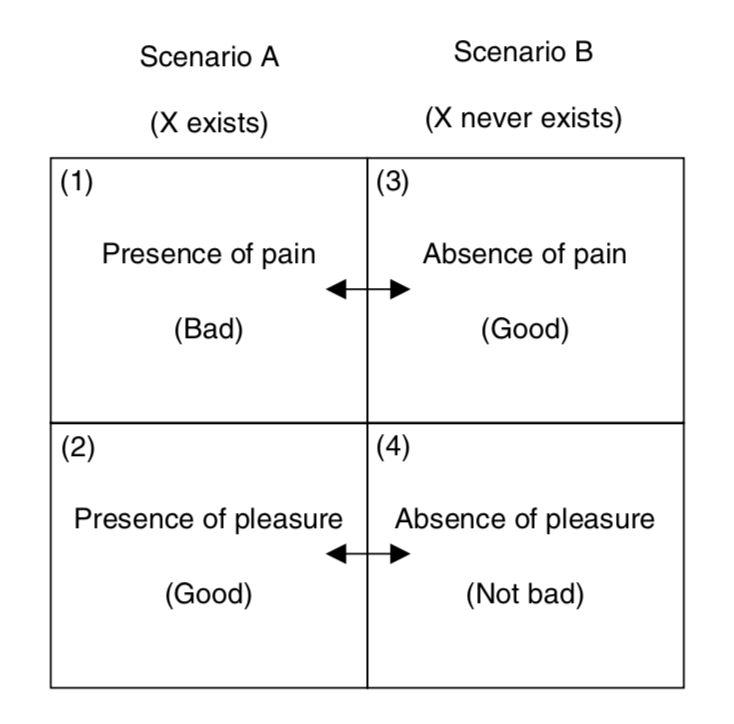
Benatar’s asymmetry states that when one exists:

The presence of pain is bad.

The presence of pleasure is good.

Whereas when one does not exist:

The absence of pain is good.

The absence of pleasure is not bad.

The first few ones pain=bad, pleasure=good should be obvious. In and of itself, negative sensation is always negative, never positive.

Sometimes there might be situations in life where you have to tolerate one negative to avoid a greater negative, i.e get an injection to avoid the negative of a worse illness in the long run, but if you could just snap your fingers instead and be immune, you would do that, and if I only assaulted you with a needle for no benefit in return, you would decline the offer as well.

Similarly, that a rapist is gaining pleasure from raping is good, the bad thing is that he’s causing harm to the victim, but if we could just connect him to a machine that gave him intense pleasure from living in a virtual reality fantasy scenario where he’s raping people all day, that’d be good.

  • More confusing tends to be the idea that the absence of pain is good but the absence of pleasure is on the other hand not a bad thing.

I think the asymmetry can simply be seen as an acknowledgement that the whole point of obtaining pleasure is largely to avoid being in pain.

That pain is a default state of sentient existence that we are constantly seeking distraction/relief from, metaphorically kind of like a knife in your chest, and you have to take painkillers all your life to alleviate it, whereas if you are never born in the first place, there is no knife in your chest, the absence of the painkiller is only a problem when you have the knife in your chest.

Benatar also uses such an example in his book where person S (sick) has a capacity for a quick recovery, which is important, because person S is sick, person H (healthy) on the other hand has no capacity for a quick recovery, but this is irrelevant, because person H is not sick.

We have needs/wants/desires, that is a guarantee. We try to fulfill those needs/wants/desires our entire lives, and if we fulfill them, either a new set of fresh needs/wants/desires pops up (you already ate, now your appetite increases for dessert) or the old ones simply come back in time (you go back to being hungry again), rinse and repeat.

As though I’m on a treadmill, suffering behind me, relief in front of me. If I stop running, the direction I’m being pulled into is suffering. In case I reach relief, the treadmill simply extends further and now there’s relief in front of me again, and the relief I just reached will soon convert into suffering again. Or, if I wait long enough, I’ll just be pulled back into the other suffering that was behind me previously.

  • If the whole point of obtaining pleasure is to avoid being in pain, then we have an explanation for some our common intuitions and assumptions about reproduction, so let’s get into some of these examples.

One example Benatar also frequently uses is the one of preventing a bad life vs. preventing a good life. If you know you’re going to bring a severely disabled child into existence that will do nothing except to be in chronic pain for 3 years and die, you would likely consider it good to abort such a child before this happens, or if you’re a hardcore pro-lifer who thinks even killing a freshly fertilized egg is wrong, you’d think I’m an asshole if I knew my cum contained such a child and I deliberately used it to produce a child instead of flushing it.

On the other hand though, you’d have a hard time finding even some of the most insane pro-lifers who would argue that I’m doing something horrible by flushing semen that contains potentially very happy future persons down the toilet, how dare I deny the cum their happiness?

So although the severely disabled, pained child that never comes to be will not be able to appreciate that their horrible pain has been prevented, we consider it good that their pain has been prevented (absence of pain=good, even if there’s no one to feel good about it), but unless I prove that my sperm suffered as a result of being flushed down the toilet because it wanted to become a conscious child in the future, we wouldn’t think flushing it is a harm (absence of pleasure=not bad, unless there is someone to feel deprived of that pleasure).

  • I also like to use the example/experiment of making a dissatisfied population satisfied vs. creating a new satisfied population (of more individuals than the other one).

We have two planets, planet A and planet B.

On planet A, there are 1000 miserable aliens. On planet B, there is no conscious life.

We have two buttons, button A and button B.

If you press button A, the 1000 miserable aliens will receive the resources needed to satisfy them.

If you press button B, 2000 satisfied aliens will be put on planet B, while the aliens on planet A will remain in their miserable, tormented state, living lives of abject misery.

Which button should we press? By pushing button B, you would ultimately create more pleasure, but is it really important to create that pleasure when there is no one on planet B who even craves to feel said pleasure? I would say no, you should press button A.

If I could either 1. make every suffering organism on earth happy right now or 2. create a higher number (than all inhabitants of earth combined) of happy aliens on a different planet like mars, we’d have to go for the second option if we accept pleasure maximization rather than suffering elimination as the most important priority, it would create more happiness.

Even the topic of reproduction vs. adoption could be brought up here although that is somewhat of a different topic – there are already millions of need machines on this planet to be satiated, but instead you just create a new need machine. Why?

  • Pain is more painful than pleasure is pleasurable. If pleasure and pain were symmetrical, why wouldn’t you tolerate a high amount of pain for an even higher amount of pleasure? Heaven and hell scenarios.

Another important and strong point to establish the asymmetry.

Let’s say heaven and hell existed, and the deal would be that after we die, we can just choose between 1. eternal nothingness or 2. going to hell for 100, 1000, at the highest 10.000 years of the worst imaginable tortures, but then going to heaven to experience the best imaginable pleasure for all eternity afterwards.

I’m willing to bet that if we actually had this possibility in front of us that no one would with honest conviction say that they could bear going to hell first and then go to heaven afterwards, we would all choose nothingness.

But the question is why? If pain and pleasure are perfectly symmetrical, it shouldn’t be this way, even if I said it’s a million years in hell. What is a mere million years in hell measured against an eternity of the best imaginable pleasures in heaven? If you’re really convinced that pleasure is just as pleasurable as pain is painful, that we should symmetrically, rather than asymmetrically consider these things, then why not take the deal? An eternity should make up for that pain.

Over your lifetime, you’ll be subjected to two scenarios, one is 10 years of being unconscious vs. 10 years of being in hell and the other one is 10 years of being unconscious vs. 10 years of being in heaven. The deal is you can only make a clear choice in one scenario (hell or nothingness, heaven or nothingness), but in one scenario of your choosing, you’ll have to leave it up to luck and flip a coin. In which scenario will you feel more comfortable flipping a coin, will you flip a coin over which scenario you will flip a coin in?

No, you’ll be certain that not experiencing pleasure when you’re not feeling deprived of it is not that big of a deal (absence of pleasure=not bad unless it is a deprivation for someone) and you’ll be certain that avoiding hell is important even though whilst you’re unconscious, you won’t appreciate the prevention of your suffering in hell (absence of pain=good, even when there’s no one to enjoy it).

If we assume that the whole point of obtaining pleasure is to avoid pain, then we can easily make sense of all these intuitions – it’s good that the bad life has been prevented because the goal is pain avoidance, it’s not bad that the happy life has been prevented because no one is suffering as a result of not having a happy life in some kind of pre-birth deprivation chamber, unborn purgatory, so there’s no problem with that happiness not existing.