On circumcision/genital mutilation.

I think circumcision generally falls under what we can refer to as unnecessary harm, I don’t support it.

1 – It’s painful in the moment or afterwards.

Either while you’re being circumcised if it’s done by some primitive religious moron without anesthesia, or definitely afterwards.

Perhaps if you’re young enough while it happens, you won’t remember it later, but I fail to see how that is supposed to be a justification. Let’s say I could torture someone for hours, but then give them a hypothetical pill that will make them forget all of it.

The fact that the torture happened in the moment while they were being tortured is bad enough, it doesn’t matter if they remember or forget it.

2 – It can also cause long term suffering by decreasing your ability to obtain sexual relief/satisfaction.

Here people will of course argue back and forth about if circumcision has any effect on your sexual pleasure or not. Some will claim yes it decreased their ability to feel pleasure (I am in that category), some might even say it increased their ability to feel pleasure to get cut because they had some kind of problem with their tight foreskin beforehand and just didn’t use all options to try to retract them, whatever it may be.

But just looking at the most obvious facts, it seems non-sensical to me to claim it has no decreasing effect. Yes, you are cutting skin that contains sensitive nerves off of your dick (it’d be weird if that in itself didn’t take any feelings away), and once that is done, your glans will no longer be constantly protected by anything wrapped around it, so it’s free to rub against your pants all the time, prone to the process of keratinization.

Forcing an internal organ to be an external organ, so to speak. Would it not be reasonable to say that if instead of walking on your feet, you learned to walk on your hands, your hands would become kind of desensitized over time? I play guitar, so the fingers that I put on the strings become less sensitive over time, they’re constantly exposed to pressure.

If you constantly expose something and it is not protected, it generally tends to become less sensitive to fine touch, yes. Does that take some kind of Einstein genius to come up with that theory?

3 – Benefits seem little to non-existent to make up for the harm/loss.

Hygiene? Do you live in a third world shithole with no access to soap? I doubt it anyway though, I know just from my personal experience in the past that when I sweat and jizzed, and I have no protective skin around my glans to stop lints and dirt from getting stuck in and glued to my glans, it does in fact get stuck in and glue to my glans. How exactly is that more hygienic?

But whatever, yes, wash yourself.

Less likely to get certain STDs? Contraception, again, not impossible, no need to resort to such drastic measures when it can be solved more comfortably.

Penile cancer? Almost no one gets penile cancer, you can also take other measures not to get cancer like living a healthy lifestyle/not smoking, and wouldn’t that also justify cutting all girls breasts off because then they can never get cancer in them? Breast cancer is certainly more likely than cancer in your genitals, penile cancer is extremely rare.

How about you just ask them what they want if it’s not absolutely necessary? Same for your tonsils even, I don’t think it would have as negative of an effect on someone as being circumcised or having breasts cut off, but still, why do it if it’s completely unnecessary in that moment?

Yes, if you cut x part of your body off, that part cannot become infected or riddled with cancer anymore…so therefore cut it all off?

Phimosis? This is the only one that is kind of more controversial, but it’s not really unsolvable either, there are specific creams and stretching exercises to retract your foreskin without having to cut it, and you can also only get partially circumcised and not tightly if nothing else helps.

Overall I think this is a barbaric and backward ritual, I don’t think it’s unfair or inconsiderate or anything to criticize the ones doing it, the reasons people give for it are frequently pathetically shallow.

Often it’s supported by religious morons who think children should be property, ”parents have a right to choose for children” – maybe if it’s harmless and/or necessary, but not when you’re inflicting unnecessary harm/pain/suffering on them like strapping them to a table and cutting their skin off, or beating them with a hammer, or sticking needles in them, etc based on thinking that invisible creatures exist and command you to do so.

Religion should never be an argument here, that’s just saying you live in a fantasy world and believe in invisible creatures for which you have no evidence, so that’s why you inflicting potentially intense harm/pain/suffering on others is justified, the easter bunny said I have to shove my fist in an infant’s vagina, so it’s fine basically.

Same goes for a parent’s petty aesthetic preferences, who cares what you think looks pretty? Should you also be allowed to cut up your daughter’s vagina or breasts to make them look more pleasant to your liking?

Then we have the feminist morons that are completely apathetic to any plight men face and just state that female genital mutilation is worse than male genital mutilation. It depends on how you do it is simply the answer here, so this is just wrong to categorically state FGM is worse than MGM, by default, always.

You can cut off the skin around the clitoris, this is more similar to cutting foreskin off. Some primitive cultures cut the entire vagina open, yes, but some primitive cultures also cut the entire dick open and stick their dicks in the cut open dick, it’s a matter of how you’re mutilating them.

It doesn’t matter though, I could also say ”look, feminists, anal rape is worse than sexual harassment, therefore sexual harassment isn’t a big deal, so shut the fuck up”. This is fallacy of relative privation, A and B are both bad, but B is worse than A, so therefore we’re going to pretend A is now good. Having two arms amputated is worse than only one arm, so therefore having one arm amputated somehow isn’t a big deal? That’s just non-sense.

And I’m sure you can find more obscure reasons why people do it, but these tend to be the common sayings/standards. In conclusion, I see no point in the ritual/practice.

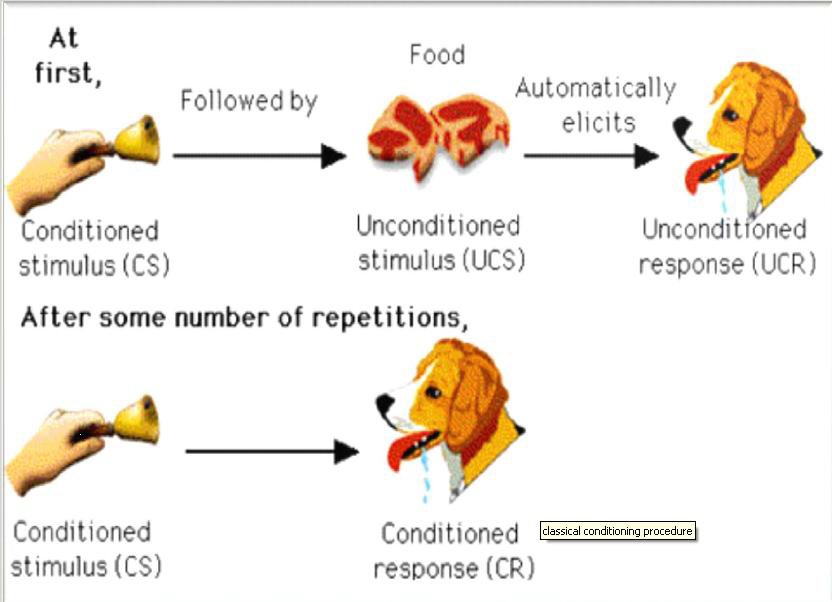
Learning by association – one can have false intuitions about pleasure and harm.

The experience machine is a thought experiment meant to demonstrate that somehow, sentient organisms care about other things except escaping pain/maximizing pleasure, I believe this is fundamentally impossible.

As in, there’s a machine you can get into, and it will create greater pleasure than you get from living your current life with your family, friends, maybe partner, etc, and they would also be well taken care of without you, so it’s no big deal, just get in there and feel even better.

If we chase pleasure, why wouldn’t everyone get into that machine?

I think the answer is simple – because they’re delusional and therefore don’t actually believe the experience machine will give them more pleasure, so I don’t see how this experiment threatens the value theory of hedonism.

Humans learn by association, unless you are very systematic perhaps like some autistic people are, you likely don’t analyze the details of every situation as to what causes more or less suffering, you make rough associations between things, and I believe this explains fixation on deontology and virtue ethics over utilitarianism.

John saw his mom get raped by a guy with a red hat and leather jacket as a child, now he gets a panic attack whenever he sees a guy with a red hat and leather jacket in public because in his mind red hat and leather jacket=rape.

You see lying generally results in harm, so therefore you conclude that lying must always result in harm and tell the nazis the jews are in your basement. See, you did a good job there in your mind, you prevented lying so you prevented harm.

You see that ending human life generally results in harm, so therefore you conclude that ending human life must always result in harm and become a pro-lifer who cares about the non-existent welfare of non-conscious fertilized eggs and support anti-euthanasia laws to make sure that everyone suffers as much as possible from being forced to live and can’t escape.

One can have false intuitions/delusions about what will efficiently reduce suffering/maximize pleasure, the deluded religious terrorist thinks he must bomb the gay pride parade to stop these evil faggots from infesting society with AIDS. See, I’m saving all of you from going to hell by stopping these evil pro-AIDS propagandists from forcing you to have unprotected anal sex, this means we’ll all go to heaven later on, so it is the lesser of two evils.

The answer for the experience machine is no different – we make illogical associations.

You simply don’t associate the experience machine with pleasure, you associate the things you already have in your life with pleasure, like your girlfriend’s pussy or whatever it may be.

And then I come along and say see, I have a fancy experience machine here in my basement, you just have to get into it, and then you’re going to feel even more pleasure jizzing all over yourself all day than when you jizz in your girlfriend’s pussy – watching two hairy fat old men buttfucking all day, your life is going to be perfect.

Do you believe me?

Do you trust me?

Just get in there.

It sounds unrealistic, many simply would not believe me, and that’s the problem.

This doesn’t prove they’re not after more pleasure, this just proves that they don’t believe they will actually get more pleasure from getting into the experience machine.

I think the same reasoning can also explain why people are scared of death, reject negative utilitarian and antinatalist ideas of stopping procreation to stop suffering and don’t accept the epicurean view, i.e death isn’t a big deal because if you’re dead, you don’t notice that you’re dead, so it won’t be a big deal for you.

If someone doesn’t actually conceptualize non-existence as non-existence, but simply as a second existence without all the pleasures one could have in it, then what they are actually picturing is not non-existence but a maximal state of suffering, i.e zero pleasure.

In life, not having pleasures means to suffer.

You don’t eat, you hunger.

You don’t drink, you thirst.

You don’t shit, you constipate.

You don’t breathe, you suffocate.

You don’t jerk off, you get tense and frustrated.

You don’t socialize, you get lonely.

You don’t maximize your pleasure, you start to suffer. But this is only when you exist, not when you don’t exist.

And I find it questionable if people actually even comprehend that, we have a hard time picturing not existing, so what we might end up imagining is not nothingness but simply an existence where you are deprived of all goods, floating around as a disgruntled ghost missing out on all the earthly pleasures you could have had, had you stayed alive.

Pro-lifers and pro-natalists somewhat reveal this thought process all the time when they ridicule the antinatalist’s risk-aversion, they say along the lines of:

”Ah, so we shouldn’t breed children so we don’t risk their suffering, but that’s idiotic, because we gotta take risks in life all the time, life without risk would just be boring! You get in the car, you might get into an accident. You sit in the sun, you might get skin cancer.”

Yes, in life. If you’re actually going to live life and not take any risks in it, what results is a life of boredom, which is suffering, which repels you, so you don’t accept such a life and take some amount of risk, if you avoided driving altogether, you’d suffer from not being able to move effectively through society anymore.

You might be imagining the downsides of not taking any risks in life, which is crushing boredom, and then project this onto non-existence, but non-existence is a different ”scenario” altogether in which absolutely no one is experiencing any level of boredom from not having any risks taken on their behalf, so then in that case, there is no problem, the problem is you delusionally picturing non-existence as a second existence filled with the suffering of boredom.

So just like not getting into the experience machine doesn’t prove you’re not after more pleasure, someone objecting to non-existence doesn’t prove they’re not trying to avoid pain, one can simply have misguided intuitions about still continuing to live in a suffering state after one died like ”But what if death isn’t the end and what comes after is even worse??? How do I know that if I smash my computer (brain) with a sledgehammer, the data (consciousness) isn’t still somehow invisibly floating around in the air?”.

Dying and death are also close to each other, though different, and the dying process is often painful and scary for us, so of course, if we associate death with that, we become irrationally scared of death, which is just a harmless ”state” of non-existence though, and we may then make the connection that what happened before our birth was also non-existence, so we become just as scared of that as of the non-existence after we died, non-existence is scary.

As in, you equate painful dying with death itself, and you equate death (non-existence) with not being born (non-existence), so you end up delusionally imagining that you need to be born in order to avoid the horrible pains of dying, which is just that – delusional, if anything not being born is the only thing rescuing from the process of decaying and dying.

I don’t think it’s possible for any other value theory to be true, everything is about sensation.

If you care about doing anything, it is because you believe it will reduce suffering/maximize pleasure in others or in yourself.

Even if a deontologist still wouldn’t lie in a case where the nazis are ringing on their door and ask them if the jews are in their basement, all that proves is that lying is making this deontologist suffer so intensely that they abstain from it in order to avoid suffering. So in that sense, I don’t even think there is a real deontologist.

You’re authoritarian, because you believe an authoritarian approach reduces suffering in the world, or even if you’re shown evidence it doesn’t, you just personally get off on domination and power play stuff.

You’re libertarian, because you believe a libertarian approach reduces suffering in the world, or even if you’re shown evidence it doesn’t, you just personally get off on being as free as possible.

You’re religious because you’re deluded and really believe heaven and hell exist, or you at least think that having this view integrated into society will give people a morality to follow and thus reduce suffering, or even if you’re shown evidence it doesn’t lead to that, you just personally get off on living this fairytale.

So on and so forth. If you know that following a given morality does not efficiently reduce suffering in the world, what reason could there possibly be for you still following it except that it reduces suffering in you to follow it? I don’t think there is any, everything’s about sensation.

Benatar’s asymmetry – some thought experiments.

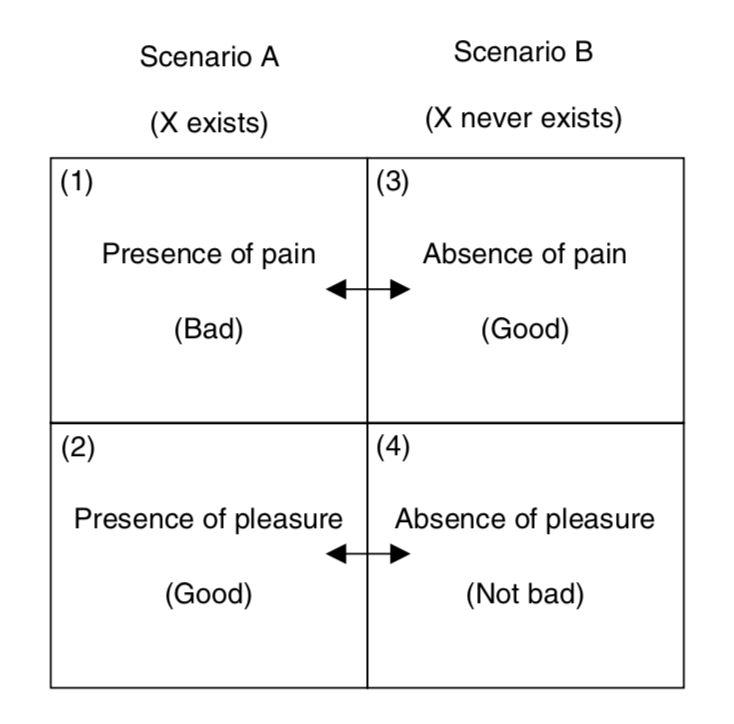
Benatar’s asymmetry states that when one exists:

The presence of pain is bad.

The presence of pleasure is good.

Whereas when one does not exist:

The absence of pain is good.

The absence of pleasure is not bad.

The first few ones pain=bad, pleasure=good should be obvious. In and of itself, negative sensation is always negative, never positive.

Sometimes there might be situations in life where you have to tolerate one negative to avoid a greater negative, i.e get an injection to avoid the negative of a worse illness in the long run, but if you could just snap your fingers instead and be immune, you would do that, and if I only assaulted you with a needle for no benefit in return, you would decline the offer as well.

Similarly, that a rapist is gaining pleasure from raping is good, the bad thing is that he’s causing harm to the victim, but if we could just connect him to a machine that gave him intense pleasure from living in a virtual reality fantasy scenario where he’s raping people all day, that’d be good.

  • More confusing tends to be the idea that the absence of pain is good but the absence of pleasure is on the other hand not a bad thing.

I think the asymmetry can simply be seen as an acknowledgement that the whole point of obtaining pleasure is largely to avoid being in pain.

That pain is a default state of sentient existence that we are constantly seeking distraction/relief from, metaphorically kind of like a knife in your chest, and you have to take painkillers all your life to alleviate it, whereas if you are never born in the first place, there is no knife in your chest, the absence of the painkiller is only a problem when you have the knife in your chest.

Benatar also uses such an example in his book where person S (sick) has a capacity for a quick recovery, which is important, because person S is sick, person H (healthy) on the other hand has no capacity for a quick recovery, but this is irrelevant, because person H is not sick.

We have needs/wants/desires, that is a guarantee. We try to fulfill those needs/wants/desires our entire lives, and if we fulfill them, either a new set of fresh needs/wants/desires pops up (you already ate, now your appetite increases for dessert) or the old ones simply come back in time (you go back to being hungry again), rinse and repeat.

As though I’m on a treadmill, suffering behind me, relief in front of me. If I stop running, the direction I’m being pulled into is suffering. In case I reach relief, the treadmill simply extends further and now there’s relief in front of me again, and the relief I just reached will soon convert into suffering again. Or, if I wait long enough, I’ll just be pulled back into the other suffering that was behind me previously.

  • If the whole point of obtaining pleasure is to avoid being in pain, then we have an explanation for some our common intuitions and assumptions about reproduction, so let’s get into some of these examples.

One example Benatar also frequently uses is the one of preventing a bad life vs. preventing a good life. If you know you’re going to bring a severely disabled child into existence that will do nothing except to be in chronic pain for 3 years and die, you would likely consider it good to abort such a child before this happens, or if you’re a hardcore pro-lifer who thinks even killing a freshly fertilized egg is wrong, you’d think I’m an asshole if I knew my cum contained such a child and I deliberately used it to produce a child instead of flushing it.

On the other hand though, you’d have a hard time finding even some of the most insane pro-lifers who would argue that I’m doing something horrible by flushing semen that contains potentially very happy future persons down the toilet, how dare I deny the cum their happiness?

So although the severely disabled, pained child that never comes to be will not be able to appreciate that their horrible pain has been prevented, we consider it good that their pain has been prevented (absence of pain=good, even if there’s no one to feel good about it), but unless I prove that my sperm suffered as a result of being flushed down the toilet because it wanted to become a conscious child in the future, we wouldn’t think flushing it is a harm (absence of pleasure=not bad, unless there is someone to feel deprived of that pleasure).

  • I also like to use the example/experiment of making a dissatisfied population satisfied vs. creating a new satisfied population (of more individuals than the other one).

We have two planets, planet A and planet B.

On planet A, there are 1000 miserable aliens. On planet B, there is no conscious life.

We have two buttons, button A and button B.

If you press button A, the 1000 miserable aliens will receive the resources needed to satisfy them.

If you press button B, 2000 satisfied aliens will be put on planet B, while the aliens on planet A will remain in their miserable, tormented state, living lives of abject misery.

Which button should we press? By pushing button B, you would ultimately create more pleasure, but is it really important to create that pleasure when there is no one on planet B who even craves to feel said pleasure? I would say no, you should press button A.

If I could either 1. make every suffering organism on earth happy right now or 2. create a higher number (than all inhabitants of earth combined) of happy aliens on a different planet like mars, we’d have to go for the second option if we accept pleasure maximization rather than suffering elimination as the most important priority, it would create more happiness.

Even the topic of reproduction vs. adoption could be brought up here although that is somewhat of a different topic – there are already millions of need machines on this planet to be satiated, but instead you just create a new need machine. Why?

  • Pain is more painful than pleasure is pleasurable. If pleasure and pain were symmetrical, why wouldn’t you tolerate a high amount of pain for an even higher amount of pleasure? Heaven and hell scenarios.

Another important and strong point to establish the asymmetry.

Let’s say heaven and hell existed, and the deal would be that after we die, we can just choose between 1. eternal nothingness or 2. going to hell for 100, 1000, at the highest 10.000 years of the worst imaginable tortures, but then going to heaven to experience the best imaginable pleasure for all eternity afterwards.

I’m willing to bet that if we actually had this possibility in front of us that no one would with honest conviction say that they could bear going to hell first and then go to heaven afterwards, we would all choose nothingness.

But the question is why? If pain and pleasure are perfectly symmetrical, it shouldn’t be this way, even if I said it’s a million years in hell. What is a mere million years in hell measured against an eternity of the best imaginable pleasures in heaven? If you’re really convinced that pleasure is just as pleasurable as pain is painful, that we should symmetrically, rather than asymmetrically consider these things, then why not take the deal? An eternity should make up for that pain.

Over your lifetime, you’ll be subjected to two scenarios, one is 10 years of being unconscious vs. 10 years of being in hell and the other one is 10 years of being unconscious vs. 10 years of being in heaven. The deal is you can only make a clear choice in one scenario (hell or nothingness, heaven or nothingness), but in one scenario of your choosing, you’ll have to leave it up to luck and flip a coin. In which scenario will you feel more comfortable flipping a coin, will you flip a coin over which scenario you will flip a coin in?

No, you’ll be certain that not experiencing pleasure when you’re not feeling deprived of it is not that big of a deal (absence of pleasure=not bad unless it is a deprivation for someone) and you’ll be certain that avoiding hell is important even though whilst you’re unconscious, you won’t appreciate the prevention of your suffering in hell (absence of pain=good, even when there’s no one to enjoy it).

If we assume that the whole point of obtaining pleasure is to avoid pain, then we can easily make sense of all these intuitions – it’s good that the bad life has been prevented because the goal is pain avoidance, it’s not bad that the happy life has been prevented because no one is suffering as a result of not having a happy life in some kind of pre-birth deprivation chamber, unborn purgatory, so there’s no problem with that happiness not existing.

About the speciesism of pro-lifers.

Pro-lifers sometimes bring up historical examples about how certain minorities have been dehumanized in the past, and then say that individuals of the opposite position, like pro-choicers and antinatalists are guilty of a similar mindset as nazis and slave owners.

I would argue that pro-lifers are the ones that are guilty of the nazi mindset, not the other way around, many of them are speciesists with no respect for consciousness and suffering, frequently they don’t care about harm to non-human animals, they only think that all humans need to be protected, even when those humans are incapable of being harmed like a freshly fertilized egg, which is analogizable to a slave owner caring about his braindead white grandmother because she’s white, but not about fully conscious black slaves being whipped all day – zero respect for suffering, they only respect what looks similar enough to them.

Their go-to point is that fetuses are a human life. They are human, and also alive.

To that I would respond that sperm and braindead humans are also human and alive. Bacteria is alive too, so are fruits and vegetables, but fair enough, they’re not human.

If you really think about it on a deeper level for a moment, is being human actually what makes it bad to have certain things that you currently don’t want to happen to you (like having a knife in your throat, being burned alive, cut open, etc) bad?

I could do these things to a braindead human, and it would in no way bother that braindead, but still perfectly human and living (other than for the brain) organism, it would not bother ”them” one bit, so it seems like containing human DNA is not what determines whether or not something is actually bad or good, this is determined by consciousness, sentience, pain and pleasure.

Of course, it’s possible to offend family members and friends by let’s say having sex with or defecating onto a braindead human body, but that just proves again that then the thing that made that activity problematic is sentience/consciousness, not human DNA, it offends the feelings of those around the braindead human.

But just in and of itself, how is a braindead human harmed more by being pulled the plug on than a computer is harmed by being pulled the plug on?

Here they might say fetuses will become conscious over the course of 9 months, braindead humans won’t. But then you just need to ask about fetuses of other species and if they think it’s fine to abort them, or in fact just hypotheticals, like grassblades that become conscious if I let them grow long enough, am I now obligated to completely inconvenience myself for them and never mow the lawn again because it’s important to let grassblades become conscious?

I’m sure they’d say no, it’s only important to not stop a human organism from becoming conscious before it can have any desire to become conscious because it simply isn’t conscious yet, which then again reveals that it is about the sacred human DNA particles for them, in which case the question is still relevant – their notion that we must wait until an organism becomes conscious is again only confined to organisms containing the sacred human DNA.

  • Having human DNA is not what makes being harmed problematic, it’s irrelevant just like having white skin color or a certain set of genitalia.

I would make the exact same point to a racist slave owner that values the protection of all whites, whether those whites have the capacity to be harmed or not, but on the other hand can’t be bothered to care about the welfare of black slaves.

A braindead white human might be white, but so what? Do you think it bothers them to be whipped? Having white skin color is what makes being hit with a whip into a bad thing? You’re an idiot if you think that. If you were honest you would name the characteristic ”sentience” as to why you would like to avoid being hit with a whip, and guess what, black slaves are also sentient.

Just that pro-lifers are not racists, they are often speciesists. They care about the poor fertilized egg that doesn’t care any more about its own existence than a tomato cares about being kept alive, the concern of the fertilized egg not to be squashed is as non-existent as a tomato’s concern to not be turned into tomato soup – but many of them will gladly pay someone to abuse pigs, cows, chicken for them because they don’t contain the sacred human DNA.

Thinking that dehumanization is some kind of problem is already bigotry, because you are assuming that just because something is not human, it is perfectly fine to harm that organism.

  • ”Despite clearly having the ability to create value notions, good and bad, pleasure and pain, you get no ethical consideration, because you’re not in my particular group, you’re not white/human.”

Just like a racist slave owner or nazi, such pro-lifers have zero respect for consciousness and suffering, or only manage to acknowledge it as existing when they see someone of their close ingroup, i.e other white humans, anyone who looks too different is falsely identified as an object, despite being a feeling (obviously, non-subjects don’t feel) subject.

The mentality is quite similar, so it just looks completely self-unaware that they’re accusing the other side of thinking like the slave owners and nazis, similar to when said speciesist pro-lifers accuse someone of being hostile towards the disabled for aborting a severely disabled fetus but then justify harming other animals by pointing out that they are less intelligent than humans, which would mean that there’s nothing wrong with farming sufficiently intellectually disabled humans on the same intelligence level as such animals.

I think sometimes they get away with all this because pro-choicers are also speciesist and go along with this non-sense, there are some that will make uneducated or confused claims that human fetuses are somehow not human or alive (although even that is often times a misinterpretation on the pro-lifer’s part when the discussion is about what constitutes a human, i.e a person, not if it contains human DNA), because if they really insisted on sentience/suffering-ability, they would make themselves vulnerable to being consistency-tested about their speciesism as well.

”So do you not eat other animals? They’re also sentient! Hypocrite!” – so they figure instead they’ll resort to saying some complete non-sense like ”human fetuses aren’t alive”, to which the pro-lifers will then proudly respond that science is indeed ethically on their side and fetuses are indeed living organisms just like jizz and bacteria, so the debate is over.

  • It shouldn’t even matter if something is human or alive.

What the nazis did to the jews wasn’t bad because they were human, what the slave owners did to the black slaves wasn’t bad because they were human, it was bad because they were conscious.

Sure, if hypothetically, the nazis were a group of people that only rounded up a few braindead jews that are clearly incapable of feeling pain, and these braindead jews had no family or friends to grieve over them, and then they put these jews into the oven, there’d probably be no harm in that, not inherently more of a problem than doing it to a piece of wood, it would cause the exact same amount of bad feelings and grievances in the world: zero.

We might be inclined to feel bad for such braindead jews because they look similar to humans we know to be conscious, so that bias overcomes us, but ultimately rationally analyzing the situation would lead one to conclude that that is as silly as feeling bad for a living, but non-sentient grassblade or a piece of wood.

The benevolent world destroyer objection to suffering-focused ethics.

A common objection to the view that we should put the elimination of harm/suffering above everything else in ethics is that if that’s the only thing that matters, there would be no problem with someone pushing a button that would painlessly kill all life in an instant, thus also taking away all happiness and good moments in life we could experience.

I would argue against that and say that ultimately the view that such a button shouldn’t be pressed is far more absurd, it depends on why we think life or happiness are important priorities in the first place. Is happiness really important if the possibility of unhappiness does not exist?

I think that as soon as sentient organisms exist, they are trapped in a system of having to constantly chase the next pleasure rush in order to avoid suffering, kind of imagining it as a treadmill with suffering always behind you and pleasure/relief in front of you. You have to keep running or you will be pulled into suffering by the treadmill, and in case you reach pleasure, you’ll also either be pulled back into suffering soon enough or the treadmill extends and now there’s pleasure in front of you again, while the pleasure you just obtained will soon crumble and convert into suffering.

This is a metaphor for sentient life at its core being a game of having to fulfill your needs/wants/desires or being tormented. Your neediness is always guaranteed, the fulfillment of your needs is not. We try to fulfill our needs our entire lives, and when we fulfill them, either new sets of needs pop up (like appetite after hunger having been satiated) or the old needs simply come back if you wait long enough (you’re hungry again).

If hypothetically I could push this button that would immediately just make everyone fall asleep forever or evaporate them painlessly in one second, of course all fulfillment would be gone…but all unfulfilled need would also be gone. So is it a problem for there to be no fulfillment of need when there is no need to fulfill?

If we had two planets, one filled with a population of miserable aliens and the other one is just empty of conscious life, and I could push a button that would give the miserable aliens the resources needed to satisfy them or I could push a button that puts a satisfied population (of more aliens than on the other planet) on planet B but leave the aliens on the other planet miserable and tormented, would it really be an important priority to create a new population of satisfied aliens over eradicating the already existing dissatisfaction on the other planet?

That is what sounds absurd to me much more than world destruction, caring about need fulfillment when there are no unfulfilled needs, that’s like caring about receiving a bandaid when you don’t even have a wound, as in, you don’t have the problem (suffering) but for some reason you claim you need the solution to it (pleasure).

  • Let’s say there were a pill that could make you both immune to cancer and chemotherapy, wouldn’t you take it?

This is another example of problem (cancer) and solution (chemotherapy). If cancer exists, of course it can be important to have the option of chemotherapy. But if you could hypothetically take a pill that made you completely immune to ever getting cancer, but it also made you immune to cancer treatment, would you not take this pill because it makes you immune to cancer treatment?

I think that would be absurd, just like caring about the existence of happiness on planet earth even if suffering didn’t exist anymore. Of course, as a sentient organism already trapped in a system of having to chase pleasure in order to avoid being subjected to torture, I think it’s very important that I obtain my pleasures, but I don’t look at a different planet like mars and bemoan that there are no martians having an orgasm.

  • Death is not a harm, it is the end of harm.

I think society has a false idea here of what death entails, they see it as a harm, when in reality, it is ultimately just putting a stop to the ability to be harmed. Of course, in the process of being killed, you can lose pleasure and thereby be pushed into the suffering area, but when you don’t exist, there is no suffering as a result of there being no pleasure, you just no longer have the ability to be harmed or pleasured anymore.

Death can only be extrinsically harmful, intrinsically it is harmless.

The ”act” of being dead is essentially exactly the same thing you have done for a great period of time before you existed, do you think of that as a horrific tragedy? You didn’t feel hunger or appetite in the year 1200 because you didn’t exist, so the fact that you didn’t enjoy your favorite foods wasn’t a problem, and once you’re dead, you also won’t feel hunger or appetite, so the fact that you won’t enjoy your favorite foods won’t be a problem.

When someone is killed, family members and friends might grieve, if we legalized this act, people would be scared about being killed before it happens to them, perhaps you prevent a productive person from preventing more suffering in others (like a scientist who is working on the cure for cancer for example), you might cause pain to the person in the process of killing them.

But in and of itself there is no harm, particularly not in the unrealistic world exploder/destroyer example, where it is specified that no one would feel any pain, and clearly if no sentient life exists after that, then there would be no one to grieve that we all just died, and there are no more problems to solve, so great activists and scientists to cure us of our ills would no longer be needed, all ills are already cured because we’re all dead.

Taking all of that into account, I’d say it’d be absurd to not press such a button, it’d be the perfect way to solve all problems, including the problem of even needing/wanting life and happiness. Every want problem, including the want to see life flourish in the future is a problem that is solved by simply not existing. We might be inclined to think it is a big deal, but we won’t when we don’t exist.

Of course, once you’re already here, the deal is clear, you’ll have to fulfill your needs or you’ll be tormented, so we tend to think that fulfillment is really important, that’s all we intuitively know to be true – get more pleasure out of life or suffer. So if we’re only able to imagine this state of having a constant wound (suffering/desire) to fix, we think that the absence of bandaids (pleasure/desire fulfillment) would be a problem, when in reality this is about taking both the wound and the bandaid away, not only the bandaid, leaving the wound.

It could be analogized to an addict who doesn’t understand the idea of treating their addiction anymore, they can only think of it as ”they want to take away my drugs and leave me tormented”, but even treating a drug addict’s craving is not as harmless as pressing the world exploder button, it is in fact much more harmful, because the addict can still have remaining cravings for the pleasure given by the drug after being treated, it’s still possible for some feelings of deprivation to remain.

When you push the ”kill everything” button on the other hand, you have truly killed all craving, you have extinguished all addiction, to be scared of that scenario is literally to be scared of nothing.

The pin prick objection to suffering-focused ethics.

A common argument against negative utilitarianism/suffering-focused ethics/antifrustrationism, i.e the ethical theory that we should eradicate suffering/unfulfilled desire rather than to maximize pleasure/create as many fulfilled desires as possible, is that you would have to forego an extreme amount of pleasure, in case that that pleasure can only be created by also creating a rather small amount of suffering, like a little pin prick with a needle, just once.

You have the option to create a much better world, go from a state where everyone is only eating unseasoned potatoes and old hard bread, mediocre jerking off into a tissue to having a perfect virtual reality scenario where you can always have whatever appetite satisfaction and perfect orgasm that you want, but you have to give one person a little pin prick with a needle in their finger just once, otherwise you can’t push the button to create the virtual reality scenario.

  • So if you’re a true suffering-eliminationist, you shouldn’t give that one person the pin prick, right? It would cause suffering.

Wrong, this is either a really badly thought-through or dishonest point against the elimination of suffering. People fail to comprehend that increasing pleasure in an organism is the same thing as reducing suffering in an organism, and reducing suffering in an organism is the same as increasing pleasure in that organism. If you feel better, you feel less bad, if you feel worse, you feel less good.

If a suffering-eliminationist failed to give this one person a pin prick with a needle, they would cause much worse suffering to be generated by keeping us all trapped in a boring condition of life where we can only eat potatoes and jerk off into a tissue, so not giving this person a pin prick would be actually be the pro-suffering stance to take.

  • The point is that the need for the pleasure should not exist in the first place.

Of course, once a sentient organism is unfortunate enough to already exist, they will have to obtain pleasure/relief in order to avoid being subjected to suffering.

  • You must eat or you get hungry, so you eat.
  • You must drink or you get thirsty, so you drink.
  • You must defecate or you constipate, so you defecate.
  • You must jerk off or you get tense, so you jerk off.
  • You must socialize or you get lonely, so you socialize.

Use whatever example you want, you must obtain pleasure or you are subjected to suffering. Once you’re here (as a conscious organism), you are trapped on a treadmill with suffering on one side and relief on the other, and it works in such a way that suffering is always the direction that you’re being pulled into, so you always have to keep running towards pleasure in order to avoid the unpleasant fate of falling into the meatgrinder.

Once you are on this treadmill, i.e forced into existence by your procreators, of course any negative utilitarian/antifrustrationist/suffering-eliminationist would claim that it’s less bad for you to be as close to the relief area as possible, but that doesn’t mean that being in the relief area is less bad than not being trapped on the treadmill that constantly pulls you into the direction of suffering in the first place, having to chase pleasure in order to avoid suffering is quite a burden to impose on someone.

Of course, if I throw a child into the ocean, they might be less bad off keeping their head above water than to painfully drown, but that doesn’t mean they’re less bad off than not being thrown into the ocean in the first place. If I throw you into a hole filled with horse shit, you might be less bad off being able to climb to the surface of the hole to get a breath of fresh air than to sit in horse shit, but that doesn’t mean you’re less bad off than not being thrown into the hole in the first place.

  • Pleasure can still be instrumentally valuable under suffering-focused ethics, it’s just that non-existent people or animals don’t need it.

I reject all kinds of authoritarian ideas that prevent pleasure, because they thereby cause suffering, because again, taking away pleasure from a sentient organism means that they will suffer.

I don’t support cutting off children’s foreskins if the supposed problems that foreskin poses like a lack of hygiene or STDs can also be otherwise solved by other means like soap and contraception, because having a foreskin might give them increased ability to feel sexual pleasure (keeping the glans from keratinizing and less sensitive to touch), and not having more sexual pleasure in your life means being more sexually frustrated, which is suffering again.

I don’t think it’s fair to ban drugs and prostitution just because bad things sometimes come from it (or rather are associated with it), because denying someone those freedoms causes a great decrease pleasure, which means that it’ll cause a great increase in suffering again, not being allowed to take drugs to deal with reality or being forced into sexlessless can be quite tormenting.

What makes idea of creating a new child so that that child can experience life’s pleasures so ridiculous though is the fact that if someone who will experience pleasure is never created in the first place, they won’t be trapped in some other place where they are missing that pleasure, they don’t exist, so who cares? Why should any risk be taken if the absence of that pleasure is not currently bothering the non-exister? They don’t exist, so who cares.

  • So let’s pick a slightly different scenario.

Let’s say it’s not giving one person a pin prick in order to create a perfect world for people that already exist, let’s say I only have the perfect utopian equipment and technology at my disposal to cause pleasure on mars, but I still need to create an alien species to benefit from it.

In order to do that though, I’ll have to torture someone to death, then I can push the button to create the species that will then be put into the virtual reality scenario where they’ll be greatly pleasured.

At that point, I’d say it’s wrong, there’d be a disagreement between suffering minimizers and pleasure maximizers. In that scenario, there is no need for the pleasure, no one is suffering as a result of it not existing, because the creatures that will crave it don’t exist yet.

The aliens that currently don’t exist are not trapped in some kind of unborn purgatory, writhing in agony over not being put into meatsuits and then connected to the endless orgasm machine, so why torture someone, or even just give someone a pin prick with a needle to create those aliens in order to then connect them to the endless orgasm machine to give them pleasure they didn’t need?

They did not feel deprived of pleasure, so you’d be torturing someone to prevent no greater bad, all I’d be doing is torturing someone to create a problem, which is the need/want/desire for pleasure these aliens will be tormented by once they exist, it’s not like causing pain to heal an already existing problem like in the scenario where you have to give one person a pin prick to create a perfect utopian reality which will help already existing people escape boredom.

  • Or just take a scenario where it’s also possible to have a ”kill everyone in an instant painlessly” button.

Give one person a pin prick to create a utopia for everyone, or just push a button that immediately painlessly kills everyone, then I’d also say push the ”kill everyone” button and there’d be a disagreement between suffering minimizers and pleasure maximizers.

Of course, if I push the button, we avoid the uncomfortable pin prick, we also don’t get the perfect utopia land, but that’ll be irrelevant because no one will exist to lament that they feel bored without the perfect utopia land, so win win situation.

It would be like giving one person a stabwound to give 100 people with cancer chemotherapy vs. pushing a button that will make these people’s cancer go away and make them immune to ever getting it again at any point.

Once the cancer is gone, the reason why anyone pursued chemotherapy is gone, so why stab this unfortunate person to give 100 people chemotherapy when I could just make them all immune to cancer by pushing a button?

Why give one person a pin prick to create a utopia which they only chase after because the alternative is suffering, when I could just push a button to kill everything and thereby extinguish the chance of any suffering ever happening again?

So in conclusion, under suffering-focused ethics, pleasure can still play a role as an instrument to the underlying goal of eradicating suffering. Taking away pleasure when it will result in suffering can in fact be a great problem, but what I’m saying is that there are no unborn children in an unborn purgatory suffering as a result of not receiving pleasure, and that there are likewise no dead people invisibly floating around as ghosts, horribly distressed about not experiencing pleasure.

”We have to draw a line somewhere.”

A common argument in the debate about sex between minors and adults is that we just have to draw a line somewhere. Even if we’re being intellectually honest enough to admit that youngsters sometimes want to have sex with someone over the age of consent, it’s still wrong, because it opens the door to the chance of abuse, so we just have to draw a line somewhere, like 16, 17, 18 and treat everyone who had sex with a person under that age as a rapist, even if they’re not, to deter real rapists who would rape people under those ages.

The first problem that should be easy to see with this type of argument is that it can literally be applied to tons of other things that society is not making a big deal out of, so why exactly should we apply this disproportionate amount of worry to sex?

Example 1: Children are allowed to ride bicycles. This carries a certain risk of danger, because it opens the door to parents forcing children to ride their bicycles to school because they’re too lazy to drive, although these children are not yet competent and smart enough to navigate traffic.

Some of these children will get into car accidents and be crippled for life. So what is the solution here, kill everyone who gives a child a bicycle? Does that sound sensible?

Example 2: Young girls are allowed to use make up, the use of beauty products amongst young girls is socially acceptable. This carries a risk of danger, because it opens the door to narcissistic parents manipulating and forcing young girls to partake in beauty contests that they don’t want to partake in, damaging to their self-esteem, causing them eating disorders.

So what is the solution, what should I do whenever I see a young girl wearing make up? Assume that everyone who lets a little girl wear make up is an abuser, beat the shit out of her father?

Example 3: Children are allowed to hear about religion and spirituality. This carries a certain risk of danger, because it opens the door to terrorist organizations trying to lure children into joining a terrorist group like ISIS.

So what is the solution, shoot every more or less harmless religious person taking a willing child to church to sing in a choir, because some ISIS terrorist uses the freedom to talk about religion to try to indoctrinate children?

  • The problem is the same in all these situations.

Yes, sometimes, a freedom is abused to do something bad, but this doesn’t mean it always happens, so it’s not a clear harm in all cases, so it’s unfair to subject the ones who are innocent to consequences that are supposed to protect against harm causers.

Some children also willingly ride a bicycle, some little girls also willingly wear make up, some children also willingly go to a church, and although I think religion is garbage and generally does more harm than good, I still don’t think a peaceful religious person taking a willing child to church should be treated the same way as an ISIS terrorist to uphold some kind of principle of absolute caution, it’s simply not the same.

  • Ultimately, I see sex between children/minors and adults as similar of a topic to drug use, prostitution, gun use, etc. It’s something that needs to be regulated in certain ways, but it shouldn’t be banned.

It’s not a red-light, absolutely harmful activity. Sometimes it has a higher chance of resulting in harm, but it’s unfair to say that it always results in harm, like torturing and/or raping someone.

Manipulating, blackmailing and forcing others, including children obviously should be illegal, unless someone can name a good reason why they had to do it to prevent a greater harm, like self defense for instance, or giving a child or intellectually incompetent adult a vaccination that they need to not contract a painful disease.

Forcing a minor to have sex can still be perfectly illegal regardless of strictly adhering to a certain age of consent, and similarly this should be more taken into consideration when it comes to those over the age of consent as well, e.g. in reality it’s worse to drug and then fuck an 18 year old than to have consensual sex with a 14 year old, but there are some sexists who would want to kill everyone for fucking their 14 year old sister and then being perfectly fine with manipulating/pressuring a hot 18 year old girl into having sex in some way.

That is why close-in-age exceptions are also still an unfair deal, you’re still persecuting an adult for having sex with a willing minor, and you might be less likely to detect abuse between two children because they’re both under 18 or 16 or 14, so it must be fine.

Which isn’t true, forcing someone to have sex is the problem, not sex at any particular given age, there’s nothing that says an 11 year old can’t voluntarily have sex with a 19 year old, but on the other get abused by a 12 year old in their family.

This reasoning can also be applied to everything else, you shouldn’t be allowed to force the child to ride a bicycle when they’re too incompetent to ride it, or a little girl to wear make up, or a child to (non-sexually) hug you just because you feel entitled to it either – all I’m saying is that same standard should be applied to sexuality ultimately.

Then, there are some other risks in practice that might arise, same as with other somewhat risky, but not intrinsically harmful activities like drug use or prostitution, or even just riding a bicycle.

STDs and pregnancy could potentially happen, so children need to receive sex education. If it’s possible that a child can learn traffic rules, how to navigate the road, then I really don’t see why it should be so complicated to teach a child or a mentally retarded person how to use contraception, it is not much more difficult – and again, manipulation, blackmail, force from abusers who want to pressure someone into not having safe sex can be illegal regardless of age of consent, that would still fall under rape/molestation nonetheless.

Some adults might be able to pressure a child into riding the bicycle without a helmet. So what? Does that mean you now think everyone who gives a child a bicycle must be publically castrated and shot for their crimes against children? I don’t think so.

  • More subtle forms of rape like manipulation or blackmail still fall under rape, so they’re no reason to have an age of consent, rape is already banned.

Pedophobes seem to be scared that even though rape is already illegal, children would still be manipulated and blackmailed into sex…but if someone manipulates a child or an adult into having sex by giving the child false information about something, lying to the child/minor to get them to have sex with you, that still falls under rape, so that doesn’t explain why we need an age of consent for that, rape is already perfectly illegal.

In conclusion, I think sex at a young age can sometimes result in harm, but doesn’t have to. Banning it is also guaranteed to cause a lot of harm, so the best thing we can do is to make it safer by social acceptance and regulate it, similar to topics like drug use and prostitution, where harm can be involved, but it’s not inherent to the act, so just banning it for everyone would be unfair, it’s better to make it safer by social acceptance.

Teach children about contraception and safe sex early on, and hammer the idea into people’s heads that they ought to respect a child’s autonomy, unless they can actually legitimately demonstrate that a child is harming themselves by doing a given thing. You can still have the right to give them a vaccination if it’s truly necessary to prevent a greater harm, sure, but you’re not entitled to hug an unwilling child, you’re not entitled to force a child to play the guitar instead of the violin just because it suits your personal preferences more.

If you question it a little, you’ll see that it is frequently the pedophobes who are abusive, and that is what is stopping them from being reasonable about the topic of sex in childhood. It’s exactly the most anti-pedophilia conservatives, puritan bigots who think they have the right to force a child to hug grandma, the child has no right to refuse what the slave owners want, the child only can’t be abused sexually, that’s the only way you can’t abuse a child. Fuck it, even if the child actually wants to hump a pedophile’s leg, it doesn’t matter, it’s still wrong, but forcing the child to do other things that are not even necessary to prevent a greater harm to the child in question is perfectly acceptable, don’t respect children’s autonomy to any degree.

Another ulterior motive that some men have might also be that they don’t actually want rape to be illegal, perhaps they use lies and manipulation to get laid with girls over the age of consent, but if it were actually more about rape rather than age, then you couldn’t do that, you wouldn’t be allowed to tell an 18 year old girl lies in order to get into her pants either, so then they just want an age of consent to protect their younger sisters for a while until they’re hopefully old enough to not fall for any tricks rather than to truly insist that non-consensual sex be illegal.

If you promise a 14 year old girl a relationship in return for anal sex, it’s wrong, if some 18 year old girl is dumb enough to fall for it, you did a good job, her fault she fell for it. All sex must be rape, defiling a girl’s ”innocence” and all we can do is protect our younger sisters from that as long as possible because sex has to be about manipulation…I’m sure if it were up to some men, they would simply only make it illegal to have sex with their female family members and that’s it.

  • I think ”we have to draw a line somewhere” is also just an excuse violent bigots are using to hide their bigotry.

If people really just thought we had to draw a line somewhere, so it’s really unfortunate that a 30 year old is being arrested for fucking a willing 15 year old as a safety measure to ensure that no one manipulates 15 year olds into sex when they don’t want to, they wouldn’t be nearly as outraged about it as they are right now.

Why are they always foaming at the mouth then, regardless of whether or not the child/minor wanted to have sex? Either way, you always see comments from them like:

  • ”ALL PEDOS MUST BE KILLED!!! NO CURE FOR THIS PERVERSION!!!”
  • ”CUT THEIR DICKS OFF NOW!!!!!!!!!!! SUPPORT PEDO GENOCIDE!!!!!”
  • ”I HOPE YOU GO TO JAIL AND GET ASSRAPED BY A NIGGER!!!!!!!!!!!!!!!!!”
  • ”THERE’S NO EXCUSE! A 15 YEAR OLD CAN NEVER CONSENT!!!!!’

And other such pleasantries. If it’s so crystal clear that this idea of an age of consent just exists to deter a few bad people from doing bad things, why are people so outraged when they are perfectly rational enough to admit that sometimes sex between minors and adults is voluntary, even when you talk about it to them in private sometimes?

I think the answer is clear, they are living in a delusional disney fantasy world where children are supposed to be asexual, and they want to force anyone under the holy age to fit this role of being completely asexual. The idea of your child being sexual is icky, similar to how children also find the idea of their parents being sexual icky, but they don’t have the same amount of power to destroy their parents sexual lives on a whim.

This is clearly revealed in certain arguments the pedophobes make, like the argument about power imbalance. An adult has authority and power over a minor, so if they have sex, it’s abuse of power.

You only need to put this in any other context to see what a failure this argument is: a child voluntarily does garden work for extra pocket money for a parent who has power over them, they could force the child by grounding them if they don’t do the garden work, that is true.

But so what? The child clearly did it voluntarily, so power has not been abused. Same is possible for sex too, a minor could be pressured to have sex by a teacher if they threaten the minor with a worse math grade, but the minor could also just voluntarily have sex with the teacher in spite of the teacher’s power over them. Just because I own a gun and thus have power over you, that doesn’t mean I raped you if you had sex with me…as long as I didn’t use the gun to pressure you and you wanted to have sex with me regardless of my gun.

Power difference does not equal power abuse, pedophobes only assume this in the sexual context, because they likely already made another false assumption – which is that children are fundamentally asexual, so the only reason why a minor would have sex with their teacher is because they have been manipulated into being sexual by some evil pedominati propagandist, because obviously what everyone under 18 really wants is sit in a sandbox and play with barbie dolls, and then this evil pedo whipped out his dick and my daughter thought it was candy and accidentally put it in her mouth!!!!! – in delusional pedophobe disney fantasy land.

So I don’t believe this line drawing argument for a second, religious idiots and sex negative feminists legitimately act as though they believe even a person one second under their holy age is too stupid to tell the difference between cock and candy, they are living in a delusional fantasy world.

Does a society have the right to make a harmless act into a harmful one?

A common disagreement in the discussion about sex in childhood/youth is intrinsic vs. extrinsic harm. Some things are intrinsically harmful, in and of itself harmful, e.g. someone sticking a knife in your eye when you clearly don’t want that, we could argue that is always harmful.

But some things are only extrinsically harmful, e.g. a girl wears a skimpy dress and gets raped, this doesn’t prove that wearing a skimpy dress is in and of itself results in harm. Someone instigated harm in response to it, but it doesn’t in and of itself always result in harm.

Those with philosophical positions accepting of sexual relationships between children/minors and adults generally make the point that sex in childhood/youth is not intrinsically harmful, what can be harmful is when someone is manipulated, blackmailed, forced into sex regardless of age, in which case the coercion is the real harm, not the child sex itself obviously.

Or when society has an overtly harmful, negative reaction to a completely voluntary sex act that was intrinsically harmless, but then society made it extrinsically harmful by reacting in this hysterical fashion, harm caused by social stigma, the child/minor enjoyed the sexual encounter but was shocked to find out how society feels about it.

Those opposed to all such relationships often have an intuition that all such relations are harmful because children and minors are fundamentally asexual (or ”innocent”, whatever that means, sex supposedly makes you guilty) and would never have sex unless someone forced them to, or they believe that for some reason even if some want it, ”we just have to draw a line somewhere” and not even try to distinguish between the harmful and harmless cases in a more detailed manner in court.

Even when you point out to these people that in case a minor simply wanted to have sex with an older person, they weren’t manipulated, it didn’t result in any harm to them, except the negative reaction from society, some of them would still say ”but there are still social consequences to this that the child cannot comprehend yet!” although there is no evidence that these consequences are anything but self-caused, society’s fault and nothing else.

Basically blaming the victim, appealing to a self-created consequence, just like a rapist ironically. Even if dressing like a whore isn’t harmful, who cares? Once I rape you, you’re still harmed, so that proves dressing like a whore is harmful.

Even if having sex with a child/minor isn’t intrinsically harmful, who cares? Once we send you to jail and socially ostracize you for it, you and the minor (by extension) are still harmed by our hysteria, so that proves that sex at a young age is harmful, because we harm you for it.

  • Which raises the question: does a society have the right to make a perfectly harmless act into a harmful one by having an overtly negative, violent reaction to it?

It doesn’t have to be sex, we could pick any other subject for demonization and public hysteria and we would have the same argument, anything can be made extrinsically harmful.

Let’s just say as an example to test for consistency, we had a society that didn’t demonize children receiving orgasms, but children eating broccoli, both can be perfectly healthy if someone is not overtly averse to receiving either.

This society does believes that giving a child broccoli is always child abuse, automatically it is assumed that when a child eats broccoli, it can never be anything but harmful, it must have involved force and coercion – innocent children should not be eating broccoli. Period, end of discussion, if you question this, you’re one of these disgusting assholes who forces children to eat broccoli at knifepoint as well.

If a child finds out that they might like green vegetables by having eaten another one first (similar to how some children find out they would like to have sex by discovering masturbation and porn), and then they voluntarily receive broccoli from an adult, society has an overtly negative reaction to it:

  • The adult is socially ostracized, sent to jail.
  • Everyone is hysterically screeching at the child, asking them about their abuse.
  • People make jokes in front of the child how this evil abuser is now hopefully going to get repeatedly assraped in prison. Don’t drop the soap you piece of shit, HAHA, if you give kids broccoli you get raped in jail, so therefore, broccoli is unhealthy, it’s basic logic!
  • The child repeatedly hears that they now ”lost their innocence”, there’s something indescribably magical about never having eaten broccoli under a certain age, and if you did it before, you ruined your ”innocence” for life, now you are guilty! Oh no! What a travesty!
  • If the child doesn’t admit how horribly abused they were, everyone will assume they are completely mentally defective and just don’t understand how horribly abused they were, so the therapists won’t stop harassing the child, they become a social outcast, the weird victim of broccoli who doesn’t even admit they were victimized, how outragous! The evil broccoli pervert certainly manipulated this child!

After a while, this takes a toll on the child, the child feels confused and bad about it.

Society reaches the inescapable conclusion:

  • Broccoli is bad and unhealthy for children, it’s obvious!

Most humans are socially imitative creatures who don’t have it in them to tell all of society to go fuck itself, so what does the child do? The child grows up to parrot the lies that have been imposed on them by the anti-broccoli cult, the child grows up to associate the negative feelings that were really caused by society with the person who gave them broccoli, and grow to resent that person, when really it would be more reasonable to direct that hatred at society.

Therapists and psychologists who aren’t really deep thinkers but just social status quo enforcers who have similarly just been socially indoctrinated into thinking broccoli is the devil now conduct a study in which people like this, who have eaten broccoli as children partake, even people who did not voluntarily eat it, but have been forced to at knifepoint (which is the same in society’s eyes anyway, since children can NEVER consent to broccoli! NEVER!).

They reach the conclusion that people who have eaten broccoli as children indeed often times grow up to feel very bad. See, this settles the debate, broccoli is bad. A perfect post hoc fallacy, is it not?

Child eats broccoli, child is traumatized at some point after, this proves broccoli traumatizes children.

A happened, then B happened, therefore, A directly caused B. The child left the house, the child was wetted by the rain, therefore, leaving your house causes you to get wet, even when it does not rain outside. Ironclad reasoning right there.

  • Should this society really have the right to insist on their stupid taboo and claim that they have demonstrated that eating broccoli causes harm to children? Or would anyone who has not been indoctrinated into their insanity think of them as primitive barbarians in desperate need of being educated (perhaps even forcibly) in order to change their ways?

I think the answer is obvious, you wouldn’t accept this type of picking a subject and making it into a taboo in any other context unless it were actually legitimately proven to be harmful, so it’s logically inconsistent and hypocritical when you do so when it comes to child sexuality.

I’m sure if they observed this behavior in a cult where something else would be demonized that isn’t sex, like broccoli, they would be perfectly able to observe the fact that these imbeciles have never come up with a reason as to why they think broccoli is inherently harmful to children and point out to them how society isn’t exactly making it easy for the child to enjoy eating broccoli.

  • ”You fucking retard, YOU YOURSELF are creating this negative consequence, children don’t have to be harmed by broccoli, YOU HARM THEM by having this negative bigoted reaction to it! This is no better than saying homosexuals shouldn’t be allowed to raise children, it’s harmful, just because you raise your children to bully children of homosexual couples, you’re clearly the asshole here!”.

But when it comes to seeing that they are the ones that create the harm in response to sexual relations between children/minors and adults, they completely fail to recognize that they are the monster and somehow manage to rationalize the harm that they inflict as harm done by the perfectly harmless orgasm.

  • ”My 14 year old daughter voluntarily had sex with a 30 year old man, she got an orgasm and was overall satisfied, so I beat him to a bloody pulp in front of her! She started to scream in panic, see, this proves that orgasms are traumatizing unless you’re exactly the holy age, like 16, 17 or 18 that our religious cult has deemed to be the only correct one!”.

It’s idiotic, come up with a reason for why you think x is harmful, don’t just appeal the to the fact that people who engaged in x as children often grow up to feel traumatized and depressed in the confines of a society that does everything in their power to make children feel bad about x, whatever x may be.

If you don’t accept the ”evidence” of the anti-broccoli cult, then it’d be inconsistent for you to accept the ”evidence” pedophobic bigots lay out for how sex in childhood and youth is harmful, because they’re using the same method: lumping voluntary and in-voluntary sex together and ignoring social pressures and biases.

If an act is only harmful because society reacts badly to it, then the act isn’t really harmful, it’s society that is being harmful. So why not ban the harm caused by society rather than the act that it demonizes based on irrational grounds? Because they’re just irrational, so they just fail to see that they’re being irrational, that’s the most plausible answer here.

Real value vs. projected value.

Good and bad are real facts, not up to opinion. The reason why people think it is entirely relative whether or not something is good or bad is because different circumstances and objects produce different sensations in different subjects, so they end up falsely concluding that ”everyone just finds something different good or bad, it’s a matter of opinion”.

As in, person A experiences a negative sensation in response to almonds, because person A is allergic to almonds, person B experiences a negative sensation in response to peanuts, because person B is allergic to peanuts. So the value relativist says ”see, the person A thinks almonds are bad, person B thinks peanuts are bad, so what nut is good and bad is a matter of opinion”.

Wrong, almond is not good or bad, it’s a neutral object.

Peanut is not good or bad, it’s a neutral object.

What is negative is negative sensation, and in person A it’s caused by almonds, and in person B it’s caused by peanuts. So what is bad here? Very simple, negative sensation, nothing else. It’s not the almond or the peanut, it’s the sensation that is bad, just because it’s caused by different objects in different subjects, doesn’t mean that bad sensation is not objectively real.

Sometimes, two organisms die of different causes too, one of cancer and one of AIDS, that doesn’t mean that the answer to the question of ”did someone die?” is ”it’s just a matter of opinion”.

Sometimes, two organisms break their legs of different causes too, one by falling off a bicycle, one by falling off a mountain – but they both had a broken leg, that’s the same for both, it’s not up to personal interpretation just because the leg was broken by different circumstances.

This idea that we all just have different things that we find bad is a delusion, what is bad is always the same – bad sensation. You can feel bad and less bad, this function objectively exists in sentient organisms, it’s predetermined for you, you have no choice but to feel pain when someone attacks you with a chainsaw.

  • Then why is there so much disagreement over what is good and bad?

The reason why there are ”disagreements” in ethics is exactly because everyone ends up falsely detecting and identifying where harm is and where harm is not, but if everyone simply had a clear understanding that it is only harm itself which is harmful, then they wouldn’t have all these stupid supposed disagreements.

Different objects cause different sensations in different subjects, so the subjects end up falsely concluding that the object that brought them alleviation of suffering is the good, rather than the elevation of their sensation state from one negative to one less negative state.

For example, John experiences suffering reduction in response to the American flag, eliciting feelings of group membership and patriotism, John falsely ends up concluding that the American flag is now ”a good thing”, when obviously the American flag is just a neutral object, the real good was the elevation of his emotional state from one negative of feeling lonely and excluded to a less negative state.

Now John feels more empathy for the poor American flag being burned than a fully sentient chimpanzee being burned alive, because he illogically equates the American flag with his conscious experience of pleasure, so he concludes American flag=conscious being, if you burn the poor American flag you’re causing suffering to it!

  • Analyzing in detail all day what would best reduce suffering is more complicated of a task than simply generalizing and thinking that one holy rule like ”never break the law” saves everything.

And everyone is guilty of this to some degree, we can’t help but to some degree equate the object that brings us alleviation from our suffering with the alleviation of suffering, but it is vital to recognize that this is what prevents us from being perfect.

This type of intuitive, sloppy, lazy way of processing reality is exactly what leads to deontological ethics, where we start to stubbornly think that adhering to a given dogmatic rule is more important than preventing real life harm, because we stubbornly equate that one rule with the reduction of suffering and don’t want to go through the more complicated process of thinking what rule is appropriate for each and every situation that could possibly exist.

This could manifest in many different stereotypes:

  • The police officer who supports causing suffering to peaceful drug users because he observes that law is sometimes important to prevent suffering in society, maybe his sister got raped once and he saw that law mitigated against that suffering, the rapist got arrested, so now he subconsciously associates law with suffering prevention and harasses people for smoking weed and pissing against a tree because law=always good!
  • The irrational sex-negative feminist who has been sexually exploited by a man in a position of power over her once (maybe the sister of the police officer) and now she equates power with abuse and thinks no relationship where two parties have a different level of power is possible, it’s all rape, women are weaker so all sex is rape!
  • The libertarian who doesn’t think any rich person should have to pay taxes because they observe that being locked in a cage, being restricted causes suffering and misery, so they end up completely ignoring that never restricting anyone’s liberties and forcing them to share resources can also lead to extreme suffering and misery.
  • The corrupt con artist who thinks money is all that matters, because money can buy resources that can be used to alleviate suffering. But if money could not buy you resources to alleviate suffering, why would money be important? It wouldn’t be, so money itself isn’t important, suffering alleviation is the real good, and chances are their scams cause more suffering than they alleviate overall.

It’s a projection, the subject fails to comprehend that good and bad are just emotions, not located in objects around them. You suffer appetite, so you eat a piece of chocolate, the piece of chocolate alleviates your suffering – so if you really lack the critical thinking skills, I just need to give everyone in the concentration camp getting a tortured a piece of chocolate and you conclude ”what a wonderful place to be! They look happy! Piece of chocolate=good!”.

Pro-lifers are an excellent example of this, this type of thinking is exactly why people are so opposed to the idea of antinatalism. By stopping the production of all conscious life, we could end all suffering, we would also take away every moment of joy and happiness, but that’d be irrelevant, because people that are never born they don’t feel the need to acquire joy and happiness, just like if you’re not addicted to heroin, heroin has no value anymore.

Non-existers don’t need pleasure to avoid suffering, only disadvantaged existers need to obtain pleasure to avoid suffering, before I was born I didn’t enjoy a piece of chocolate but I also didn’t feel any appetite for the piece of chocolate.

But many don’t get this, because intuitively, we notice that when they don’t get a pleasurable experience, they suffer from not having that pleasurable experience, so they chase it, that is the nature of our sentient experience.

And they know that in order to have pleasurable experiences, one must be alive too. So they want humans to be alive, because in life they can chase pleasure in order to avoid suffering, suffering that did not exist before the life was created. It’s good to extinguish an already burning house, it’s not good to set it on fire for the good of extinguishing it again, that’s not a profit.

It’s like an immature child only seeing ”extinguishing fire=good” and now wants to play fireman, so they set the house on fire, so that then they can extinguish that fire again. Make a need/desire, so that then you can fulfill that need/desire, create suffering in order to avoid it.

In all of this, they simply fail to see that if we simply weren’t alive, then we wouldn’t need pleasurable experiences to avoid suffering anymore, you only need to achieve pleasurable experiences to avoid suffering once you’re already alive, and they are projecting their experience as a sentient organism onto the ”experience” of the fetus who literally has no experience whatsoever because it isn’t conscious.

It’s good to extinguish an already burning house, it’s not good to set it on fire for the good of extinguishing it again, that’s not a profit. But this applies in many areas of ethics, all deontology I would argue is tainted by this type of irrational projection.

We identify certain things as important, because they help us to or we’re under the delusion that they’ll help us to alleviate some form of suffering, that is the real underlying goal, but if we’re not constantly careful, we start to falsely identify the object itself as good and forget that it’s about the emotions, the piece of chocolate you just ate isn’t good, what is good is that it alleviated your suffering, you went from a deprived, negative to a less deprived, less negative state.

It’s impossible to even find a different example of this phemonenon, because every endeavor can be traced back to suffering avoidance. So for example, people value money, but I could argue that they don’t really value the money, they value obtaining certain resources with it, the money is only an instrument, so them thinking ”money is good in and of itself” is wrong, an identification error.

But ultimately, neither are the resources that are bought with it good in and of itself, we also only try to obtain those resources to alleviate our suffering, so that’s really all it ever boils down to – and humans constantly lose track of that and falsely start to identify the object that is used to achieve the end goal as the real good, when the real good is the end goal that they just lost track of.

Like the police officer thinking law is good because it prevents harm, but then causing more harm in the name of the law. Or the democrat thinking giving everyone a right to vote is good because it prevents the harm of dictatorship, but then causing more harm as a majority voting for a violent dictator. Or the corrupt thief thinking money is good because it prevents unfulfilled desires, but causing much more desires to be unfulfilled in the process of making the money.

Sensation=intrinsic value.

Everything else we proclaim to value=extrinsically valuable to improving intrinsic value.

Value realism – feelings are facts about objective reality.

Vital to a lot of ethical discussions is the question ”what is good and bad?” The answer is they are sensations, and sensations are in fact real, good and bad are words we use to refer to them, adjectives for the nouns pain and pleasure I would argue.

Pain and pleasure, these are objectively existent brain states. Pain is a useful motivator, at some point, organisms developed the ability for consciousness, a fish will struggle much harder to survive and replicate itself, motivated by pain and pleasure, feeling pain when it is stuck in a situation that would hinder its success at making more fish copies of itself, like starvation or another animal biting it, trying to rip it out of the water.

Nature accidentally, unintentionally invented a motivational mechanism called suffering that helps the organisms that can feel it survive better than non-feeling organisms, it’s not a delusion that this mechanism is really happening in animals.

Can we put pain, suffering, negative valence into a petri dish and analyze it? No, but we can easily prove it by experience, unlike supernatural claims about gods, unicorns or ghosts. The manual is in general rather simple, you can easily just stick a knife into your eye, now you know what negative qualia is, this doesn’t work the same way for rubbing your hands together and hoping that a unicorn appears, it’s not a religious dogma.

I think the organisms that experience negative qualia are often confused about whether or not negative qualia exists, because it is often produced in different organisms by different objects, which then leads them to conclude value relativism, i.e ”what is bad is a matter of opinion and taste”, when what is happening in reality is that they simply fail to identify the sensations in and of themselves as pre-determined labels of goodness and badness.

  • Different subjects experience different sensation in response to different objects, circumstances, phenomena, this is not proof that the sensation itself does not exist, just that it is caused by different objects, circumstances, phenomena.

Person A has an almond allergy, upon ingesting almonds, they experience an allergic reaction, triggering the production of pain/suffering/negative qualia.

Person B has a peanut allergy, upon ingesting peanuts, they experience an allergic reaction, triggering the production of pain/suffering/negative qualia.

On the other hand, person A experiences pleasure in response to peanuts, whereas person B experiences pleasure in response to almonds.

So does this mean that bad is just a matter of opinion? No, it just means that bad is caused by different objects in different subjects.

In person A, badness was caused by almonds, in person B, badness was caused by peanuts, but they still equally experienced an instantiation of badness/negative qualia, and that sensation is real, they both objectively speaking felt bad in response to a different object.

To conclude that therefore value is relative, just because different sensations are caused by different objects in different subjects, would be as ridiculous as to conclude that because two individuals broke their legs due to different causes, broken legs don’t exist, or that because two individuals died of different causes, the dying process doesn’t really exist, it’s a matter of opinion.

Person A broke their leg being thrown off of a mountain by a bear, person B broke their leg having a bicycle accident. Therefore, broken legs don’t exist, because broken legs are caused by different phenomena in different subjects. Person A died of cancer, person B died of AIDS, therefore, dying is not real, because it has different causes. Person A suffers feels negative in response to almonds, person B feels negative in response to peanuts, therefore, negative qualia is not real, because it has different causes.

That is the inane assumption value relativists are making.

Similarly, they frequently like to pretend that the goodness or badness of a sensation is determined by what we deem it or acknowledge the sensation to be, something along the lines of:

  • ”But pain isn’t really bad, bad is just a personal value judgement.”

So when I stub my toe, it does not really feel bad, it feels like absolutely nothing at first, and then I sit down and think long and hard about what I’m going to label my sensation, good or bad? Then I label it bad, although I could have easily avoided feeling bad by labelling it good, and only then the sensation of stubbing my toe, that initially felt like absolutely nothing whatsoever, starts to feel really bad – when I deem it to be bad – otherwise it is not bad.

I just had a cactus rammed up my asshole, but this does not really feel bad, I only personally judge it to feel bad for no logical reason at some point afterwards, and then it starts to feel bad.

It’s idiotic, because it would be impossible to personally judge a sensation on anything other than what it feels like. It had to feel bad, or otherwise you have no information that you could judge it as bad based on, for it to be acknowledged as bad, it has to feel a certain way, i.e bad, otherwise there’d be no way to later on judge and acknowledge it as bad either.

If the sensation literally just felt like nothing whatsoever, how would we judge it to be good or bad? How would we acknowledge it as anything? We couldn’t.

  • Based on personal preferences perhaps? You label some sensations as good or bad based on what you personally like or don’t like?

Even that reasoning would fail, because preference is not disconnected from this fundamental fact that you can objectively feel bad or less bad either.

What is preference, as in, I like apples but I don’t like oranges supposed to mean, if not ”apples make me feel better” and ”oranges make me feel worse”? What is I like vaginas but I don’t like horse cocks supposed to mean, if not ”vaginas make me feel better” and ”horse cocks turn me off”?

  • All preference means is certain things make you feel good – so that already concedes the existence of objective value, i.e good and bad feelings objectively exist.

Fact is, preference is already a term that concedes the existence of objective value, all that having a preference for something means is that it improves your welfare, your welfare that objectively exists. You have a preference for the apple, so that means you feel better when you eat them. If that weren’t the case, and they’d make you feel worse in every possible, conceivable way, then it would be incorrect to say you have a preference for apples.

  • Sensations are predetermined for you, they come with – or rather intrinsically are – certain qualities. There is no such thing as a false pain, a false sensation.

The notion of someone having a false pain is bigoted and incoherent, all that can happen is that someone fails to correctly identify the cause of their pain, or that they are feeling pain because they believe in the existence of a threat that does not exist – i.e you feel frightened and pained in your leg because you have a delusion that a demon is gnawing on your leg.

But none of that changes the fact that the person is still experiencing pain, suffering, qualitatively negative sensation, so it’s not a false pain – you either feel it or you don’t feel it, you can’t point at such an experience of a schizophrenic who feels pain in their leg because they believe a demon is gnawing on it and say ”that is contradictory, false non-sense, just like saying one plus one equals three!” – because it is simply not, it is a real sensation, there’s no debating that they have an actual brain, and that that actual brain is creating a sensation.

You might say they fail to correctly identify the source of their pain, or they feel it because they are frightened by something that does not exist, i.e they are delusional, they think a threat exists although it does not exist, but that’s all. If the sensation is happening, it is real, there is no false sensation in that sense.

Then value relativists and absolute nihilists frequently like to get into even more incoherent thought patterns of concluding that bad sensations aren’t real, because they only exist in organisms that are able to feel them, but not in trees or computers, ”the universe” is an all-around favorite here.

  • ”Well, to the girl I’m brutally raping, rape might be bad, but, fact is, the universe does not care about rape, the universe doesn’t think rape is bad, so it’s not really bad”.
  • ”But notions of ”bad” and ”good” only exist if sentient beings exist, they don’t exist somewhere else in our careless universe, so it’s just a notion in the girl’s head that it is bad when I’m brutally raping her”.

This is simply them failing to acknowledge that some facts are contingent on other facts.

Bad sensations only exist if sentient organisms that can feel feelings exist, but the fact is that feeling organisms exist, so as long as that’s the case, bad sensation exists.

A road that is 10 miles long is only 10 miles long if prior the last 5 miles of that road, there are another 5 miles that then ultimately add it up to 10 miles.

Another thing to point out with this relativist/nihilist argument is also that of course if these objects they are appealing to, e.g. ”the universe” would actually start to feel feelings, they would just dismiss it on the same basis that they are now dismissing the experiences of sentient organisms on.

So if someone like that is brutally raping a girl and says ”but it’s not really bad, because, uh, the tree that is standing next to me doesn’t think it’s bad!” – we just need to create a hypothetical scenario in which a tree could feel suffering.

So let’s say we now have a sentient tree that is observing the rape and also says ”stop raping, rape is bad, I’m the anti-rape tree!” – then the nihilist would just dismiss it on the same basis:

  • ”But rape is only bad TO the girl I’m raping AND the tree, it’s not bad to, uh, the sun. See, the sun doesn’t care, it’s only the irrational rape victim and the tree with their irrational ”bad” feelings” that have a problem with rape!”.

Fine, so let’s say we now have a sentient sun that is observing the rape and also says ”stop raping, rape is bad, I’m the anti-rape sun!” – then the nihilist would just dismiss it on the same basis:

”But rape is only bad TO the girl I’m raping AND the tree AND the sun, it’s not bad to the universe. Ha! See, the universe doesn’t care, it’s only the irrational rape victim, the tree and the sun with their irrational ”bad feelings” that have a problem with rape”.

So let’s say we now have a sentient universe that is observing the rape and also says ”stop raping, rape is bad, I’m the anti-rape universe!” – then…you know the conclusion.

Ultimately, the nihilist is just saying ”because bad is really happening, it is not really happening because it’s only happening in things in which it can happen after all” – truly bad sensations somehow aren’t really real because they happen in organisms that can feel them, and not outside of them in trees or stones.

  • So some of them might concede at some point that bad sensations can exist, but then the next question of obligation comes in: ”why shouldn’t I cause suffering to others?”.

Because you care about it when it happens to you based on the fact that it feels bad.

There are categories, like ”worthy of being prevented” or ”worthy of being repeated” in your mind when you navigate the world, and the fact is that you put suffering into ”worthy of being prevented” based on the fact that it feels bad.

So if I can find you another organism that can also feel bad, like your mother, or a pig, or an octopus, your obligation is the same – suffering is worthy of prevention because it feels bad, and your mother, the pig, the octopus feel bad when I stick a knife in their eye, so you ought to stop me, unless I’m preventing even more badness by sticking a knife in them.

If you want to say that you only think of suffering as worthy of prevention because it happens to you in particular, then we would arrive at the conclusion that you ought to avoid pleasure just as much as you are trying to avoid suffering, because pleasure also sometimes happens to you in particular, same category, so if that qualifies suffering as worth avoiding ”it happens to me”, then you would try to avoid the orgasm just as much as the knife in your cock.

If I say I should flush shit down my toilet because of a characteristic intrinsic to shit, i.e it’s shitty, then I should also flush it down when I shit in a different toilet, because it’s still shitty, if it’s on the other hand only worthy of being flushed down my toilet because it sits in my toilet in particular, not in your’s, then I must also flush my credit card down my toilet if it were to fall into it.

In conclusion, truly bad sensations exist, and if you think of them as worthy of being prevented because they really feel bad, then you ought to prevent them for others as well, if they are worthy of being prevented because they happen to you, then any sensation that happens to you is worth avoiding by virtue of happening to you.

So you either have to think of suffering in other organisms just as worthy of prevention as in you, or you have to start treating pleasure and suffering as equivalents when they happen to you, which is physically impossible anyway because if you avoid suffering, you feel pleasure, and if you avoid pleasure, you feel suffering, so it would be an impossible task.

You put yourself into category ”worthy of consideration/protection from harm” based on a certain characteristic, which is sentience/consciousness, others share this characteristic with you, so they logically have to go into the same category.