The idea that suffering can be good.

An idea often espoused in response to hearing about antinatalism or just in general as a delusional coping mechanism with life is that suffering can be good sometimes, individuals like Jordan Peterson for instance get celebrated for speaking to people with this type of ”tough love” approach, and telling them that life is suffering but it’s all worth it, we shouldn’t just stop the production of suffering-capable organisms.

The idea behind this general idea of suffering supposedly being good sometimes and we shouldn’t just prevent it all from happening by stopping the production of sentient, suffering life (e.g. humans, other mammals, insects, not necessarily fruits, vegetables, fungi) right away is that basically when you suffer, it builds character, strength and resilience that you will need to deal with aforementioned sentient life, or it might be a warning signal of some sort.

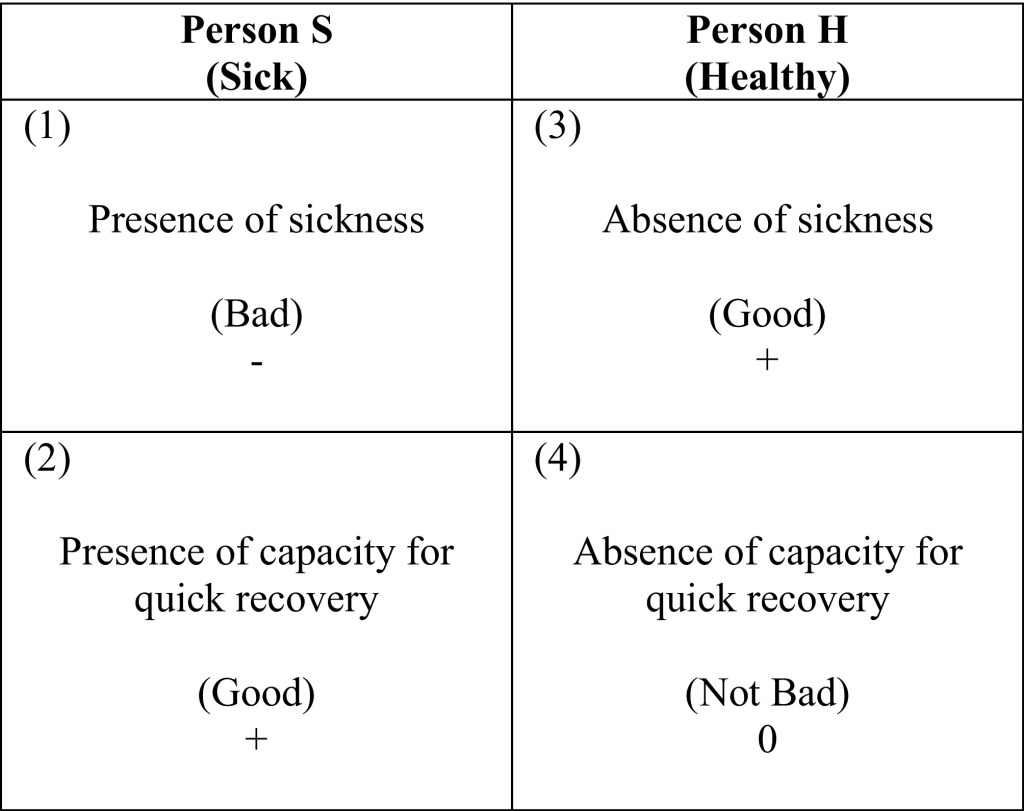
The issue with this should be obvious though – negative sensation itself is by definition bad just like water is watery, it is literal badness, a negative sensation/experience of some sort, the fact that sometimes one suffering is required to avoid an even greater suffering doesn’t prove suffering itself to be good. Suffering, badness itself, is bad.

For example, if we have to torture one person to prevent a billion from being tortured just as intensely and there’s nothing else we can do about it, then it’s the lesser of two evils, but the torture itself still feels bad, it’d be better if we could prevent it by cutting up an apple instead. If you say negative sensations can be positive, you might as well say wet is dry or hot is cold, it automatically cannot be anything but contradictory, good suffering is an oxymoron.

Sometimes in life, you have to experience one suffering to avoid an even greater one, but that doesn’t mean that suffering itself is good, that just proves it’s less bad than the more intense form of suffering that otherwise would have happened.

An example would be the painful vaccination in order to avoid a much worse disease you’d otherwise be prone to dying of, but you’re getting it exactly because suffering is bad, because suffering from an illness would be worse than one little needle prick in your arm for a few uncomfortable seconds. If you could snap your fingers in order to obtain the immunity, you would do that instead. The pain itself is bad, the good is the immunity to the illness.

Pain is a warning signal is also something that defenders of suffering will often say, i.e you feel your hand being burned on the stove top so you pull it away.

Again, we can demonstrate again that it’s not the pain itself that is good, but the avoidance of the greater pain, if you could be informed of the danger by something else without the pain, like someone standing next to you who notices it quicker always simply reminding you you’re about to burn yourself before you accidentally leave your hand on the stove top for too long, you would go for that instead of burning yourself to any degree at all.

So we can notice a pattern here in all of these situations where suffering is supposedly good, the person only falsely identifies it as good because it later on results in the prevention of an even greater form of suffering, and if the person could prevent the greater suffering without having to inflict a lesser suffering onto themselves, like snapping their fingers instead of getting an injection, then they would take that less painful option.

Why would you need a warning signal to prevent the worse pain of completely burning your hand on the stove top from happening instead, if pain is not a problem? You wouldn’t, so suffering can have instrumental value to the avoidance of a greater suffering sometimes, that doesn’t prove negative sensation itself to be simultaneously positive.

Suffering makes you stronger they say, but why do you even need to be stronger? Right, only to avoid more suffering associated with being weaker, thus vulnerable to more suffering in the future. If suffering is only ”good” because it helps you to avoid more suffering in the future, then that if anything proves that suffering is bad, because you’re only bearing said suffering to avoid even more of it in the future.

The only reason why you even need more character, strength and resilience built out of suffering in your life to begin with is to later on deal with more potential suffering emerging in your life, to not fall into deep despair upon being faced with adversity and challenges, so it actually doesn’t prove suffering to be good, it proves suffering to be bad.

When your hamster died of cancer, it was ”good for you” because it desensitized you to you later on seeing your mother die of cancer.

  • But why is it good to be desensitized to your mother dying of cancer?

Only because otherwise you’d suffer even more intensely from witnessing that incident, which is bad, it’s the avoidance of that suffering which is the real good which the suffering of seeing your hamster die has only been instrumental to achieving, not the suffering itself, suffering itself is always bad, just like all water is watery and all shit is shitty.

Negative sensations are indeed not positive. Going with the lesser of two evils doesn’t make it no longer feel bad, just less bad than the other bad. The needle in your arm still produced a negative sensation, it’s just that getting a disease would hurt even more, if you could snap your fingers to grant yourself immunity to illness, you’d probably do that instead.

If someone holds a gun to your head and forces you eat either one bucket of horse shit or ten buckets of horse shit, that doesn’t mean that one bucket of it suddenly tastes good, it just tastes less bad than ten buckets of horse shit.

The fact that suffering sometimes happened prior to a good event doesn’t mean that it is good, if a fire burns down your house in the winter and now you’re sitting in the cold, that doesn’t prove fire to be cold. Now you might be sitting in the cold, but the fire burned your house down exactly because it was hot.

  • But what about masochists?

Even a masochist ramming a needle into his urethra or a depressed individual cutting their arm isn’t enjoying suffering – they are enjoying the relief of a suffering they are already experiencing, merely using a pain to eliminate a greater pain.

A masochist will experience intensified sexual frustration if he doesn’t inflict pain onto himself, then leading to him becoming more tense and pressurized, thus ultimately more suffering in the long run.

A depressed person will experience intensified depression or other negative states if they don’t cut their arm, so they cut their arm to blend out the worse pain with the pain in their arm, so to speak.

If I told anyone beforehand who has absolutely zero masochistic preferences that I’m a magician and could it make it so that by snapping my fingers, they won’t be able to have an orgasm anymore unless they cut their eyeballs out and rub some chili sauce in their sockets, set their pubic hair on fire and extract every tooth they have with a plier, they wouldn’t want me to do that.

Perhaps they would even use lethal violence to prevent me from doing that, they would rather be able to cum without having to inflict intense suffering onto themselves, because all suffering is bad, just like all water is watery, all shit is shitty, if the masochist could get the exact same relief without the pain involved, they would do so.

Sometimes, some extreme masochists may find themselves in a situation where they have to do these things to avoid sexual frustration, which is a form of suffering, but if you could choose beforehand to get the exact same amount of pleasure from something else, you wouldn’t want to be the one who has to extract all their teeth with a plier in order to cum.

So what is happening here is essentially that as a delusional coping mechanism, when suffering is experienced by people, they observe that it is sometimes the lesser of two evils to bear one suffering over another even worse form of suffering, like the sensation of the needle pricking your arm to avoid a worse illness like small pox.

Then, they fall victim to the delusional conclusion that this now means that even when the suffering in question is not required to avoid a greater suffering, it is still good, because somehow, bad feelings can somehow be good, wet can somehow be dry, hot can somehow be cold.

I get that it’s a delusional coping mechanism which might help some of them to get through the day, but it’s a problem that they even have to get through a day where they require such a coping mechanism to begin with, and it certainly becomes a problem when this coping mechanism is used to justify all sorts of suffering that isn’t required for the avoidance of any greater problem.

  • War? Whatever, pain is a warning signal.
  • Factory farming? Whatever, suffering creates great wisdom.
  • Children dying of starvation in Africa? Pull yourself up by the bootstraps.
  • You have terminal cancer? Whatever, what doesn’t kill you makes you stronger.

It’s being used as an excuse for not fixing problems.

The problem with this ”suffering is good” approach in the context of reproductive ethics (natalism vs. antinatalism, to procreate or not to procreate) used by pro-natalists and pro-lifers should also be rather obvious – there is no unborn purgatory from which children need to be rescued, no one is spared from a worse fate by being reproduced.

It’s true that once you exist, you sometimes have to tolerate one suffering to avoid an even greater one, but obviously before the child actually exists, the child doesn’t actually exist, so it’s not somehow worse off, suffering in an unborn purgatory, lamenting that their parents that don’t reproduce them are somehow subjecting them to worse suffering in the unborn purgatory than by subjecting them to life on earth.

You’re just creating a pain machine to be motivated by that pain to try to avoid that pain again, there’s nothing efficient or productive about that, the suffering caused by reproduction is not instrumental to avoiding some kind of greater pain that exists in the universe.

So if we use the vaccination example again, the child might need the vaccination to avoid a much more painful illness once it exists, that is true, but obviously, before it existed, it didn’t need to become prone to that illness it now needs to be vaccinated against in the first place, it wasn’t sitting around in the unborn purgatory thinking:

  • ”I wish I became prone to small pox so that I can get a vaccination against it one day! Why do I have to suffer from an urge to obtain an urge to avoid illnesses?”

That the child is prone to illness in the first place is the fault of the parents that produced it, so it would still be perfectly rational for the child with a fear of needles to blame their parents for even creating its proneness to illness in the first place without knowing whether or not the child will be fine with that later on.

This same line of reasoning is then of course even used to justify more child abuse on top of reproduction:

  • ”The child needs to be spanked!”

Why?

  • ”To learn discipline!”

But why does the child need to learn to be disciplined?

  • ”To toughen up and compete with others, get a good job! Hardship builds great character!”

But why do they need to be resilient and successful in life? Right, because otherwise they will fail to acquire resources to fulfill certain needs, wants, desires in their life, they won’t be as fulfilled and satisfied, perhaps not achieve their goals in life due to said lack of discipline.

  • And who’s to blame for that?

You are to blame for them experiencing those needs, wants, desires they need to fulfill to avoid being tortured by them, because you imposed those needs, wants, desires onto them by reproducing them in the first place, non-existent individuals don’t need, want, desire anything.

It’s like I create a some sort of sadistic game, call it torture and the carrot, where I’m locking you in my basement and tell you that in order to obtain food for further survival, the carrot, you have to saw your left hand off. Then I can justify cutting your little finger off, because that will get you used to pain and desensitize you to later on getting your entire left hand cut off, which you have to do to obtain the carrot or starve to death. See, I’m actually doing you a favor I could say, I’m helping you get closer to the carrot!

See the problem? The problem with this is that I created that problem of you being in need of the carrot in the first place. It’s true that sometimes children have to learn to be disciplined (though highly questionable if beating them will achieve that) to not fail later on in life, but they only have to do that in the sense that if they completely fail at life, they’ll fail to fulfill needs, wants, desires that the procreator instilled into them by not aborting them before they became conscious.

The procreator creates the sick torture and carrot game, sometimes the child now has to endure hardship to get to the carrot, so the procreator justifies giving the child a spanking so it’ll be more desensitized to the more intense hardships and adversities later on in life, but all of this is only a problem if the procreator puts the child into this torture game where you have to bear torture to avoid even worse torture in the first place, which they still haven’t explained why anyone should think that’s a worthwhile endeavor.

If little billy is not created, he doesn’t need to be spanked harder to be more disciplined in order to obtain a good job requiring his emotional resilience and strength later on in life in order to avoid suffering from a low income and being a loser, non-existent little billy does not suffer from an urge to obtain an urge to obtain a job to obtain enough money to fulfill his needs in life from the unborn purgatory in this very moment.

So first you abuse the child by imposing the threat of deprivation on it – need, want, desire, i.e do x or suffer, and then you justify making the child suffer as a necessary evil by disciplining it to desensitize it to later on facing even more intense suffering which will be instrumental to avoiding only some of the suffering you have imposed on it by creating the threat of deprivation in the first place, that seems rather absurd.

Bullying is another great example of this flawed thought process of ”good suffering”.

First you were all skinny and weak, were called a faggot and beaten up in school every day, every girl denied you access to her vagina, then you started working out, taking steroids and beating the shit out of everyone and now you’re drowning in pussy because now you’re much stronger.

  • Totally proves that negative sensations must be good, right?

Wrong, because again, even if the suffering helped you toughen up which then later on resulted in you staving off the suffering of sexual frustration by finally being tough enough to be sexually selected for by some females, the suffering itself you experienced was still bad, the experience of getting bullied was not enjoyable regardless of whether or not it helped you to avoid an even more unenjoyable experience at some point.

Now you exist, so now you need to stick your peepee in a vagina to avoid even worse suffering from not doing so, but when you didn’t exist, you were not trapped in an unborn purgatory, needing to need to stick your peepee in a vagina to avoid even worse suffering, thinking to yourself ”Man, I wish I had to stick my peepee in vaginas in order to avoid suffering sexual frustration, unfortunately my parents won’t impose sexual needs onto me by reproducing me”.

You need it now, but you didn’t need to need it, your parents put you in need by reproducing you, it’s a net negative, you didn’t want to want it before you wanted it, you didn’t desire to desire it before you desired it.

So ultimately, whilst you already exist where you have to tolerate negative sensations from time to time to avoid an even higher amount of negative sensations in the future, the negative sensation itself is always bad, just like water is always watery and shit is always shitty, and before sentience evolved in this universe, the universe was not somehow worse off without us, starving for sentient organisms to be put inside of it.

  • There was no pre-existing damage to fix, we are the damage.

The faulty idea that suffering is good is largely used to justify its continued infliction, it might help one as a coping mechanism to get through the day once in a while to believe it’s all happening for some kind of greater good, but the fact that you even need to get through a day to begin and tell yourselves these lies is a negative, a problem – you are in need, you’re in desperation.

And if we don’t start being more honest about the fact that suffering is bad, procreators will keep putting organisms into situations where they have to tell themselves that suffering is good to cope with life.

The reason why you need that coping mechanism in your life to begin with is because procreators keep creating problems, in an emotional state where they themselves are falling victim to the exact same coping mechanism, thinking:

  • ”Suffering is good, might as well breed, if my children suffer horribly and die of cancer, it’s gonna be real good somehow, it’s just gonna toughen them up!”.

Once suffering exists, it can be necessary to bear one suffering to avoid an even greater one, but the existence of suffering itself to begin with is unnecessary in the grand scheme of things, the universe was never somehow worse off without sentient organisms inside it, our suffering serves absolutely no greater good.

On retributivism and punishment.

Eye for an eye notions, retributivism and punitivity are profoundly intuitive to many, the idea that we ought punish someone for the sake of punishing them, that once you’ve done x, you deserve to have x punishment done to you, the idea that we shouldn’t without restraint harm a child rapist who is no longer a threat and sitting in a prison cell all day offends them deeply.

They may say something like:

  • ”Why shouldn’t we shove a broomstick up this evil rapist’s asshole, why would that be bad to do that if he did the same thing?”

The answer is obvious – for the exact same reason why it was bad when he stuck his dick up the child’s ass – because it causes pain and suffering, which is always bad.

Sometimes you may tolerate one suffering to avoid a greater one, like getting the vaccination to avoid the greater suffering of a deadly disease, or tolerating a boring workplace to obtain money, which you also only need to obtain resources that help you prevent some condition of suffering in your life in one way or another, but suffering itself is always a bad thing.

Even a masochist hurting themselves for sexual pleasure or a bipolar individual cutting themselves for emotional relief are not enjoying negative qualia (it is impossible for negative qualia to be enjoyable) – self-harmers are already experiencing suffering, so to blend out that worse suffering, they have to inflict pain onto themselves, using pain to eliminate a greater pain, for the masochist it would be sexual frustration, for the cutter it might be depression.

So if harm (negative qualia) is always bad, then it can never be the better option to inflict it, unless it prevents an even greater, more intense harm, i.e you see the child rapist raping the child, so you push him off that child to prevent more harm.

The problem with this in the context of punishment is that when the harm causer is being punished, they are usually already detained, that’s kind of implied in the act of punishment – it is an act of violence against the harm causer after the threat the harm causer poses has already been deactivated, otherwise it would just be an act of defense. It might be perceived as punishing by the harm causer, but it’s not for the sake of retribution, punishment.

So while it is perfectly justified for you to defend against the rapist whilst he is raping the child to prevent harm, it would be illogical to insist on punishing him after he has already been stopped and is already spending his whole day in a prison cell where he can no longer assault children anyway.

It was bad when he raped the child because it caused harm, plus he didn’t need to do that in order to defend himself against some kind of greater threat posed by the child, the child was not a threat, but for that exact same reason, it’s now arguably also bad if you shove a broomstick up his ass after he has already been stopped from raping the child, it’s the exact same negative qualia experienced by different subjects, and that negative qualia is not good.

Eye for an eye notions of retributivism are frequently based in human bigotry, cognitive biases, narcissism and delusion, they essentially believe it to be bad to harm feeling things for the wrong reason on a very instinctive, primitive, emotional level, which is why they then fail to acknowledge it as just as bad when abuse is happening to criminals in prison.

So for example, when your mother gets brutally murdered, you may have some kind of gut feeling telling you that this is only bad because it happened to your mother in particular, in which case, it’s not a problem if it happens to the murderer of your mother, because he isn’t your mother, so it wouldn’t be bad to harm him like it was bad when he harmed your mother.

But in reality of course, what happened to your mother was bad because she is a sentient, suffering-capable organism and it doesn’t get any more complicated than that, if it were only bad because it happened to your mother, then it wouldn’t be bad if it happened to literally anyone else who is not your mother, which is simply untrue, it would still cause negative sensation to have a knife in your throat, even someone didn’t give birth to you.

But, that’s of course also why it’d be bad if the murderer of your mother had a knife in his throat, because he’s also a sentient, suffering-capable organism.

Or when a pretty, cute girl gets brutally raped, you may have some kind of gut feeling telling you that this is only bad because she’s pretty and cute, in which case, it’s not a problem if it happens to her rapist, because he’s most likely not that pretty and cute, so it wouldn’t be bad to harm him like it was bad when he harmed the pretty girl.

But in reality of course, what happened to the girl was bad because she is a sentient, suffering-capable organism and it doesn’t get any more complicated than that, if it were only bad because it happened to someone pretty and cute, then it wouldn’t be bad if it happened to literally anyone else who is not pretty and cute, which is simply untrue, it would still cause negative sensation to get raped even if you’re ugly.

But, that’s of course also why it’d be bad if the rapist of that girl got raped, because he’s also a sentient, suffering-capable organism.

Obviously none of these factors that people ascribe some kind of superficial value to are ultimately important to them, the point here is that the harm itself is bad, it’s not bad based on your nepotistic delusions of it only being bad when it happens to your family, women and/or children that elicit some kind of primitive instinctive reaction in you.

If I put any sentient organism in an isolated cell where it cannot possibly pose a threat and torture it, it’s going to be unambiguously bad, no matter what, it will produce negative sensations, no way around it.

It’s usually done for the fleeting emotional pleasure that the victims or angry mobs derive from punishing someone, in which case they then grant the harm causer the right to justify his deeds based on the fleeting emotional pleasure he derived from causing harm.

  • ”But what if the rapist raped your sister? You’d want him dead too!”

But what if you were the rapist? You’d want to rape too!

If you would be the person that wants to do x, you would want to do x too, therefore, doing x is now justified, that seems to be the idea here.

If you want to put Ted Bundy on the electric chair for the purpose of jerking off to it, then so can he consistently keep justifying violently killing women for the purpose of jerking off to it, it’s the same exact justification, you’re both arguing it’s ok to inflict torture so you can jerk off to it.

In many cases, retributivists then justify this sort of behavior by arguing that it is necessary:

  • ”But he could still attack a prison guard!”

In which case, that problem could be solved by just sending more than one prison guard to his cell the next time, rape and murder remain unnecessary harms, because these harms are not required to detain the threat being posed – unless it legitimately happens in a moment of defense against the criminal.

  • ”But he could escape prison!”

Unlikely, but if it’s true, that problem could be solved by just building more steadfast prison walls, rape and murder remain unnecessary harms, because these harms are not required to detain the threat being posed by the criminal.

  • ”But that costs money!”

Which is the least harmful method of defending yourself against the threat. Some individuals cause a lot of harm, so we put these individuals into a home where they cannot cause a lot of harm anymore for the purpose of public safety. I think paying a certain amount of money generally produces less harm than being forced to wait to be executed.

Some may argue that life in prison is actually worse than being executed, but the point is that once a criminal is detained, there is no reason to not consult them on this matter first, I am not against the right to die, it’s just unnecessary to take the ability to decide their fate away from them, plus, again, prisons don’t have to be torture facilities that make someone suicidal in the first place.

If they wanted the death penalty, it wouldn’t be a penalty anymore, it would just be making use of the right to die, which we can have regardless of our criminal status.

  • The only good argument for punishment would be deterrence.

So let’s say we just took the concept again of taking any sentient organism, putting it in a cell and torturing it, but it had to be done just once to prevent an even more intense harm from befalling everyone, let’s say everyone going to hell and burning alive over and over again eternally. In that case, it would still be bad, but it would obviously be less bad than not doing it.

The problem here again though is that it’s usually far from being this clear cut when it comes to crime and punishment. And the distinction between guilty/criminal and innocent/non-criminal remains insignificant, if anyone had to killed to save 1000 others from torture, and there were nothing else we could do about that, it’d be the better option to kill one regardless of their criminal status.

  • Detainment is still deterrence.

No sentient organism wants to be restrained in any way, again, unless it releases another restraint they already experienced, like a masochist being more tense and frustrated if he doesn’t inflict pain onto himself, and you have no way of knowing the exact preferences of all potential criminals. A reduction of your freedom is still a deterring factor, to some it may be a greater one than death, to some it may not be.

  • You don’t necessarily always know if you’re going to prevent a greater harm.

Unlike in the aforementioned hypothetical scenarios I just pointed to, you don’t necessarily know if you’re going to prevent more harm than you cause, perhaps you stick a broomstick up someone’s ass but all the harm you prevented from happening was 5$ being stolen, that’d be bad.

Let’s say you know for sure you could prevent a lot of people from stealing a potato by cutting their hands off and burning them alive in the streets, just the infliction of that punishment would be worse than a potato being stolen once in a while.

  • Althroughout human history and to this day, draconian punishment has been inflicted and crimes have still been committed.

We’ve inflicted torturous draconian punishments on prisoners but their optimism bias was still strong enough for them to believe that they’re never going to get caught, then got caught, tortured to death, and people still committed crimes thinking they’re never going to get caught, optimism bias and overestimation of one’s own invincibility is strong in many humans in general, criminal or non-criminal, but especially when you’re committing a crime (exception of some calculated criminals of course), you might already be in a rather impulsive mental state.

  • You don’t know what exact effect the punishment will have on each potential future criminal. Perhaps it demotivates them to commit crime, perhaps it leaves them neutral about their crimes, perhaps it motivates them to commit even more crimes.

In fact, countries like Norway where prisons look like hotel rooms seem to have the lowest crime rates, whereas a lot of countries that punish rather severely seem to have much higher crime rates.

What if you threaten a potential serial rapist and killer whose goal it is to bring all whores to justice with death, then he rapes and kills even more whores out of spite, then shoots himself, whereas if he were only to be threatened with a debate about whether or not raping whores is good or bad in a 5 star hotel, he would turn himself in to tell us all about it? You threaten the enraged school shooter with death and then he wants to shoot everyone even more for what he thinks is doing the right thing.

We stick a broomstick up the rapist’s asshole.

  • Rapist 1 one stops raping because he wouldn’t like to experience that.
  • Rapist 2 with poor impulse control just jizzes on her belly instead of her pussy next time and runs away in disorientation.
  • Rapist 3 is pissed off for first being denied the pussy he wanted and now wants to take revenge against society for threatening him with torture for intruding vaginas that he considers his private property.
  • Rapist 4 is in addition to being a sadistic rapist also a masochist who wouldn’t necessarily mind having a broomstick shoved up his ass.
  • Rapist 5 gets an adrenaline rush from the fact that we now stick broomsticks up people’s asses for raping, that makes the whole rape game and trying not to get caught even more exciting.

Retributivists often have an irrational belief that criminals are ”just evil” with no explanation for it and all you got to do is just threaten them with death, they can’t be suicidal because that would mean that these monsters have feelings, when in reality, they’re of course ”just evil” out of nowhere.

They devalue criminals, so chances are they’re not even deeply contemplating the emotions and what could possibly motivate them. In that mindset, if they feel that alienated from them, of course they’re going to think it’s as simple as carry some garlic around and the evil vampires won’t attack you.

Punishment for the sake of punishment is bad anyway because all harm itself, the state of being harmed is bad, doesn’t matter if it’s a cute little girl or some fat ugly serial rapist, so pure retributivism is a failure, it’s an irrational concept.

If it’s done to prevent a greater harm, it’d be better to have the information on whether or not said punishment is actually efficient at preventing future harm, which in practice seems almost impossible to tell beforehand.

Therefore, for all intents and purposes, in practice, it still seems more sensible for the default position to simply be not to inflict harm on someone once you’ve stopped them from causing harm, unless you can demonstrate in that specific scenario that it will prevent a greater future harm, if it’s clear cut, i.e cut one hand off to stop a thousand hands from being cut off, nothing else you can do, then you cut one hand off, but in real life it usually simply isn’t that clear cut.

Need and want – same thing.

Need and want sound distinguished, but if you question what distinguishes a want from a need on any deeper level, it seems the same. The answer as to what is the difference is most often that you need something if you need it to live/survive, whereas when you want something, you don’t need it to live/survive.

The problem is that this ignores that you do not need to survive either – you just want to because it’d make you feel bad if you didn’t. But ultimately, there is no great distinction, it’s the same process, the same function, same mechanism.

  • Need, want, desire all essentially describe the exact same phenomenon.

Needing something means that there is a certain thing and/or circumstance, and you have to obtain that certain thing and/or circumstance in order to avoid a given amount of suffering – obtain x or endure a certain amount of suffering, and that’s the exact same thing that wanting means.

We just usually refer to ”want” as a less intense form of a need than ”need”, as in, you want a new car, but you need food, because one suffering you’d experience as a result of not obtaining food would be more intense than the suffering you’d experience as a result of not obtaining the new car.

If you don’t get the new car, you will suffer to some degree, but if you don’t get the food, you will suffer more intensely. You will experience negative qualia either way, but more intensely if you’re not given food than when you’re not given a new car.

It can be vital and important in ethical discussions to find out which need is the most intense to avoid the greatest amount of suffering, and to simplify this process, at some point this distinction of need and want has (I’d conjecture) probably been created to tell the intensity of needs apart, as in:

  • We have a certain amount of money to donate, we could spend it on rich asshole who will experience suffering if he doesn’t buy a new mercedes, or we could donate it to starving children in Africa, and the suffering of said children from not obtaining food would be more intense than the suffering the rich asshole would experience from not obtaining a new mercedes, so we spend it on starving children in Africa.

Or:

  • The rapist will experience suffering if he doesn’t rape you, but this suffering is likely not more intense than the suffering the victim will face upon being violently raped, and there are other outlets that he could use, such as porn and prostitution to play out his fantasies in a harmless scenario, so we don’t allow rape.

But this doesn’t mean that the rapist doesn’t need to rape you to avoid suffering from being deprived of raping, our potential rapist needs to have sex or even assault others to avoid suffering intensified sexual frustration (if that’s what he gets off on), of course we shouldn’t just let him rape because that will very likely cause worse suffering, but it’d still be dishonest to say that a rapist never suffered from not raping or a thief never suffered from not stealing – and that’s all need is, do x or you get tortured in some way – that’s what need is, that’s what want is, that’s what desire is.

This makes people uncomfortable, so they accusatorily call it ”want” instead of ”need” to downplay the fact that there will still be suffering, to rationalize that we live in an inefficient world where we cannot meet everyone’s needs without frustrating someone else’s, where when one avoids suffering, another one is suffering because of it, so they stop to acknowledge that it is suffering at all.

It’s an easy excuse to dismiss others suffering, I ”need”, you just ”want” so you’re unimportant, I’m important, I need things, you just want them.

The sadistic serial killer shouldn’t be allowed to rape you with a jackhammer just because that is what he needs to do to get off, it would cause much more frustration of need than satisfaction of need overall, but it’s similarly delusional and unfair to deny that he’s a victim of need, in need, tortured by this unfortunate need – every need is a problem, doesn’t matter what it is.

It’s bad for him to rape you with a jackhammer, but it’s also bad he’s suffering if he doesn’t do so, just most likely less bad than getting raped with a jackhammer. The problem in allowing him to rape you with a jackhammer would not be satisfying wants instead of needs, the problem would be satisfying less intense needs rather than more intense needs, or less rather than more needs, ultimately it’s about how much suffering is being prevented and caused.

  • The real solution to the problem of all need is obvious – don’t create it.

As long as the needer exists, it will need, i.e suffer if it doesn’t obtain certain resources. There are living things, like plants and bacteria, and then there are living things that are also conscious, and those conscious things desire all sorts of different things.

When a plant doesn’t obtain water, it doesn’t notice it, when a conscious thing doesn’t obtain water, it notices it, then tries to obtain it.

Sentient organisms are motivated by pain, they experience pain to be motivated by pain to try to avoid that exaxt pain again – hunger, thirst, constipation, sexual frustration, fatigue and the more complex the organism, the more small needs there likely are, the metaphor of a whip is good, you get continuously whipped, and the whipping will get less intense by obtaining different objects.

Sometimes of course, they do fulfill their needs, they stave off suffering for a while, but that is all it is. We put some form of a weight on you, and then we take it off again, this feels good, that is what the good is, and that constitutes all need, want or desire means.

You get whipped, and when you obtain the resource you need, you get whipped less intensely, this feeling of having the weight lifted off of you is what we call pleasure, the defecation wouldn’t feel what we call good if you weren’t made to feel uncomfortable by the shit clogging you up first.

Of course, pleasure is good in the sense that it avoids the alternative of getting whipped even more intensely, but it is the inferior option as compared to not getting whipped at all, which is what we can only achieve by not creating a needer/wanter/desirer that runs on suffering in the first place, existence has zero advantage over non-existence.

If there are no more desire machines, there is no more pleasure either, but the lack of pleasure can obviously not be a problem as it is just a relief of the suffering, if no one is getting whipped, then it’d be absurd to bemoan that now there’s no pleasure of avoiding the whip anymore, you don’t need to avoid the whip if you’re not getting whipped (literally, suffering would not be the alternative to there being no pleasure).

You do not need a relief of suffering that doesn’t even exist anymore. It’d be absurd similar to bemoaning that if we cut a cancer tumor out, there’s no point in chemotherapy anymore, when the whole idea is that chemotherapy is only good because it gets rid of cancer.

All needs, including the need to survive or propagate life are a problem resulting out of the continued creation of needers, if no needers exists, life won’t need to continue existing for them, there is nothing beyond us that needs us.

You could say that procreators need to create more needers to satisfy some of their needs, the children were needed by their procreators and the procreators of those procreators also needed those procreators, but obviously this doesn’t efficiently solve the need problem in the long run and in practice also subjects the new needer to possibly enduring much worse suffering than the suffering the procreators would have experienced if they didn’t procreate.

And if we question long enough:

  • ”But who needed the needer that came before that new needer they created?”

We will at some point arrive at the first sentient organism that ever existed, and who needed that first sentient organism to exist? No one, before consciousness itself existed, no waters felt horribly tormented over the lack of conscious fish swimming inside it.

Most organisms fail to fully grasp that if they didn’t exist anymore, suffering would not be the alternative to pleasure (relief of suffering) they now experience, so they believe that needs must be created for the good of filling them up again, which is about as absurd of a concept as giving someone a wound to put a bandaid on it.

Instead of admitting that while they need things now, they didn’t need them before they existed because they didn’t exist, they’d rather become suffering denialists that downplay the massive amount of unfulfilled needs in the universe and keep injecting new needs into it, satisfying some of their needs but causing a much bigger need problem.

And then when their child turns out to be the one that can’t adequately fulfill their needs in life, they play word games like this and pretend the child’s needs aren’t needs, the victim of reproduction ”just wants” things because they’re selfish. They have the right to inject the victim with need, but the victim has no right to even file a complaint against these void rapists.

Social mimicry.

Molly Helt discovered an interesting aspect of her son’s autism somewhat serendipitously, during a plane ride. When the plane descended, in an attempt to help relieve painful pressure in her son’s ears, she tried to get him to yawn by yawning right in front of him.

About 45 percent of us yawn when we see someone else yawn, but Helt’s yawns had no such effect on her little one.

The observation prompted Helt, a clinical psychology researcher at the University of Connecticut, to investigate the contagious yawning in children with autism.

“Yawning when you see someone else yawn requires empathy, on a certain level,” Helt said.

She found that most children with autism are unlikely to copy this behavior, and the finding may help scientists better understand important aspects of human communication and social behavior that children with autism don’t experience.

https://www.livescience.com/10076-kids-autism-experience-contagious-yawning.html

Social mimicry is a social behavior largely exhibited by non-autistics, in simple terms, they automatically copy what they observe in someone else – monkey see, monkey do. Autistics more often are not as susceptible to it, all to differing degrees.

Social mimicry had certain benefits althroughout our evolutionary history. Let’s say one caveman is running away from a wild animal that isn’t visible to their tribe yet and now signals with panicked hand gestures that there is a danger to the tribe, then it is simply beneficial for the other cavemen to be susceptible to social cues and body language, understand what the caveman is signalling, then starting to run away as well.

If you’re too autistic to register the social cue and focused on analyzing objects, you might be the first one to get eaten by the wild animal, only taking notice of it once it is too late to act on the evidence of its existence.

As with many other biases and social behaviors exhibited by neurotypicals to this day, evolution did not necessarily favor a 100% accurate, rational, systematic perception of reality that is closer to that of an autist, but often rapid acting based on social intuitions and gut instincts instead.

On each of five trials, each child was asked to watch carefully as a demonstrator showed how to retrieve a toy from a box or build a simple object. Importantly, each demonstration included two necessary actions (e.g. unclipping and removing the box lid) and one unnecessary action (e.g. tapping the top of the box twice).

The box was then reset behind a screen and handed to the child, who was instructed to “get or make the toy as fast as you can.” They were not specifically told to copy the behavior they’d just seen.

Investigators discovered almost all of the children successfully reached the goal of getting or making the toy, but typically developing children were much more likely to include the unnecessary step as they did so, a behavior known as overimitation.

Those children copied 43 to 57 percent of the unnecessary actions, compared to 22 percent in the children with autism. That’s despite the fact that the children correctly identified the tapping action as “silly,” not “sensible.”

Researchers now plan to investigate precisely what kind of actions children copy, and how that tendency to copy everything might contribute to human cultural transmission of knowledge.

Hamilton said parents and teachers should be aware of the social value in going beyond the successful completion of such tasks.

https://psychcentral.com/news/2013/04/09/autistic-kids-tend-to-imitate-efficiently-not-socially/53604.html

What must be pointed out in all of this is that many behaviors that have been selected for also have immense disadvantages, especially in our modern environment, which is often missed by neurotypicals that exhibit these certain biases and social behaviors themselves, thus often fail to critically examine its negative effects and only think of the autist as deficient for not acting like a copying machine.

Social mimicry is also why neurotypicals are susceptible to social indoctrination and many people to this day still value what their culturally isolated tribe/group says instead of what science indicates.

The earth is not flat, but their tribe says that it is flat, so because there have been certain survival benefits to following the tribe, they fail to reject the false information (that the earth is flat) because they want to keep being a member of the tribe, which entails rejecting the correct information (that the earth is not flat).

They are bad at logical argumentation and subconsciously run every argument they hear through a list of vapid social concerns rather than to address the argument itself.

  • Would saying this in public enhance my social status?
  • Would saying this in public enhance my social status, thus my sexual success?
  • What does the person making this argument look like?
  • What is the social status of the person making this argument?
  • What is the consensus of my primitive tribe on this person making this argument?
  • What is the hidden intent of the person making this argument?
  • What is the legal (majority voted on) status of what this argument proposes?

It influences public morals and laws – the neurotypical develops a strong attachment to certain rules without being able to exactly explain why said rules are important, they simply copied it at some point throughout their development and never questioned the belief, then said neurotypicals are often angered by an autist rejecting and questioning their inconsistent beliefs that they cling to simply for membership of the tribe.

Some examples of beliefs resulting out of automatic social mimicry would include:

  • Religion:

A normative human may be more likely to believe in god over allah, although in objective reality, there exists no evidence for the existence of either any more than for the existence of the easter bunny. They can see the insane belief for what it is when they witness someone who believes in a different fantasy world narrative, but they can’t see it in themselves, they believe in their particular god as it is written about in the book about their particular god simply because they grew up in a culture that believed in said particular god.

  • Speciesism:

A normative human may be more likely to believe in the sacredness of one animal over another, in objective reality, of course any sentient animal wants to avoid harm, you don’t want to avoid harm because you have human DNA, you want to avoid it because you’re sentient, if you were braindead you wouldn’t care about avoiding the knife in your throat.

Non-human animals and human animals are alike in their interest not to experience suffering, the pain of a dog is the same as the pain of a pig. But for no other reason than that they grew up in a cult where dogs are worshipped and pigs are put in gas chambers, a majority of social pantomimes end up believing that there is just something inherently ”wrong” with killing a dog but not a pig.

They can see violence and cruelty when they look at a different culture that mistreats the sacred dog, they get angry and want to torture the perceived heathens of this different culture to death slowly for the atrocities (it’s bad because it causes suffering, not because it’s a dog) they commit, whilst chugging down the tit juice of a tortured cow, and if they lived in some different part of the world, they’d be chugging down cow’s piss without thinking about it, it’s the same exact function of a social copying machine.

  • Drug laws:

Alcohol and cigarettes are drugs, but ”drugs” are thought of as something that is illegal, forbidden by the tribe, so often people say ”alcohol and/or drugs” as if ethanol is not a drug, this is because of social mimicry – they learned that certain drugs such as marijuana, cocaine, heroine are forbidden in their tribe, so they only call those drugs drugs, drugs that they take legally they fail to even consider as drugs intuitively.

The alcohol they put in their bodies is probably much unhealthier and dangerous than many other potentially illegal drugs they could be taking, but they don’t acknowledge that, when it comes to the illegal drug they say ”but people could do bad things on these drugs and die of it!” without acknowledging that people do bad things on the socially acceptable drugs that they’re taking and they still accept the usage of said drug because they understand that the usage of the drug alcohol doesn’t cause harm to someone else, so it’d be unfair to arrest everyone that drinks it just because some do bad things on it.

But they only see that when it comes to the socially acceptable drug, when it comes to a drug drug, they are perfectly fine with ruining someone’s life for taking it, because they’re ruining their lives with that drug….so let’s just lock them up and ruin their life for them so then it’s ruined anyway!

  • Age of consent:

Although you could argue that the lower we go in age, the more likely a person might be to be manipulated into sex due to their lower intelligence, this doesn’t mean that just because a person of said age is having sex, it must be the result of some sort of evil scheme or abuse, they could just be wanting to have sex at an earlier age than is socially acceptable as well.

Regardless of an official age of consent law, it can made illegal to rape, force and manipulate someone to have sex with you, the age of consent serves to arrest people for having sex with someone who consented under what is considered the holy number, it offends religious sensibilites, different groups of neurologically normative humans deeply believe that the age of their particular location is the correct one and harmless sexual encounters under that age are simply never possible, only because they grew up in that particular location.

Even if there were some kind of particular IQ you needed to consent to sex scientifically speaking, which I don’t believe exists any particular evidence whatsoever for, and you showed these normative humans that the 15 year old under the holy age of 16 possessed all the same exact attributes the average 16 year old possessed to consent to sex, they would still reject the idea because it’s not 16, so it’s always unacceptable.

  • Genital mutilation:

Even if there is no medical reason (to avoid some sort of actual, greater harm) to cut the genitalia of a child, many cults still believe that it must be done, often times because of another belief based in social mimicry in one of many fantasy creatures like god or allah.

They will use all sorts of rationalizations for this from hygiene (as if soap doesn’t exist in the first world) to straight up denying cutting a sensitive part of someone’s genitals off, leaving it without protective skin could ever impair sexual function at any point, otherwise they’d have to admit that their genitals also have been harmed and their orgasms might not be as satisfying as they could be, they’d have to go against the tribe’s belief, this produces discomfort.

Supporters of genital mutilation in the form of ripping foreskins off will then often times be outraged that one would compare their barbarism to the mutilation of vaginas, also primarily because they from social hear-say blindly parroted from members of their cult that female genital mutilation is of course much much worse than male genital mutilation and ought never be compared under any circumstance.

Although in reality, it of course simply depends on how you are mutilating the child. Some cultures cut off more, some cut off less. Some cut the girl’s skin around the clitoris off, this is more similar to the process of cutting a foreskin off, some more violent cultures cut the entire pussy open, some cultures cut the entire penis open and then stick their penises in that cut open penis, it’s just social mimicry – wherever you grow up (without being autistic enough to see through it).

A question that comes up in all of this though is that if neurologically normative humans are predisposed to copying social behavior so much, where has the behavior started? Generation after generation, neurotypicals copy the behavior of other neurotypicals, but at some point, the trend must have been set for them to copy, someone must have started engaging in the behavior, and this is where it gets a little bit darker.

The rank and file are usually much more primitive than we imagine. Propaganda must therefore always be essentially simple and repetitive. In the long run basic results in influencing public opinion will be achieved only by the man who is able to reduce problems to the simplest terms and who has the courage to keep forever repeating them in this simplified form, despite the objections of the intellectuals.

Joseph Goebbels

Despite there being autistics and non-autistics, there are also psychopaths and narcissists. Psychopaths lack empathy, but they are also good at manipulating neurotypicals to do their bidding.

At first blush this may seem counterintuitive, even outrageous. We tend to think of psychopathy as the province of criminals, with leadership qualities that may land someone atop a fringe religious cult, say – not in a boardroom. But before discussing the research, let’s consider for a moment why this possibility is actually less bizarre than it may initially seem.

The hallmarks of the psychopathic personality involve egocentric, grandiose behavior, completely lacking empathy and conscience. Additionally, psychopaths may be charismatic, charming, and adept at manipulating one-on-one interactions. In a corporation, one’s ability to advance is determined in large measure by a person’s ability to favorably impress his or her direct manager. Unfortunately, certain of these psychopathic qualities – in particular charm, charisma, grandiosity (which can be mistaken for vision or confidence) and the ability to “perform” convincingly in one-on-one settings – are also qualities that can help one get ahead in the business world.

https://www.forbes.com/sites/victorlipman/2013/04/25/the-disturbing-link-between-psychopathy-and-leadership/#5361dfe14104

Just as in the earlier example I gave of social mimicry having the benefit that when another caveman ran away from a wild animal, signalling danger to the tribe, you get the social cue if you’re susceptible to body language and run away as well, whereas if you’re too autistic, you might not get the cue and get eaten – some humans that are called psychopaths have also evolved to take the role of the caveman signalling that there is a danger to the tribe, resulting in all the other cavemen running away and to then take all the resources from their cave and run away, psychopaths falsely signal danger to take advantage of others for their benefit.

Here the benefit would be with the autist again, being left to wonder how these normative lifeforms could be so stupid as to not notice what is going on, as the autist would be the only one left in the cave, able to recognize what the psychopath is doing. A wild animal never arrived, the psychopath simply took all the resources from the cave and ran away.

Adolf Hitler and his nazi comrades successfully studied the non-autistic condition:

So the answer to the question of why normative humans for instance believe in certain gods over others, or that certain animals can be tortured but others can’t, or certain ages of consent are correct but others aren’t, or certain drugs are bad because they’re drugs so they’re bad but other drugs are not drugs so they’re not bad, or certain parts of genitalia must be sliced but others not so much is because humans higher on the spectrum of psychopathy most likely set the trend for them to follow, because it’s a profitable niche to be working in, you can make a lot of money off of exploiting social pantomimes.

If they believe in god, you can make them pay for salvation on a piece of paper to not go to hell. If they believe in happy cows that are gladly made into milk machines, then they’ll pay you to factory farm these animals. If they believe that exactly 16 (or better 17, 18, as high as possible so that you, as a prison owner can make as much money as possible) is the right number, you can make money from arresting someone for having a partner under that holy age they believe to be holy. If they believe that certain drugs are innately dirty and associated with evil criminals, you can make money from arresting someone for taking said drugs. If they believe that certain parts of their children’s genitals are inherently diseased, you can make money from cutting said parts off of children’s genitals.

There is close to nothing that is insane enough for them to not believe in, it is a simple matter of repetition as Hitler already pointed out, this happens with youtube comments and memes all over the internet all the time.

That’s how moral panics (social trends where they believe something to be harmful that isn’t harmful, exaggerated risks of harm) or let’s also consider the opposite, let’s call it moral calms (social trends where they believe something to not be harmful that is actually harmful, normalized cruelty) are easily established.

Once something is repeated frequently enough and has been integrated into the society you as a psychopath are about to parasitize and form to your benefit, all that the non-autistics have to do is essentially to breed more children into it in order for them to start automatically mimicking the proposed model of behavior.

Pedophobes and the argumentum ad baculum fallacy.

There is absolutely zero evidence for the hypothesis that sexual experience in childhood or youth is inherently harmful, there is at best proof that there is a correlation between sex in childhood and trauma in societies that are unaccepting of sexual relations between children/minors and pedophiles/adults, no proof whatsoever that sex in childhood or youth in and of itself causes the trauma.

Because pedophobes irrationally feel disgusted and threatened by the topic, they immediately think of certain harmful factors when they try to process it, like manipulation, blackmail, force, anal penetration, STDs, pregnancy, etc, which are all things that are not inherently connected to the act of having sex with a child/minor though.

Children have genitals and can obviously find out about the existence of sexual pleasure by exploring them on their own, without somehow needing to be fooled or violently coerced into doing so, there’s no evidence and/or reason to think it’s the result of some kind of evil scheme by some underground pedophile cabal misleading children through propaganda.

So if a little girl wants to simply experience the same pleasurable sensation from rubbing herself against a pillow by rubbing herself against a pedophile’s leg, and the pedophile isn’t some kind of violent psychopath that does something to her that she doesn’t want later on, like anal rape, there’s no evidence that such an encounter would be harmful to children unless society reacted negatively to it.

There is zero conclusive scientific evidence that children that voluntarily received sexual relief even in societies where pedosexuality was acceptable felt traumatized by sex, and there are zero reliable or coherent explanations from pedophobe professionals as to how this magical process of trauma just poofing into existence out of the great nowhere is supposed to work, even if the child initially engaged in the sex act without having been manipulated or otherwise forced into it and society simply stopped reacting negatively to it.

Pedophobes just like any other group of bigots assume that because they could prove a correlation between sex in childhood and higher depression rates in adulthood, it proves that it’s caused by the pedophilic sex act itself.

It is similar to how a homophobic bigot would assume that if they see some questionable study that says children of gay parents are more likely to suffer from depression, they assume that it’s directly caused by the fact that the parents are gay and definitely nothing else, the child is depressed because their father sucked a dick, not because the bigots are raising their children to harass children of gay couples.

It’s just a post hoc fallacy, correlation equals causation – B happened after A, therefore, A caused B. The child had sex, the child is traumatized by society’s negative reaction to it, so therefore, sex causes trauma, that’s the faulty idea here. The child left the house while it was raining, the child was wetted by the rain, therefore, so leaving your house causes you to be wetted.

When it gets to that point in the discussion, the pedophobes sometimes simply like to commit another fallacy to prove their point by then simply appealing to the extrinsic harm caused by the harsh social reaction that they themselves are creating in response to such sex acts and say something along the lines of:

  • ”Even if having sex with children is not inherently harmful, in our society, there are still consequences to this perverted behavior either way, so it’s still just as harmful to the poor child in the end, they’ll feel ashamed later on! Why does it matter by what exactly the trauma is caused? No excuses!”

It is ultimately an argumentum ad baculum fallacy – because it’s an entirely self-created consequence. Instead of proving something to be harmful, society, which you are forming part of, is causing harm to someone for engaging in an activity you don’t like, then pretend that the activity they engaged in is harmful because you harmed them in response to engaging in the harmless activity, frequently followed with standard moronic phrases like ”don’t drop the soap LOL”, i.e if you’re a pedo, you get raped in jail, so therefore, pedo=bad.

Argumentum ad baculum (Latin for “argument to the cudgel” or “appeal to the stick”) is the fallacy committed when one appeals to force or the threat of force to bring about the acceptance of a conclusion.[1][2] One participates in argumentum ad baculum when one points out the negative consequences of holding the contrary position (ex. believe what I say, or I will hit you). It is a specific case of the negative form of an argument to the consequences.

https://en.wikipedia.org/wiki/Argumentum_ad_baculum

Let’s say you like to wear red hats. I don’t like that, so in response to you wearing a red hat, I cut your head off and set you on fire. Does this prove that wearing a red hat is harmful? No, it does not, it just proves that I harmed you in response to wearing a red hat, but it does not actually prove the wearing of red hats to be intrinsically harmful.

The pedophobe at this point in the discussion is just appealing to a consequence that they themselves are creating.

They pretty much admit that child sex is not intrinsically harmful, they just appeal to the consequences bestowed by the bigoted society they form part of, such as for example:

  • The child and the pedophile being separated.
  • The child being screeched at by their hysterical parents.
  • The child being sent to a similarly delusional therapist.
  • The child receiving strong social pressure to ”accept their rape”.
  • The child hearing they now ”lost their innocence” and this is a great problem.
  • The child seeing the pedophile tormented/beaten in front of them.
  • The child feeling responsible for the pedophile going to prison.

This is no better than any other bigot althroughout human history just using force and threat to explain why the behavior they are bigoted against is somehow bad.

  • Don’t be a homo or else I’ll beat you up for it, therefore, gay sex is harmful/bad.
  • Don’t be a whore or else I’ll rape you for it, therefore, prostitution is harmful/bad.

Just that the pedophobe is essentially saying:

  • Don’t be a pedo or else I’ll beat you up for it in front of the child you gave an orgasm, thereby traumatize the child, then attribute that trauma to the orgasm rather than my uncivilized primitive conduct, therefore, child sex is harmful/bad.

It is akin to a homophobe in Saudi Arabia arguing that even if the homosexual activity itself does not cause harm, when you, as a bigot, set the homosexuals on fire for having homosexual sex, they are still harmed by it, therefore, somehow the sex (rather than the consequences you inflict on homosexuals for having sex) is still harmful, so homosexual sexual relations ought to be outlawed because otherwise you’ll burn these faggots!

It’s ironically the argument of a rapist while pedophobes pretend to be so anti-rape, like saying you can’t go outside dressing like a whore, it’s bad, because if you do that, he’s going to rape you, this proves how harmful it is for women to not wear a burqa, there is a consequence for not wearing one, a consequence which the rapist himself is creating, which is that he’ll rape them for it.

It might even become circular reasoning, i.e it’s harmful to have sex with the child, because if you have sex with the child, we’ll harm you (and by extension through this whole drama the child too) by imprisoning you for it, and why do we harm you for it? Because having sex with the child is harmful, you sick pervert! – That would be circular.

As an example to illustrate just how absurd appealing to self-created, extrinsic harm to demonstrate that an act is harmful is, let’s say society acted about harmless sexual encounters between children and pedophiles about any other pleasure-seeking activity, like eating ice cream.

They all believe that because children don’t have fully developed brains yet, a child can never possibly consent to buy ice cream you sick monster, it’s a crime even if it really seemed like the child consented to taste the ice cream, that’s not real consent because they haven’t reached the age of consent yet where society has decided the child is allowed to consent to eating ice cream.

Whenever there’s an ice cream salesman and the child agrees to buy it, some psychotic lunatic father has a meltdown in front of the child.

  • ”OMG this is my daughter you sick fuck, one step closer and I shoot! I don’t care that there’s no actual evidence whatsoever that eating ice cream in childhood in and of itself causes lifelong trauma, once I’ve beaten you pervert to a bloody pulp right in front of my little girl, she’s still traumatized, so that proves that ice cream is indeed very traumatizing, I’m doing this protect your precious wellbeing, little Suzie! You can’t consent!”

The child is then pressured by society to accept that they have been horribly wronged by having been sold exactly the ice cream flavor that they wanted, if they don’t, they’re just the poor dumb child that can’t understand how horribly violated it was by having been sold ice cream and the therapists won’t stop harassing her.

She also hears others joke how the guy that sold the ice cream is now going to prison and has Big Bubba shove his chocolate ice cream in his asshole, teehee, violent anal rape for a completely victimless crime harming absolutely no one, it doesn’t get any funnier than that!

At some point now, little Suzie is kinda sad.

Society concludes – ah see, ice cream is very harmful to children indeed! Doesn’t matter if selling ice cream isn’t ”intrinsically harmful” or any of this weird science and philosophy shit jargon, I’m a simple man, fact is, little Suzie is harmed, so no ice cream! NO ICE CREAM!

  • Has this society legitimately proven how bad the selling of ice cream is by harming the ice man in response to selling a child ice cream, have they made a great consequentialist argument as to why selling ice cream to children is always bad?

No, it hasn’t, they just demonstrated themselves to be primitive barbarians in need of psychiatric institutionalization that for some irrational narrative harm others in response to selling ice cream to children, anyone who has not been indoctrinated into their cult can fully see through their non-sensical notions of right and wrong behavior.

That they are in fact just suffering from a delusion that the selling of ice cream is harmful, and then attribute the harm that they cause in response to ice cream being sold to the selling of the ice cream rather than their uncivilized, backward, moronic behavior.

The vast majority of humans on this planet, neurotypicals, the neurologically typical are socially imitative animals that have a strong tendency to conform to many rules that are taught to them without questioning, this had certain benefits of social security at some point in our evolutionary history, but is also why humans can be indoctrinated into believing things that are completely disconnected from reality or fail to understand science like the earth being round, when their society keeps insisting that it is flat, it produces discomfort to go against their tribe.

Just like someone can be indoctrinated into believing that god is real but allah isn’t rather than to acknowledge that god is just as real as the easter bunny – someone can also be indoctrinated into believing that one particular age of consent, like 18 instead of 14 is the only correct one, and feel uneasy and repulsed whenever this delusional perception of their’s is challenged to any degree at all, although they most likely exactly see the delusion for what it is if they witnessed someone who believed in a special number that were even higher than their’s and thought that sex under 21 is never possible without resulting in harm later on.

Of course the lower we go, the more likely someone might be to be manipulated into having sex, the point is that it is being treated like a religion. Just because someone is more likely to be manipulated into sex, that doesn’t prove that when they have sex, it must be the result of manipulation, it could be, but doesn’t have to be, rape is the problem which can still be illegal regardless of the age of consent, but many pedophobes have a religious mindset in that they would pretend that all sex under the holy age is rape no matter what.

So does this problem apply to the ”victims” of ”rape” (wanting to get raped is an oxymoron, if it’s wanted it ceases to be rape) that they initially wanted to engage in when they were children, obviously, if a social animal is being put under excessive social pressure to pretend they got raped, then they will more often than not simply start to go along with the narrative to avoid being labelled as the poor, dumb rape victim that doesn’t even understand how raped it truly is.

Pedophobes would see their behavior for what it is if were to be manifested in someone else, like the hypothetical society that demonizes particularly selling ice cream to children, they would just as clearly detect that it’s not the selling of the ice cream itself that causes the harm, but the complete overreaction to it of sending someone to prison for it and pressuring the child to accept how it has been wronged.

Yet when a pedophile gives a willing child that discovered sexual pleasure and now wants to receive a pleasurable sensation in the form of an orgasm rather than ice cream (which is probably even healthier in the long run), they torment the pedophile in front of the child, then attribute the resulting trauma to the harmless pleasurable sensation of relief from sexual frustration rather than their fundamentally irrational, psychotic behavior.

Of course, you could even argue that because in response to ice cream being sold, the cult reacts in this violent manner, it might be somewhat negligent of the iceman to sell ice cream when he knows that the reaction has the chance of in some way emotionally harming the child from seeing the iceman being harmed in front of them, but the harm still lies in the reaction.

The social reaction doesn’t need to exist in the first place, so it would still be better to simply get rid of the reaction, just like in the cases of pedophiles and children exchanging sexual pleasure, obviously the real problem at hand is that you’re castrating and shooting people in front of children for selling them ice cream, not the selling of the ice cream itself.

Antinatalism and the question of a hypothetical utopia.

An occasional objection to antinatalism/the idea that it is better never to be brought into existence is the idea of transhumanism and a future utopia in which things are perfect or just better than they are now.

  • What if we just made the world a perfect place for everyone, and then there’d be no more suffering?

The first flaw to detect in that question is obviously that the pleasure is still a relief of suffering, they exist in direct relation to each other. For example, more pleasure of satiation, less suffering of hunger, more suffering of hunger, less pleasure of satiation. If you feel better, you feel less bad. If you feel worse, you feel less good.

So by creating a world of no suffering, you must create a world with no sentient life in it, thus no pleasure either.

To use a metaphor, it’d be like saying what if we just alleviated the pain of the stabwound by putting a bandaid on it, but the stabwound didn’t actually exist?

That makes no sense, you don’t have pleasure, relief of suffering, without suffering, just like you don’t have extinguished burning house without burning house, or cured infection without infection. If the infection is cured, that indicates that the infection must have existed beforehand. If fulfilled desire exists, that indicates that unfulfilled desire must have existed beforehand to some degree.

  • Where would that pleasure come from if there’s no pain to relieve? A utopia in the strictest sense of perfection involding ”no suffering at all” seems impossible.

So still, life involves suffering that must be fixed, you’re still creating the problem and then perfectly alleviating it instead of not creating it to begin with.

It’s not that I dismiss the utopia hypothetical because it is unrealistic, dismissing hypotheticals based on being unrealistic is irrational, I dismiss it based on it being contradictory, if you fulfill a desire then it had to be unfulfilled beforehand, just like if you told me you extinguished a forest fire, the unextinguished fire also had to exist beforehand, I wouldn’t believe someone that they extinguished a fire they just told me doesn’t exist.

  • Let’s assume that utopia instead simply means we could alleviate every need, every pre-existing condition of suffering in due time before it gets too out of hand.

Right now, sentient organisms have needs that are not being fulfilled – they have to go to work, they may get lonely, they rot and expire, they get addicted to substances and suffer the negative side effects.

In the utopia, this wouldn’t be the case.

Let’s say in the utopia, they could fulfill all their needs in time without too much suffering involved, the desire mechanism is never left to fester and rot like it is right now in our current world, e.g. you could be an alcoholic forever and you never suffer any great side effects like there are right now, like liver cirrhosis or throat cancer.

  • Would it be worth it to create conscious life then?

I still don’t think the perfect problem solving means obligate us to create more problems.

The endless orgasm utopia is an important priority if there is someone that is sexually frustrated, requiring to be endlessly jerked off, if you just don’t create the organism with a need for the endless orgasm utopia, the endless orgasm utopia loses its extrinsic value to solving that problem of someone being frustrated sexually.

  • So the same fundamental question remains, why does suffering need to exist at all?

Why do we need to instill sexual frustration, deprivation, tension into an organism so that it can be endlessly jerked off afterwards? Why do you need to create the problem that made you become an alcoholic in the first place? It’s still a deficit/harm, you’re in need…you just always manage to resolve it in time before it gets too bad.

You may say because the procreators also suffer a desire to create more children, but even then, just going extinct once would solve all suffering, whereas by putting things in the utopia, you still didn’t solve the problem, you just created the best possible bandaid for the wounds of desire and deprivation, which is better but not optimal, and it will take a while until any such thing will exist if it will ever exist at all, which will mean a lot more less benign suffering until then.

The procreators also experience deprivation, but what would truly solve the problem of deprivation is stopping the creation of more pain machines, not creating more and more and trying to manufacture more perfect bandaids.

They have an irrational perception that necessity – need, want, desire must exist, when the only thing that in reality needs anything is us, there would be nothing horrible about us simply no longer existing. They assume conscious life must be, so that then we can solve problems (need, want, desire) that the creation of that life caused in the first place.

Just because the cure for AIDS exists, I would not necessarily intentionally try to give myself AIDS in order to get rid of it again afterwards, so why would you insist on creating unfulfilled desires, instilling deprivation into a perfectly non-conscious, non-bothered organism, just because the perfect means to fulfill those desires, alleviate that suffering exist?

You can use many metaphors to demonstrate the absurdity of creating desire for the good of fulfilling it, creating damage for the good of fixing it again afterwards, for example:

  • Setting a house on fire for the good of extinguishing it again.
  • Throwing the child into the ocean for the good of saving it from drowning.
  • Infecting someone with AIDS for the good of giving them AIDS treatment.
  • Breaking someone’s leg for the good of giving them painkillers.
  • Stabbing someone in the chest for the good of pulling the knife out again.
  • Shitting on someone’s floor for the good of cleaning it off again.

In the utopian scenario, we just solve the problem perfectly after creating it, but there’s still a problem of being in need.

So:

perfectly alleviated suffering in endless orgasm utopia > unalleviated suffering left to fester and rot in our current world.

But:

zero suffering > perfectly alleviated suffering in utopia.

The perfect solution to a problem is still to not create it to begin with.

So to use the same metaphors again, we could say:

  • No burning house > perfectly extinguished house > unextinguished house.
  • No drowning child > perfectly rescued child > drowned child.
  • No AIDS > perfectly cured AIDS > uncured AIDS.
  • No broken leg > perfectly numbed broken leg > no painkiller.
  • No stabwound > perfect bandaid > untreated stabwound.
  • No shit on floor > perfectly wiped off shit > shit on floor.

It is good to solve a problem perfectly, but it doesn’t get any less bad than to not have any problem in the first place.

Another problem to point out, despite also other practical factors like humans using future technology to do bad things rather than good things, is also that even if we accept that such a utopia where everyone’s needs can be satisfied in time before they mutate into too much suffering will definitely exist in the future, is that right now, it does not exist, so the future utopia still doesn’t justify causing suffering by reproduction right now where you have no means to alleviate it.

That’s like someone setting your house on fire before the waterhose was invented, just because in the future the waterhose might be invented, or injecting someone with AIDS blood before the cure for AIDS exists, just because in the future the cure for AIDS might exist, how is it a good idea to cause a problem now just because in the future there might be a solution to it? It’s not.

It doesn’t help the victims of reproduction right now, and there’s simply no necessity for a utopia in the future if you don’t produce more victims that will desire to live in the utopia, if you don’t create the necessity for it.

So it’s kind of as if we could get kill the AIDS virus, get rid of it forever right now by pressing a button (sentient life going extinct), but you insist on creating more AIDS (desires) so that then we can find the perfect pill to cure individual AIDS infections in the future (perfectly fulfilling desire instead of putting an end to desire), then we can always infect ourselves with AIDS and get rid of it immediately afterwards by taking the anti-AIDS pill, instead of just pressing the button to kill the AIDS virus forever right now.

It doesn’t matter if we drown a bunch of children here and there by throwing children into the ocean for the good of trying to save them from drowning afterwards, because in the future, we’re going to have perfect fishing nets that will be able to save every child we throw into the ocean from drowning – if we were to keep throwing children into the ocean for the sake of saving them from drowning, instead of just not insisting on throwing children into the ocean in the first place.

Solved problems don’t exist if they have not at some point been unsolved problems, a perfectly solved problem is good, it prevents an unsolved problem, but not as effectively as never creating that problem to begin with.

Promortalism and the ”just kill yourself” argument.

When you exist, you need to constantly chase relief in order to avoid suffering, you need/want/desire. Eat or hunger, drink or thirst, defecate or constipate, masturbation or sexual frustration, breathing or suffocation.

You obtain relief, or you are forced to keep suffering, that is the fundamental mechanism. When you never come into existence, you don’t obtain any relief from your suffering, but I would say that that’s not a problem, because you never exist, so you won’t feel bad about it.

By not reproducing any conscious lifeforms, we prevent all harm/suffering, all relief/pleasure as well, but again, also all harm/suffering, so there would be no one to feel bad about not eating favorite dish anymore when they don’t exist.

What comes up in these discussions is sometimes the question of promortalism. If this reasoning is used to justify not giving birth, doesn’t it also justify killing someone to put them out of their misery?

  • ”If life is so bad, aren’t we all just better off dead then, doesn’t this justify killing everyone?”

The answer is in principle – yes, in practice – no.

  • In principle:

As long as a sentient organism lives, it experiences suffering, that is bad.

If you never exist, you don’t feel pleasure, but you also don’t suffer, so it’s no problem. If you die now, you won’t feel pleasure once you’re dead, but you also won’t suffer, so it’s no problem, unless you felt suffering in the process of dying.

By obtaining any given pleasure, you’re always minimizing a greater loss/negative, no neutral point in between. If you don’t eat, you’ll suffer hunger, if you don’t drink, you’ll suffer thirst. No pleasure, then suffering. But just like never being born in the first place would solve this problem perfectly, dying as soon as possible would solve this problem of needing constant gratification for you as well.

So as long as the dying process is entirely suffering-free, let’s say in your deepest sleep, I simply painlessly lethally inject you with a substance that of course also causes no distress in any way, then I would say there’s no intrinsic harm – you didn’t see it coming and you didn’t feel it when it happened.

Your departure was painless, I prevented all future suffering, you are not going to wake up later on as a ghost in non-existence and lament that you still needed to do x (just like you didn’t before coming into existence), but now you are being deprived of life because you are dead.

Even if you say you can rationally recognize that this isn’t the case, you’re not going to be a ghost afterwards, you can still feel threatened by something even if you know it’s not going to harm you later on, just like I could feel scared by a spider even if I know it’s not going to attack me. As as long as you’re sentient, the alternative to not obtaining pleasure, the relief of suffering, is suffering, you might still have a stupid intuition that you’re going to suffer from not obtaining pleasure once you’re dead – could be. I think people often don’t think of death as the end, they think of it as some kind of second life where they feel tormented over missing out on their life.

Dying may be bad, but death, non-existence is the absence of all badness, the absence of all needs that even demand to be fulfilled, the thing we call wellbeing is no longer needed once you’re dead, so you can’t conclude rationally that death is a problem because it lacks wellbeing any more than to conclude that never being born in the first place is bad because it lacks wellbeing. The underlying philosophical idea here is antifrustrationism, and from that follows both global antinatalism and promortalism in principle, not fulfilling a need isn’t a problem if the need doesn’t even exist. Feed the hungry, but don’t make the hungry to feed them.

  • In practice:

There are some factors that complicate just killing yourself or someone else, it isn’t too easy to just kill someone entirely painlessly without them noticing it.

  • By killing yourself, you may cause more suffering to yourself or others than you would experience from staying alive.
  • By killing someone else painlessly in their sleep, you may cause more suffering to others than you would prevent by ending their existence.

I would not be too sure that it does always cause more suffering to end life though, right now, even terminally ill individuals are denied the right to die to maintain the delusion of religious idiots that life is always good even when you’re being tortured 24/7, because it’s life, so it must be good.

Equally, many do nothing but cause harm to others, you’d likely save a million farmed animals from being tortured by euthanizing some people painlessly, so I don’t particularly always trust their evaluations of how horrible it would be to end a life.

Arguably, the strongest argument against just ending life is that once a sentient organism exists, there is the potential for them to reduce and most importantly prevent suffering for other sentient organisms. So whilst being alive is worse than not being alive, it is currently instrumental to achieving the reduction or prevention of suffering, we have extrinsic value to that goal.

The cessation of anyone’s, of any suffering, negative sensation whatsoever is obviously a good idea, but in our current world, being alive is instrumental to convincing others of the fact that life is fundamentally flawed, so you can try to prevent more suffering than by just preventing your suffering by killing yourself, it would be even better than just ending your suffering.

So see it like this – if you’re in a senseless war, you don’t end the war by just killing yourself, there is more utility to staying alive and stopping the radicalization of more soldiers, so that as many as possible other soldiers stop thinking there’s some kind of greater good to all this suffering, and as such minimize harm/cruelty caused in the war by other soldiers, perhaps the soldier can even go back home at some point and start writing books about why exactly they disagree with the cause of those that initiated said war and try to convince people that it’s a bad idea, dedicate life to becoming an anti-war activist.

Whilst you are alive, you can convince others of the idea that sentient life should be brought to an end on a global, not just individual scale, and prevent other harms from befalling the other organisms around you, chances are there’s always a problem to solve. But you only need to do that because they exist in the first place, so this is not an argument for making new life, only for staying here whilst you’re already here.

If we were already all convinced that life is a failure, we’ve already managed to sterilize or painlessly euthanize the other animals, then indeed it would be questionable why we should stay alive, at that point I’d simply say it depends, will committing suicide cause you more suffering in a single instant than you will experience from staying alive and needing, desiring, wanting until dead?

You being dead certainly wouldn’t be a problem anymore, if everything is fixed, there needs to be no problem fixer anymore, because there is no problem left, except you.

So if I could painlessly evaporate all life by snapping fingers on my left hand and my life by snapping fingers on my right hand, there’d be no reason not to snap the fingers on my right hand after I’ve snapped fingers on my left hand.

In conclusion, as stated before, I think life can be worth living in practice, but not in principle.

Now let’s also address what the pro-natalist asking this question ”why not just kill yourself?” could mean as an argument against antinatalism and demonstrate how those arguments fail.

  • ”Because everyone has the option to commit suicide, it is totally fair to bring a child into existence, they can just kill themselves if they want to! You can always opt out! It’s a perfectly fair deal, take it or leave it!”

Giving someone the chance to commit suicide doesn’t diminish the harm you caused them, if they want to kill themselves, it’s already too late, you already fucked them over.

The underlying logical structure of this argument is essentially:

  • ”If the subject has the ability to free themselves from x harmful circumstance, it is justifiable to impose x harm circumstance onto the subject.”

By this standard, if a rapist locked a girl into his basement and raped her every day, he should walk free just as long as he gave her a rope to hang herself with, the judge would have to say:

  • ”Well, you could have committed suicide, so therefore, as long as your rapist gave you a rope, it’s all your fault pretty much anyway. Free the offender, forcing girls to suck your dick at gunpoint is fine because they can just choose to die if they don’t want to suck your dick, that seems sensible!”.

This is exactly the attitude the natalist is demonstrating in this scenario, it’s ok to cause potentially severe harm, because after all, your victim can still commit suicide if they don’t like it.

This can be applied to every single harm that anyone could take issue with. Don’t like being sexually harassed? Just kill yourself. Don’t like not having certain freedoms in life? Just kill yourself. Don’t like being hit by me drunk driving? Just kill yourself, I’m never going to stop!

Just like any other harm causer, natalists sometimes excuse the pain they cause by pretending that if the victim did not commit suicide yet, that proves that they actually secretly enjoyed getting raped repeatedly. If they really didn’t like it, they would have killed themselves by now.

Considering that life supporters frequently also oppose the right to die, the right for victims of their imposition to escape, we have to add even another factor in: she has to commit suicide at a time when the rapist isn’t in the house to monitor what she’s doing, otherwise he’ll lock her in a cage and take away her ability to free herself from the circumstance until she pretends to enjoy the rape.

  • ”You’re a hypocrite for not killing yourself immediately if life is so bad, therefore, antinatalism is wrong, only consistent antinatalist is a dead one!”

This again fails to take into account that life itself is correctly identified as the problem and cause of all harm, not just one life.

The underlying logical structure of this argument is essentially:

  • ”If you dislike/disagree with x circumstance, it follows that you therefore would immediately try to escape from x circumstance.”

Which is simply untrue. You can dislike the circumstance of drowning in a swamp, but still think it’s worth getting in there again to save two drowning children from it, you can be repulsed by life, and still think it’s worth staying in it to prevent more life from being created.

This does not in any way imply or mean you support life any more than thinking it’s good to jump into the swamp again to save the children means you think drowning in a swamp is a good thing, and we should throw more children into the swamp.

To go back to the basement rapist example, it would be like the rapist has three girls in his basement, and one managed to escape, then went back to the house to save the other two, and then the rapist concludes that this means she secretly thinks his basement is really cool and rape isn’t a big deal, because she returned to the basement, but that is only because the rapist is too selfish and myopic to understand that others can understand that not everything is about them.

This wondering about why someone wouldn’t just commit suicide likely follows from a myopic delusion that only one’s own suffering is bad and thus worth preventing, not understanding that it isn’t only about your suffering but suffering in general, it’s the same thing, it’s no better in someone else, so obviously you can do better by saving more than just yourself.

It’s also just an appeal to hypocrisy, similar to saying that a drug isn’t harmful because the person who points out that the drug is harmful is taking the drug as well.

  • Just replace ”life” with ”crack” for a moment.

Let’s say some crack addict is forcing children to smoke crack, another addict points out that crack addiction can be harmful. Is ”but you smoke crack yourself, if it’s so bad, then why don’t you just quit?” a good counterargument?

No, because that doesn’t diminish any of the negative effects of crack, you don’t have to quit crack yourself in order to know that your addiction has negative side effects, it’s perfectly fair to point out that forcing others to smoke crack is a bad idea.

Similarly, antinatalists are still correct for pointing out that life is harmful, even if they themselves are on some level addicted to it, the pro-natalist is simply trying to distract from their bad behavior of forcing life addiction onto other organisms.

Whether or not I quit life has nothing to do with whether or not it is a bad idea to start it, ”starting smoking is a bad idea” is a perfectly fair statement to make, even if you’re smoking cigarettes yourself.

Why exactly reproduction is a harmful act, explained step by step.

  • Suffering is bad.

Unpleasant sensation is not pleasant, sometimes in life we are forced to endure suffering to avoid even greater suffering, but that doesn’t mean that suffering itself is good which is a misconception many then seem to come up with to justify it, it just means that it is the lesser of two evils, i.e if you have to torture one person to prevent a million from being tortured just as intensely, it’s arguably the lesser of two evils, but it’s still going to feel bad regardless.

The vaccination is painful, but dying of the illness it grants you immunity to is more painful, or going to school might be painfully boring, but being homeless and without money in the future would cause you even more suffering, or standing in a traffic jam might be a suffering-inducing experience, but not arriving at the amusement park would cause you even more suffering.

So to prevent the greater pain, you take the stabbing sensation of the needle as the lesser of two evils, this doesn’t mean that the stabbing of the needle no longer produces negative sensation. If you could snap your fingers and grant yourself immunity to illness, you’d probably do that instead.

Even those that inflict pain onto themselves are still trying actively to avoid harm. If the masochist didn’t already experience sexual frustration leading to him feeling more tense and pressurized in the long run, he wouldn’t pour the hot sauce into his pisshole to alleviate that tension, if the bipolar person didn’t already experience emotional pain and depression, they wouldn’t slice their arms to alleviate that pain.

If I told you right now that I’m a magician and could by waving my magic wand make it so that you won’t be able to have an orgasm anymore unless you cut your eyeballs out, you likely wouldn’t want me to do that, maybe you’d even use violence to stop me, as you’d rather be able to ejaculate in a less harmful manner. And even if you’d want me to wave my magic wand, you’d just be a transmasochist who is suffering as a result of not being turned into a masochist similar to how a trans-person can suffer from not having a different set of genitals, so then by waving my magic wand I’d be alleviating your desire to turn into a masochist.

Suffering can at best be instrumentally required to avoiding an even greater suffering in the future sometimes, but suffering in and of itself is always a bad thing, the good thing about the painful injection is not the pain of the needle being stuck into your arm, but the avoidance of the illness.

Humans experience suffering and as a delusional mechanism to deal with it mistake the fact that they sometimes have to tolerate one suffering to avoid an even greater one to mean that bad now somehow is equivalent to good, wet is equivalent to dry, cold is equivalent to hot, so that they can rationalize all the suffering they experience or inflict on others as some sort of greater good. Good suffering is an oxymoron, similar to dried wetness, or cold hotness.

  • By creating (sentient) life, you cause suffering.

The deal of sentient life is always the same, suffering is created, if a state of deprivation is not alleviated, the suffering will intensify, if it is alleviated, two things could happen:

  • Option A: Another deprivation pops up, e.g. after hunger has already been alleviated, appetite, aching for taste satisfaction becomes more insatiable, now the subject has to eat just not to suffer an increase in boredom.

Built to chase satisfaction, not to be satisfied, imagine the desire as an irreparably broken pipe, when you fix one hole, another spot bursts open and it starts to leak out of that new hole.

  • Option B: The initial deprivation, hunger, will return in time and you will have to eat again to prevent greater suffering.

You experience unfulfilled desire, and if you fulfill it, another one pops up that will have to be fulfilled as well to avoid suffering, or the other one will simply go back to unfulfilled, then you’ll have to fulfill that initial desire again to avoid suffering.

We lock you into a factory where you receive a tank and you get whipped, you have to fill it up with water or you’ll get whipped more intensely. If you fill it up, you get another tank and get whipped less intensely. But if you don’t fill that new tank up in due time, the older tank will be emptied and you’ll get whipped more intensely again.

You can keep filling the tanks and the whipping will get less intense, but it never fully stops, at some point you just don’t receive a new tank and the last one you filled up will slowly be re-emptied. You can also stop filling the tanks, but then the whipping will get unbearably intense in a short period of time. Itch, then scratch itch, then new itch comes up or old itch comes back in time, rinse and repeat.

There are probably various suffering prevention measures you constantly take in your everyday life that you don’t even acknowledge as such anymore, like breathing air to avoid suffocation, eating food to avoid starving, drinking water to avoid dehydration, working a job for certain resources to avoid poverty, having house, bed and clothes to avoid freezing.

  • There is no pleasure disconnected from relieving/eliminating suffering.

You are constantly itched by different urges and compulsions, the pleasures in life consist of fixing said conditions of suffering again and again, so the idea that suffering is not necessarily guaranteed would be non-sensical, it is intrinsic to life that you constantly experience needs/wants/desire you have to fulfill.

  • If you don’t eat (good), you experience hunger (bad).
  • If you don’t drink (good), you experience thirst (bad).
  • If you don’t defecate (good), you experience constipation (bad).
  • If you don’t orgasm (good), you experience tension, pressure, stress (bad).
  • If you don’t socialize (good), you experience loneliness (bad).
  • If you don’t sleep (good), you experience fatigue (bad).
  • If you don’t breathe (good), you experience suffocation (bad).

There are just some examples, it doesn’t have to be just hunger that is relieved when you eat food, as some will say here that if eating is just good because it prevents the suffering of hunger, then they’d only eat old, hard bread or something rather tasteless to avoid hunger, I’m being too reductive in my description.

But, if we locked that person in a prison cell, gave them only old, hard bread for the rest of their lives, forced them to abstain from ever eating their favorite foods again, they would experience suffering as a result of that, appetite – when it actually goes unalleviated for a while and you can’t obtain a partial relief from fantasizing about grabbing another snack, because you know it’s unrealistic, you’re sitting in prison, easily it’d turn into non-trivial suffering.

And if we starved the subject long enough of course, then indeed just flour mixed with water would start to taste good, the more suffering we add, the better the subtraction is going to feel, water tastes best when you’re just about to die from dehydration, but once we’re back to 0% suffering which pretty much never happens in life, there will be no more pleasure to derive either.

A metaphor similar to the previous tank metaphor that I sometimes like to use for this would be you being on a treadmill with suffering always behind, whereas pleasure is in front of you. When you fulfill a need/want/desire/reach pleasure, the treadmill either extends further and now there is pleasure in front of you again while the pleasure you just reached will slowly turn to suffering, or the treadmill doesn’t extend and you’ll simply be pulled back into the suffering behind you if you don’t keep running.

  • So I would argue that it’s fair to say you’re harming someone by bringing them into existence.

You initiate a constant source of harm/suffering so to speak, the mechanism is simply that pleasure/relief will always have to be chased after, or else the victim will be subjected to more suffering than before.

More pleasure=less suffering, just like more bright=less dark, more wet=less dry.

So you create this suffering organism, make it addicted to pleasure/happiness and if it doesn’t obtain it it will suffer worse, it is similar to making someone addicted to a drug without guarantee that they’ll be able to obtain the drug, the object of their addiction, causing them severe suffering.

Yes, if you don’t create the organism, then the organism will not experience any pleasure/happiness, but the organism also won’t be addicted to pleasure/happiness in the first place, because it won’t exist.

So to bemoan that ”state” of non-existence would be like saying ”if we don’t make you addicted to heroin you won’t be able to enjoy the rush when you satisfy your addiction to heroin with a new injection” – though even worse arguably, because a person that already exists could at least already be depressed and thus benefit temporarily from taking drugs, they might already be dissatisfied and in need of some form of alleviation.

But when you don’t exist, you don’t need/want/desire any improvement whatsoever, not being born is experientially just like being a rock or being a chair, you won’t feel anything, neither pleasure nor suffering.

Similarly I would say that a rock or a chair not experiencing pleasure is not a big deal, but I would advise people against making a rock or a chair suffer if it were somehow possible, i.e if we had both hypothetical pleasure liquid and torture liquid that we could inject into inanimate objects in order to make them feel either intense pleasure or intense suffering, I would also say that injecting the torture liquid into things is a bad thing to do, but simply not injecting pleasure liquid into things is not a problem, if the object never becomes sentient it won’t be able to miss pleasure.

The power imbalance argument.

Something that pedophobes bring up is often times that a relationship between a child/minor and an pedophile/adult must be harmful, because the adult has authority over the underaged individual in some way, therefore it’s by default abusive if any kind of sexual act takes place between them.

The problem with this argument is rather simple to expose, it presupposes right away that having power is the same as abusing that power, which falls apart when you examine it in any other context. Power imbalances exist in all different areas of life, that doesn’t mean that every time there is a power imbalance, abuse is taking place.

Let’s say a minor is doing garden work for an adult for a little extra pocket money, now some person comes around the corner and accuses the adult of abusing his authority to blackmail children into doing slave labor in their garden. Likely, you would ask for evidence for such an assertion, that this is the case and not just a baseless accusation.

Did they use their supposed authority to threaten the minor in some way?

Then in that case, we can indeed conclude that they abused their authority, they exploited a minor’s vulnerability to benefit from the situation, causing harm to the minor.

But this isn’t assumed to be obvious, you need evidence for that, did they really do that? Because the minor obviously could have wanted the extra pocket money as well, and in that case, it’d be hardly rational to have a problem with the minor doing the garden work.

An adult (non-sexually) hugs a volunteering child – is this equivalent to forced, non-consensual hugging because the child is incapable of consenting due to the adult’s higher level of power? I don’t think so, you’d need evidence the power was actually used to force the child into it.

  • In the case of sex though, pedophobes don’t care about evidence.

If the minor were to have sex with an adult, they would automatically assume that they must have abused their authority and power to coerce the minor to have sex in some way, they automatically imagine that there is no other variable, obviously they blackmailed the minor in some way.

  • And why do they assume that?

Because of another false assumption that they have likely already made, which is that children/minors are by default asexual and ”innocent” (as if sex then makes one guilty), so they would never on their own be interested in having sex, especially not with an older person, when in reality, obviously we can easily find a scenario where a 14 year old boy would fuck his hot female teacher, not because she threatened him with a worse math grade, but because he simply wants to get off in something other than his hand.

And that’s the issue here. Pedophobes are able to imagine that a minor wants money from an older person over the holy age, and would therefore voluntarily do garden work for that money, but pedophobes don’t like to imagine that a minor could possibly also want sex from an older person over the holy age, so they automatically assume that whenever sex between a child/minor and an adult happens, it must be the result of power abuse and manipulation, no way around it.

If they admitted that the issue is manipulating someone into sex, then they’d actually have to stop opposing sex between minors and adults in cases where the minor was not manipulated into sex but simply wanted to have sex, so instead they make a completely moronic argument that somehow just having power in and of itself is abuse, and only in this sexual context.

  • Adult has authority over 14 year old in school, 14 year old voluntarily does garden work for adult for extra pocket money – not abusive despite power imbalance.
  • Adult has authority over 14 year old in school, 14 year old voluntarily sticks dick in adult – somehow abusive because of power imbalance.
  • Father has physical strength advantage over 6 year old daughter, 6 year old daughter consents to be lifted up by him – not abusive despite power imbalance.
  • Pedophile has physical strength advantage over 6 year old girl as well, 6 year old girl consents to ride on his leg for sexual pleasure – somehow abusive because of power imbalance.

They (likely already) made a false assumption, which is that children are asexual and would never possibly want sex, so they are basing their assumption that if sex between a minor and an adult happens, it must be the result of power abuse on that first fundamentally false assumption that children would only have sex if they have been manipulated, blackmailed, forced into it by some evil pedophile propagandist abusing his power over children.

The power imbalance argument is then often used as an argument to justify sex between children as well, but then somehow put a ban on sex between children and adults.

As in, if a child willingly has sex with another child, that is fine because it is assumed they have the same level of power in that situation (which isn’t always true either, some children have more power than other children, there’s nothing that says children couldn’t be child molesters and rapists too), but if it’s happening between a child and a pedophile, they say the adult has power over the child, therefore, it must be abusive, no way around it.

This is extremely flawed and disordered thinking, because the adult’s power doesn’t suddenly negate the child’s willingness, just like the power of adult doesn’t necessarily mean the child didn’t do the garden work or hug them voluntarily. Of course the adult might be more able to manipulate and coerce the child if they wanted to do so, but if they don’t even have to do that, and the child still wants to have sex just like it wanted to have sex with the other child, then there’s no more evidence to assume abuse in that situation than in child on child sex. Why would there be?

The bigot in that case is already admitting that children sometimes do want to have sex with other children without it being the result of some sort of manipulation tactic, but then when the child has sex with an adult just as willingly for the exact same sexual pleasure, it’s suddenly abusive again just because the adult has more power that they could use to force and coerce the child, and the fact that the adult has power is seen as evidence that they did that.

Even if the adult never does that and the child just wanted to be sexually stimulated as they wanted to be sexually stimulated by the other child, because power automatically equals abuse somehow, no distinction, as if they just forgot again that children are not asexual and can want to have sex without being manipulated into it. They almost grasped that children can be sexual even if they are not manipulated into it, then they forgot it again, too bad.

Then, they again also only apply this reasoning to sex of course, whereas ultimately it would become questionable how any interaction between children and adults can be anything but abusive by this backward, moronic standard. How is it allowed for a father who has a physical strength advantage to lift up his consenting 8 year old daughter? He has power over her, so even if she consents to be lifted up by him, she was obviously abused because he has power over her! Power=abuse.

The child wants the ice cream, the adult gives the child the ice cream, this is abusive I could just as easily argue, because obviously the adult has more power than the child and could too easily coerce the child into accepting the ice cream, so therefore, the fact that that adult has power over the child is enough evidence for me, obviously the child was abused.

It’s never ok to give a child ice cream, no matter how much the child wants it. How do you ultimately know the child didn’t just take the ice cream because it was scared to death of the adult’s power over it? How do you know that? You don’t, pervert.

  • We could even apply this argument to adults ultimately, doesn’t matter, any kind of relation where power differences are involved.

So let’s say I have a gun, thus have a certain level of power over you as someone who does not own a gun and you suck my dick. Does that mean that I am a rapist? That is impossible to answer that simply, because that depends on different factors.

Did I hold the gun to your head and say:

  • ”If you don’t suck my dick I’m gonna blow your fucking brains out, cunt!”?

That is the question, because if I did not, and you just wanted to suck my dick in spite of my gun, then obviously I didn’t force you to do it. Of course, it is possible that someone still feels forced because they fear someone would shoot them, but it’s also perfectly possible that you just wanted to suck my dick in spite, not because of my gun, and that is what is to find out, just like in the relationship between the child/minor and the pedophile/adult.

Did the child feel intimidated by the adult’s authority in some way (which is what arguably kind of makes it authority in the first place, if you don’t feel impressed by a serial killer holding a machete to your throat, he has no real power to make you do something) or did the child want to have sex with the adult? If not and the child just wanted to have sex, it’s absurd that anyone would call that a rape, involuntary sex, because it is factually speaking not.

Here the average pedophobe will of course be inclined to retort again that:

  • ”That’s different because the child can’t consent!”

But if the reason why they are saying that the child cannot consent to have sex with their teacher is partially or exactly because of the inherent power imbalance between them, that power imbalance is the reason why the child cannot consent, then neither can an adult consent to sex with another adult if there is a power imbalance involved, as power imbalance was stated to be trait that causes the impossibility of consent, it’s basic logical consistency.

P1 – Minor can’t consent to sex with teacher because teacher has power over minor.

P2 – Bodybuilder has power over petite girlfriend as well.

C – Petite girlfriend can’t consent to sex with bodybuilder.

A retort might be that the petite girlfriend could become just as strong as the bodybuilder though with the right training, and they’re at least adults, so that’s equal, see, no difference in power anymore.

But that obviously ignores the fact that then she would no longer be petite, just like if a child became an adult and that took away the power difference between child and adult, it would no longer be a child, just like if the petite girl became as strong, she’d no longer be petite. If you really think that power imbalance in and of itself is the problem, then I don’t see why this point wouldn’t apply.

  • Power can also be a factor that attracts someone to someone, rather than a threat.

Another thing to point out that is possible is also that a person that has less power than their partner with more power is sexually attracted by their partner’s power, wants to have sex with them because of their power, but is not particularly intimidated, but more positively intrigued by said power, obviously often times females seek out a stronger male, but don’t only have sex because they are scared and intimidated.

Perhaps the 12 year old girl having sex with her teacher is particularly aroused by the fact that the teacher is an authority figure, or by an idolized musician’s success in some way, aroused by males in some sort of position of power over her, not by boys her age that haven’t established such a position yet, thus may be considered unfit partners, but obviously I don’t think we can reliably say that 12 year old girls only want to suck Justin Bieber’s dick because they are scared of him.

So to go back to the gun scenario, you may even be aroused by me having a gun.

In that case, it’s still not abusive, obviously you weren’t intimidated by the gun, you were aroused by it, I didn’t have to use the gun to intimidate you. I could still do that, but you just being aroused by my gun doesn’t mean I used it to force you into having sex with me, it was just one characteristic that attracted you to me.

So you could just have had sex with someone in spite of, not because of their gun, or you were intrigued by, but not intimidated by it.

The pedophobe or other equal bigots (like those opposed to all sex with the mentally handicapped or non-human animals) fail to take that into account, they only see there is a gun, they see that sex happened, therefore they assume a violent crime happened with no real evidence, this is a not a good way to investigate.

Power imbalance is only a problem if the power is used to intimidate the other party into doing something they don’t want to do, the mere existence of power is not the same as the abuse of power, this doesn’t suddenly change in a sexual context because it’s icky.

Pedophobes assume this, because they likely already made another bigoted, implicit assumption, which is that children are obviously entirely asexual in every possible way, so of course in order for children to ever be sexual, some evil pedophile monster must have manipulated them into it, just like they also frequently assume that when a child acts sexually, it must be the result of the child having been sexually abused before, trying to relive the scenario, no other variable.

They take that to be evidence of prior abuse, because they assume the child can’t just have found out on their own that rubbing your private parts a certain way may cause sexual pleasure, that’s too icky to think about that, children are asexual, children cannot produce excrement, they must not be capable of performing basic biological functions like that, because it’s icky.

On suffering – part 2, antifrustrationism: positive vs. negative utilitarianism.

“Positive utilitarianism recommends the promotion or maximising of intrinsic value, negative utilitarianism recommends the reduction or minimising of intrinsic disvalue. At first sight, the negative kind may seem reasonable and more modest in what it recommends. But one way of ending human misery is by putting all human beings out of their misery. This course of action is usually considered unacceptable. This has led to a search for reformulations of negative utilitarianism, or to its rejection.”

https://www.utilitarianism.com/posutil.htm

A fatal flaw here is that most assume that the maximization of wellbeing and minimization of suffering are two different things, when in reality, pleasure is essentially just a relief sensation you get from resolving suffering, and if you take it away again, you suffer more.

Name a pleasure, most likely we will be able to name a form of suffering that it serves to alleviate. So very simple examples would be:

  • eating food (pleasure) – hunger (suffering)
  • drinking water (pleasure) – thirst (suffering)
  • defecation (pleasure) – constipation (suffering)
  • ejaculation (pleasure) – pressure (suffering)
  • sleep (pleasure) – fatigue (suffering)

and so and so forth. If you maximized wellbeing by eating food, you just reduced the suffering of hunger, no way around it. We put a weight on you, then we take it off again, this is what a good feeling is, the alleviation of a pressure that has been put on you. Put knife in, take knife out, not being harmed is what feels good, but once all harm is taken away, there’s no more pleasure.

You can get a small relief from resolving a small suffering, or a greater relief from resolving a greater suffering, workouts would be another example, it can be stressing and painful at times, but it ameliorates another pain, another form of tension in you, so that then in the end one is more relaxed than before, otherwise you’d never feel pushed to work out anymore.

Once every torturous urge that could have pushed you to eat it is extracted from you, be it hunger, appetite or boredom, the food no longer tastes good, the good feeling is what happens when we’re extracting the minus points, there are no plus points.

You can only get your head up to the surface of the hole, but you cannot crawl out of it, you’re just struggling to crawl up to the surface of the hole. You’re always sinking, and then you have to pull yourself up again, in this process, you feel pleasure, but once we’re at neutral, pleasure will stop and you’ll start sinking deeper into the hole again.

Positive utilitarianism makes this assumption that somehow our goods in life are somehow unconditionally required and important, that it could be a good action to throw someone into the hole for the good of them then crawling up to the surface again.

It’s important to fulfill desire in the sense that it prevents unfulfilled desire, but in and of itself, there is no point to creating unfulfilled desire in order to then fulfill it, e.g. if you for some reason already have an urge to stare at a red painted wall, then I may do you a favor by painting walls red for you to stare at, but I am not doing you a favor if I could hypothetically give you a pill that made you crave staring at a red painted wall, just to then paint it red (unless of course, you already had a desire to have that desire, in which case giving you the desire has instrumental value to achieving the absence of your desire to have that desire, but that desire to have that desire would still be a problem).

This realization is sometimes also referred to antifrustrationism:

Antifrustrationism is an axiological position proposed by German philosopher Christoph Fehige,[1] which states that “we don’t do any good by creating satisfied extra preferences. What matters about preferences is not that they have a satisfied existence, but that they don’t have a frustrated existence.”[2] According to Fehige, “maximizers of preference satisfaction should instead call themselves minimizers of preference frustration.”[2]

https://en.wikipedia.org/wiki/Antifrustrationism

If there is need, then it can be good to fulfill it, but there is no good in creating the need to begin with, just to then fulfill it, even if you fulfill it, it’s not better for the victim than never having happened at all, similar to if there is already a knife stuck in someone’s chest, then it can be good to pull it out, but there is no good to sticking the knife in someone’s chest to begin with, just to then pull it out again, even if you pull it again, it’s not better for the victim than never having happened at all.

Let’s say I have a car, I can make it into a sentient, suffering car that goes ”I NEED TO HAVE GASOLINE INSIDE ME, I WANT MORE MORE MORE, FUCK ME HARDER!” by snapping my fingers, can I improve this car by snapping my fingers?

I would argue no, because the only predictable good to come from that would be to afterwards make it content and unneeding of the gasoline by pouring gasoline into it again, to ameliorate its urge to have gasoline put into it, but it is already perfectly unneeding of the gasoline, so I can’t possibly make an improvement here by snapping my fingers and putting it into emotional distress over not having enough gasoline in it.

And the same reasoning consistently applies to a human or any other fetus, you cannot upgrade a non-conscious thing by turning it conscious, you can only degrade it by doing so, it’s a minus, not a plus. You create need/deficiency conditions, and then in the best case scenario you manage to erase all of them again, but chances are you’ll make more minuses than before.

A graphic demonstration that can be used to showcase this reality is also David Benatar’s axiological asymmetry from his book better never to have been:

If unfulfilled desire, suffering is the alternative, then fulfilled desire, pleasure, is important. But if there is no pain anymore, then there is no need for the pleasure anymore either, here one could use many different examples to demonstrate that point. This is another example from the book:

  • X exists: forest fire.

Forest fire=bad.

Fire extinguisher=good, because there’s a forest fire.

  • X doesn’t exist.

Preventing forest fire=continues to be good.

Preventing fire extinguisher=not bad, because there is no forest fire to extinguish.

  • X exists: cancer.

Cancer tumor=bad.

Chemotherapy=good, because you have cancer.

  • X doesn’t exist.

Preventing cancer tumor=continues to be good.

Preventing chemotherapy=not bad, because there is no cancer tumor to treat.

Preventing a harm is always good, but preventing a pleasure is only conditionally bad, i.e if someone is already in pain. There’s no problem with all chocolate being liquidated if no sentient organisms are left on planet earth, because no one who wants to eat it would suffer from its absence.

But by not creating the creatures that need the chocolate, we can still efficiently prevent their craving and addiction (suffering) for chocolate, just like if they were to actually exist and crave the chocolate, the chocolate would then be preventing their craving for chocolate. So the benefit of prevention is the same, you eliminated the craving for the chocolate either way.

If you prevent me from ejaculating, I’m suffering intensified pressure and tension as a result of that, but I’m not hurting my ejaculated sperm by flushing it down the toilet, refusing to turn it into a child that will one day be able to alleviate tension and pressure by ejaculating just like me, that can’t possibly be an issue for my sperm that I flushed down the toilet, and that’s the point.

When you bring a sentient being into existence, you just create suffering, a constant addiction to pleasure, which if not alleviated will result in intensified suffering, and even if you alleviate it, it’s still not better in the sense that it didn’t prevent suffering as efficiently as never creating it to begin with.

Saying the good in life justifies the bad is absurd because it’s just an alleviation of bad, it’s like saying it’s a good idea to stab people because then you can pull the knives out of them again and give them painkillers afterwards, some victims don’t get painkillers, but that’s justified because some of them do, the fulfilled desires justify the unfulfilled desires.

Supporters of positive utilitarianism think it can be good to create a new sentient organism, when in reality, it’s just the creation of a lifelong problem, a deficit bundle, a need and desire mechanism that constantly needs to be alleviated for it to not result in even more intense suffering than it started off with.

By gaining in pleasure you are relieving your suffering, it doesn’t get rid of suffering as efficiently as preventing it from existing in the first place though, a lifeless planet is the best (or least bad) planet by virtue of it containing zero suffering. It’s better for an already existing addict to get their next fix, but it’s even less bad if no suffering ever pushed them to chase the object of addiction in the first place.

This is a conclusion many find too repulsive to accept, so they point to supposed absurdities about the antifrustrationist view, which fall apart with the information that I just previously layed out and won’t seem quite as absurd, such as:

  • The painless genocide/benevolent world exploder button.

If preventing suffering is the only thing that matters and you had a button you could push to painlessly end all sentient life in an instant, it would be the best thing to do, you’d have to take that option, all suffering ended forever.

This is supposed to make you feel instinctively repulsed and then say ”oh no how horrible, this is like Adolf Hitler!!!”, failing to take into account that they didn’t actually establish any kind of coherent argument against pressing such a button.

Of course, if every good in life is just the relief of suffering, which it is, then it is the best possible thing you could ever do to press this button, whether you like to admit that or not, that doesn’t change the facts of the reality and its value relations we occupy.

If I press this button, I will end all suffering, I will also end all pleasure, but that is completely irrelevant, because the pleasure is just a relief of the suffering, if I have already extinguished all hunger and starvation from this universe, then there by default can’t be any problem with there being no more food to enjoy either, the need for it no longer exists, but no one who has no access to food is starving either.

I solved all suffering, the lack of pleasure isn’t a problem, that’s called a win win situation, no way around it.

If anything, it’s absurd to be opposed to pushing such a button based on the fact that it will deplete future wellbeing, it would be like saying that it’s bad to push a button that destroys both cancer and chemotherapy, because then all chemotherapy is gone.

The reason why you want to go through chemotherapy is to get rid of the cancer, so if the chance of cancer is destroyed, we’ve already achieved the goal efficiently. The reason why you chase satisfaction is because otherwise you would become dissatisfied, so if we push the big red button resulting in eradication of all dissatisfaction, we’ve already achieved the goal efficiently, you don’t need to have a relief from suffering if suffering doesn’t even exist.

  • Cancer tumor – unfulfilled desire.
  • Chemotherapy – fulfillment of desire.
  • Cancer tumor excision – painless death resulting in depletion of unfulfilled desire.
  • Knife in chest – unfulfilled desire.
  • Painkiller – fulfillment of desire.
  • Pull knife out of chest – painless death resulting in depletion of unfulfilled desire.

This of course equally applies to the question of euthanizing others painlessly. If I still want to do x, and you euthanize me in my deep sleep painlessly, then I’m not going to wake up in the thereafter non-existence and still be left wanting x, but now I can’t obtain x because you just painlessly euthanized me, taking away my wanting.

Death is not an intrinsic harm, it can only be an extrinsic harm, i.e family members and acquaintances might miss the painlessly killed person, if we legalized this act, it would scare others they might be next, perhaps you prevented someone who was interested in reducing suffering in other sentient organisms from doing so.

But there is nothing inherently harmful about you simply not being there anymore, this might be offensive, but is true nonetheless, no matter how repulsive you find that fact.

  • The pin prick of harm.

Let’s say there is a near utopian scenario where everyone’s needs are being perfectly satisfied. Perfect meals, perfect defecation, perfect sex, perfect sleep, etc, perfect eternal orgasm on morphine whilst eating chocolate cake or perfect whatever you want, but it satisfies everyone’s needs.

In order to get there though, we must give one person a tiny pin prick of harm, one needle prick in their little finger, if you don’t do this, everyone will be confined to a life of just eating old hard bread and potatoes with no seasoning, mediocre jerking off into a tissue at best, no morphine, no eternal chocolate cake.

If reducing suffering is the only thing that matters, then you shouldn’t be giving this one person a pin prick, right?

No, exactly wrong, because this misguided objection again completely fails to take into account that increasing wellbeing is directly entailed in reducing suffering in the organism, as pleasure is a relief of suffering, the increase in everyone’s pleasure is the same as a reduction in suffering. If you don’t give this person a pin prick, you will increase suffering of boredom, if you give this person a pin prick, you will greatly reduce boredom.

But this still doesn’t make life worth starting in the first place, and that’s the point this argument misses completely.

There is no unborn purgatory in which children that do not get to experience the pleasures of life are suffering from not experiencing the pleasures of life, so there’s still no life worth starting for future pleasure. Yes, if I am hungry for it, then I would take a pin prick for a 5 star gourmet dinner, but if I did not in any way need or desire it, then I would not take the pin prick for the 5 star gourmet dinner, and that’s the point.

Non-existence best describes the state of not needing the 5 star gourmet dinner, it is just nothingness, there can’t possibly any kind of problem with nothing, it’s nothing, there’s no nothingness chamber where a child is somehow tormented from not being a something.

The reduction of suffering is good, if you decrease suffering in the organism you increase wellbeing and if you decrease wellbeing in the organism you increase suffering, the only difference here is that positive utilitarians insist that pleasure must exist regardless of whether or not someone suffers from its absence, whereas I don’t see the absence of pleasure as tragic if no one is missing it, suffering from not having it.

Part 1: On suffering – part 1, value realism: utilitarianism vs. deontology.