On suffering – part 1, value realism: utilitarianism vs. deontology.

Utilitarianism:

Utilitarianism is a family of consequentialist ethical theories that promotes actions that maximize happiness and well-being for the majority of a population.[1] Although different varieties of utilitarianism admit different characterizations, the basic idea behind all of them is to in some sense maximize utility, which is often defined in terms of well-being or related concepts.

https://en.wikipedia.org/wiki/Utilitarianism

Deontology:

In moral philosophy, deontological ethics or deontology (from Greek δέον, deon, “obligation, duty”) is the normative ethical theory that the morality of an action should be based on whether that action itself is right or wrong under a series of rules, rather than based on the consequences of the action.[1]

https://en.wikipedia.org/wiki/Deontological_ethics

I would argue all deontology is ultimately a waste of time because if you keep questioning long enough, the motivation for the deontology/rights based position is always of an inherently consequentialist nature to begin with.

No deontologist can explain why they ultimately care about upholding any rule without having to appeal to the sensations guiding our behavior: suffering and pleasure.

  • Don’t murder, murder is bad!

Ok, why is murder bad?

  • Because it’s against the law!

Ok, and why is that bad?

  • Because it destabilizes our society!

Ok, and why is that bad?

At some point, you’ll have to admit:

  • because it simply results in sufferingnegative sensation.

There is no other way to explain why something is bad. What is bad is simply bad sensation itself, there’s no great way to describe it any other way, if something is bad, then it’s better for it not to exist, unless it prevents an even more intense bad.

We value different things and ideas, but only because they are or we believe them to be conducive to the reduction of our suffering in some way. If you’re sentient, you try to avoid bad, if you don’t avoid bad anymore, you’re no longer sentient.

  • You value the chocolate cake you say. Fine, but why? Would you still value the chocolate cake if whenever you ate it, you would feel like someone just stuck a knife in your eye?

We make rules to avoid suffering, we don’t avoid suffering to avoid breaking rules.

If consequences didn’t exist, we wouldn’t make rules to mitigate against them, the reason why some rules are then good is simply because they have utility, if they are no longer useful, the rules become worthless, rules are a result of the existence of consequences. There are no real deontologists, just delusional consequentialists.

  • Suffering is always bad and the core motivator of all our actions, it’s universally the goal of every sentient organism to avoid suffering.

Sometimes, you may be forced to decide between a lesser suffering and a greater suffering, but that doesn’t make the experience desirable, e.g. the vaccination is painful, but dying of a disease is worse, so you get the injection even if the needle hurts. This doesn’t mean suffering can be good, just that it is the lesser of two sufferings, two evils in this case. If you could snap your fingers to grant yourself immunity to illness, you’d probably do that instead.

Even those that inflict pain onto themselves intentionally aren’t enjoying pain, they are just using the pain to eliminate a greater pain. A masochist is already sexually frustrated when inflicting pain on himself, a depressed person is already in emotional turmoil when cutting their arm, if suffering didn’t motivate them, they wouldn’t hurt themselves to blend it out with another suffering.

If I were a magician and could make it so that someone who has absolutely zero masochistic desires right now won’t be able to have an orgasm anymore unless they cut their eyeballs out, they wouldn’t want me to do that (unless they already had a desire to obtain such a desire they had to fulfill to avoid more suffering, of course), you’d rather be able to get an orgasm without having to inflict intense, excruciating pain onto yourself.

Badness really exists, it’s a sensation and not only up to one’s personal interpretation, if a gang rape is taking place in a forest and no one is around to hear it, it still generates badness in the rape victim, no one has to point their finger at it and deem it bad first for negative sensations to start being generated in the rape victim, likewise, the negative sensations do not become positive by you randomly walking by, deeming it a good event and starting to jerk off to it.

That is what badness is, it is produced in a brain, and that brain is real, and the sensation is really being generated by it, and that is not just in someone’s opinion. You may not be able to put the badness in a petri dish and analyze it in a laboratory, but it can be experienced.

It may be produced by different objects in different subjects, but the sensation is the same, i.e the almond itself isn’t good or bad, it generates negative or positive sensation in the subject, in someone with an almond allergy, it generates a negative reaction, but the sensation itself is of negative quality, and in someone else with a peanut allergy it’s caused by peanuts, but the experience is equally bad, and the peanut, just like the almond, is neither good or bad by itself.

With that knowledge, we can in theory basically determine what the best and worst outcome would be in all situations objectively. I cannot necessarily compel someone to stop doing something bad, but it remains a fact that what they are doing leads to the production of badness, and that is not just so in my opinion.

  • ”Anally raping an infant with a jackhammer results in badness” is an objectively correct statement to make.

It may also be a correct statement that stopping said rapist from engaging in this activity of anally raping infants with jackhammers will generate negative sensations in him too, sexual frustration, but if it’s a simple either or question, then chances are very likely that not raping is a better option than raping, being forced to not rape an infant with a jackhammer very likely causes less suffering than being raped.

Or, the infant rapist could demonstrate evidence to the contrary, let’s say hypothetically satan existed and said that if our infant rapist in question doesn’t rape this one infant with a jackhammer, then 10.000 other infants will get raped with a jackhammer in hell and there is absolutely no other way to prevent it, then in that case anally raping one infant with a jackhammer would lead to the better outcome indeed.

Humans have plethora of false beliefs about where badness is located and where badness is not located, that is what essentially makes up all deontology, but that is all it is, a false belief about where badness is manifested, because it’s obviously easier to just think one holy moral standard saves everything than to painfully evaluate the utility of each action in each situation, it requires more analytical thought processes.

All sentient organisms share the same goal, it is universal that they try to avoid badness. There is no difference of opinion, they simply all tend to have various false beliefs about where it is and where it is not. We are all enslaved, getting whipped, punished with suffering, it’s just that sometimes different tasks have to be done to avoid suffering, and then we often generalize and falsely to come to the conclusion that it’s only one specific moral standard, that’s the deontologist mindset.

We believe in things because they either help us to reduce our suffering, or we’re under the delusion that they do, as in, a religious person believes in following god because they believe we’ll go to heaven for it which liberates them from all suffering or be rewarded for it in some other way, libertarians want freedom because being locked in a cage causes suffering, authoritarians want the law to never be broken because they believe it’ll result in a chaotic society with more suffering.

A girl got raped by a man in a position of authority over her once, now she associates authority with suffering, and abolition of authority with abolition of suffering, even when she sees a consensual relationship between two people where one has more power than the other, she falsely assumes a brutal rape is taking place.

Her little brother saw the police arrest the rapist, so now he associates law with reduction of suffering, becomes a police officer and violently harasses people for minor crimes that don’t really harm anyone like smoking a joint and pissing against a tree in public because law=always good! Law saved my sister after all!

They all believe in their specific rules because they believe it is conducive to the goal of reducing suffering in some way, but if I told anyone that I’m just going to push their hand onto the stove top for an extended period of time for no financial or other benefit of their’s or anyone else’s, they wouldn’t want that, unless they’re the unfortunate ones in a 1000 that can only have an orgasm if they burn their hand on the stove top, in which case there’d be a benefit again, the orgasm.

The avoidance of the suffering is ultimately the only goal, it’s just that because it’s simple, sometimes humans make strict rules out of intellectual laziness to not have to evaluate the utility of every action in each situation, like ”don’t lie” and then wrongly believe they did something good when they told the nazis they’re hiding jews in their basement.

Even if in a situation where you’d have to lie to save us all from going to hell for all eternity, and you didn’t lie, you’d still be acting as a consequentialist. For some reason, lying makes you hugely uncomfortable, so by resorting to your ”never lie” deontology, you are preventing your discomfort of coming to terms with a utilitarian solution.

Deontology is an intuitive, rather than strictly analytical way of processing the situation. Take the typical trolley problem for instance, two individuals tied to the left track, one to the right, the trolley is rolling down the left track, you can pull a lever to switch to the right track and hit the one instead of the two.

Because generally you learned that taking away someone’s right to life will result in suffering, you may shudder at the thought and say it’s bad to pull the lever, but the only reason why taking someone’s right to life away could be bad is obviously because it could result in suffering, badness, otherwise it couldn’t possibly be it.

No one gives a shit about the absence of a right to life in a culture of bacteria because bacteria has no suffering-capacity, so unless you’re actually psychotic enough to think bacteria is sentient, you wouldn’t worry about a bacteria being eaten by another, having its life destroyed.

In this situation, not taking the person’s right to life away will result in more suffering though, so obviously it’s better to do it, less badness is better than more badness.

It doesn’t take as much cognitive effort as to evaluate in detail to adhere to a strict law based, dogmatic morality, that’s all, but with deontology you end up with wrong calculations about how to avoid the greatest amount of harm all the time.

Sometimes, you may be offended by the utilitarian calculation, but that does not prove it to be wrong. For example, it’s a fact that some rapes in theory do not cause harm, we could hypothetically make up a case where a rape is not bad.

Let’s say:

  • The person consented to being anesthethized and sedated before a surgery.
  • They are sufficiently unconscious.
  • The doctor performing the rape has a micropenis.
  • We are not talking about the act of legalizing this act of rape, just the act itself.
  • This doctor is not some psychopath who would rape anyone that could notice it.

Then in that case, that rape is pretty much harmless, it doesn’t produce any badness.

You might be offended by the fact that that rape is not harmful, but are you by being offended by the fact that that rape is harmless proving it to be harmful?

No, you are not, you are just proving yourself to be offended by the fact that that rape is not harmful. That is all, doesn’t mean that the calculation ”this rape does not generate harm in the raped person” is somehow incorrect, just that you are offended by this fact.

I would argue it cannot even be called rape anymore, just giving it the benefit of the doubt. This is because rape implies a violation of desire not to engage in the proposed sex act, if that desire is in that moment not even being generated by a consciousness by a brain, then it cannot be violated because it is not currently even being generated anymore. If rape is just defined as absence of consent rather than direct violation of consent, it would also be rape to fuck a sex doll.

So whenever the calculation makes you uncomfortable like that, you may feel the urge to resort to deontology again and say:

  • ”But it’s still bad to rape in that case because you shouldn’t exploit someone for your own selfish pleasure!”

But then inevitably, if I ask you again why it is bad to exploit someone for your pleasure, you will either be able to demonstrate that it generates bad sensations in the person or you will not be able to do so, and if you are not able to do so, then it is objectively incorrect to claim that it is inherently bad to rape them.

Rape, like anything, is bad because it causes suffering. If rape were something that did not cause suffering, then rape would not be a problem. Reality and its value facts exist regardless of your opinion on it, if something does not cause suffering, badness, is therefore not bad, and you say:

  • ”To me it’s still bad!”

that doesn’t change anything, it still doesn’t generate negative sensations where you located them (only in you, because your threat detection is working wrongly). And likewise if something does cause suffering, badness, is therefore bad, and you say:

  • ”To me personally it’s not bad!”

that doesn’t change anything, it still generates negative sensations in the victim of the act we are discussing.

  • ”But what if I think suffering is only bad if it happens to me but I don’t care about the suffering of others?”

Then you are being irrational, suffering is not only bad when it happens to you, if negative sensations were only negative because they happen to you, then it would also be bad if pleasure happened to you, by virtue of it happening to you.

You try to avoid it because it’s bad, that is what qualifies it as worth preventing, so if harm happens to someone else, you are logically inconsistent in not thinking of it as just as worth preventing, if you only thought it is worth preventing because harm is happening to you, you’d try to avoid the pleasant orgasm as well, because it’s in the same category – ”things that happen to you”.

Suffering in meat suit A is bad and so is suffering in meat suit b, just like trash in trashbin A is trashy and so is trash in trashbin B.

It’s like you’re a toilet cleaner and the argument is that when you see excrement in toilet A, you flush it down because it is so shitty, so you press the button. If that is the reason why it’s worthy of being flushed down the toilet though, why shit is being put into the category ”worthy of being flushed down”, then obviously it’s just as worthy of being flushed down when you see excrement in toilet B, because it is also shitty – same category.

If you see excrement in toilet B and suddenly say ”no, that isn’t real shit, or even if, somehow I shouldn’t flush it down like in toilet A, I should just let it sit there”, you’re irrational.

If you want to say that excrement in toilet A is only worthy of being flushed down because it sits in toilet A (the ”suffering only matters because it happens to me”– approach), then you would flush down your credit card, one billion dollar lottery ticket and jewelry if it fell into toilet A too, but you’re saying it’s worthy flushing shit down toilet A because it is shit, so if shit is in toilet B, it is just as worthy of being flushed down. It’s about the content of the toilet, not about in which toilet it’s sitting in.

”You” are just one of many qualia containing toilets, the product, which is suffering, is the same. If suffering is worthy of prevention when it happens because it feels bad, then it’s just as worthy of prevention when it happens to anyone else, because it feels the same way, i.e bad.

When suffering is in a different vessel, it is bad for the exact same reason why it is bad when it happens in the ”you” vessel, the sensation itself is negative, so it’s going to be negative regardless of where we put it in. To explain why exactly this bad sensation is created we’d have to go deeper into biology, but the quality of the sensation simply remains negative and you cannot change it, whether it happens in vessel A or vessel B is irrelevant to that fact.

Take an example you are more disconnected from to see the absurdity to see value in preventing only your suffering, not suffering in general.

Let’s say we have two bugs, bug A and bug B, one of the two has to be squashed in order to prevent the entirety of all other organisms on planet earth from going to hell and being tormented for all eternity, squash bug A or bug B, the harm experienced by either will be roughly the same, they have the same suffering capacity.

Which should you squash and what would be the rationale for favoring one bug over the other? You could say if we squash bug A it’s different because bug A will personally feel it, but if we squash bug B then bug B will personally feel it, but the feeling it the same, so what’s the difference? All you can really do is flip a coin here.

A negative sensation is negative no matter where it is manifested and the motivator of all our actions, we make rules because they help us to or we believe they’ll help us to reduce our suffering, and if we label the sensation as worth preventing when it happens to us because it’s bad, then it’s logically inconsistent to not see it as just as worth preventing when it happens to anyone else.

Part 2: On suffering – part 2, antifrustrationism: positive vs. negative utilitarianism.
On child sexuality.

While there are many different non-sensical arguments used to justify the sexual deprivation and repression of children, I think the most important thing to point out in discussions/debates about the topic of pedophiles and children having sex is that there is no actual evidence that child sex is intrinsically harmful.

There are some things that are inherently harmful, such as getting slowly tortured to death, getting violently gang raped with a baseball bat, burning kittens alive, etc, no matter what your surrounding culture opines on it, some things are simply guaranteed to cause harm.

Sex in childhood is not such an activity, it’s a fact that children have genitals through which they can theoretically find out about the existence of sexual pleasure on their own, without having to be manipulated or violently forced into it by anyone.

So if let’s say a little girl actually wants to obtain the same pleasurable sensation from rubbing herself against a pillow by rubbing herself against a pedophile’s leg, there’s no logical reason or evidence to assume this would be harmful outside of the social consequences that the pedophobes themselves are creating in response to such encounters, no evidence for intrinsic harm, only evidence for children feeling harmed once they see how negatively society reacts to it.

The theory that sex in childhood is inherently harmful is based on wrongful implicit assumptions, pedophobes immediately think of all kinds of different factors that are not inherent to the act of having sex with a child or minor when they even hear the word pedophilia, such as:

  • an unwilling, innately asexual, ”innocent” (sex=guilt) child
  • force
  • manipulation
  • blackmail
  • anal penetration
  • STD exchange
  • pregnancy
  • social consequences (that the pedophobes themselves are creating)
  • violent abduction, rape, murder

without ever demonstrating an intrinsic harm to the activity of having sex with a child/minor itself.

Then, they lump both the 8 year old girl voluntarily humping the leg of a pedophile into the same category as the 8 year old girl getting violently raped by some psychopath, their disgust inhibits any trace amount of rational and critical thought they had left.

They never prove the sex itself to be harmful, just that sometimes it can be made harmful, so that then they can use that as an excuse to lump all child and underage sex into one category because they feel equally disgusted by it, thus failing to draw a distinction between harmful and harmless cases of child sex – there is no proof that child sex itself causes harm, the pedophobe just foolishly confuses their disgust for evidence of harm like any other bigot would do.

They’re employing post hoc ergo propter hoc reasoning – B happened after A, therefore, B was definitely caused by A. Person left the house while it was raining, got wet from the rain, therefore, leaving your house causes you to be wet, even when it’s not raining.

Children have sex, are traumatized, therefore, the trauma must have been caused by the sex, despite us having absolutely no objective explanation or evidence that children even in societies where it was more acceptable felt traumatized by witnessing sex, and not taking into account the harsh social reaction that we have to such encounters.

A child may be more likely to be manipulated into having sex, but this doesn’t mean that just because a child has sex, it must be the result of manipulation.

Just as a child may be more likely to be manipulated into anything else as well, but it’d be bad to therefore just ban adults from interacting with children, because obviously not all interactions between children and adults are automatically the result of abuse, this doesn’t suddenly change when it comes to sex just because you find it disgusting.

For example, just because some narcissistic, abusive parents force their children to participate in beauty contests, that doesn’t mean it’s reasonable for me to assume that whenever a little girl is wearing make-up, it must be the result of abuse, so I go up to the person that gave them the make up and decapitate them, because little girls can never under any circumstance consent to wearing make-up you sick fucks.

It’s better put a ban on the abuse element, not on harmless acts, you don’t arrest every person teaching children about religion just because some radical islamists try to use the freedom to teach children about religion to manipulate children into joining terrorist organizations like ISIS, that would be unfair to all the peaceful ones, and arresting all adults that have sex with willing minors because some manipulate and/or abuse minors is just as stupid of a concept.

I believe the pedophobes that there are probably many studies that show some kind of vague correlation between sex in childhood and various malaise, but that’s it, a strong case of correlation not implying causation. You could say children of gay couples are more likely to be depressed in a society where homophobes raise their children to harass children of homosexual couples, but this doesn’t prove that they’re depressed just because their parents are homosexuals.

They never demonstrate any conclusive proof that children even in societies were pedosexuality was acceptable felt traumatized after having had some sort of sexual experience, or scientifically explain in any way why we should assume that children would automatically be traumatized by sex itself, what is this mechanism of how wanted sexual encounters traumatize children.

Just like we can demonstrate that alcohol destroyed livers in the past as well as present, can you show us any piece of evidence that children have always been traumatized as a result of having had sex that they voluntarily engaged in, even in societies where it was more acceptable?

  • How, why and when does trauma magically poof into existence out of the great nowhere for no tangible, explicable reason whatsoever?

They just assume that correlation equals causation because they feel disgusted by it, similar to how homophobes in a society where they frown upon homosexuals would in their bigotry assume that children of homosexual couples are depressed because sex=evil, then may even ask you to disprove their theory that sex in childhood is intrinsically harmful, a theory that they’ve never proven to begin with, like a christian fundamentalist would ask you to prove that god doesn’t exist without demonstrating any proof for god first.

  • You can potentially raise children to feel bad about anything, humans had moral panics about all sorts of trivial things such as certain cutlery like forks in the past.

Your social delusions are more malleable than you likely think they are, with enough social indoctrination, there’s a possibility we could also create a cult in which giving children tomato sauce on their spaghetti would be seen as the ultimate crime against humanity, and children that have been given tomato sauce by an older friend would most likely grow up to feel quite bad about it.

Certainly, you could equally set up a study demonstrating a correlation between having been given tomato sauce by an older friend as a child and feeling traumatized, but would that in any way prove that tomato sauce is in any way inherently damaging to children no matter what, even if they wanted to have the tomato sauce on their spaghetti?

No, it would not. We simply know that it is not, we could show in an unbiased laboratory setting that if a child willingly consumes tomato sauce, it would have the overall same positively stimulating effect on said child as it would on the person over the socially acceptable age for tomato sauce consumption of their primitive tribe, so if the child wanted to have the meal, wasn’t forced to eat it, there should be no intrinsic harm element to tomato sauce itself.

And the same goes for orgasms. In an unbiased laboratory setting, we could demonstrate that if a child willingly receives a sexually pleasurable sensation, it has the same exact positively stimulating effect on them as on the person over the holy age of their primitive tribe, so if the child wanted to have the pleasurable sensation of relief from sexual frustration, wasn’t forced to receive it, there should be no intrinsic harm element to sexual pleasure itself.

So if the child wanted to have the harmless pleasurable sensation, it’s perfectly reasonable to assume that the only thing making sex harmful for the child is the consequences bestowed by the bigoted, pedophobic society they live in, that’s the only thing left that we could realistically point to.

When pushed to this point in the conversation, the pedophobes then sometimes like to commit the argumentum ad baculum fallacy immediately and say it doesn’t matter by what the harm is caused.

  • ”But we still live in that society then and even if it’s just the social consequences that traumatize the child, well, then there are still consequences either way, so no excuses!”.

It is a cheap appeal to a self-created consequence, just because someone harms you or someone else in response to doing something, that doesn’t actually demonstrate the act itself you committed to be inherently harmful, the pedophobes are simply appealing to consequences they themselves are creating at this point like any other bigot althroughout history, it’s an extrinsic harm, not an intrinsic harm.

  • Don’t be a whore or else I’ll rape you for it, therefore, being a whore is bad.
  • Don’t be a faggot or else I’ll beat you for it, therefore, being a faggot is bad.
  • Don’t have sex with the child or else I’ll traumatize the child by beating you in front of it for it, therefore, child sex is bad.

Example, let’s say a child consents to buy chocolate ice cream, now some insane person escaped from the madhouse comes around the corner and castrates and shoots the iceman in front of said child because he believes that children are terribly harmed by eating chocolate ice cream without having studied every single ingredient in it first.

Consenting to taste ice cream requires rocket scientist level intelligence in this person’s distorted view of reality, obviously the problem here is the deranged person, not the act of selling ice cream itself.

On the other hand, when it comes to a pedophile giving a child a pleasurable sensation in the form of an orgasm rather than chocolate ice cream, society mistreats the pedophile in front of the child for it, for example:

  • An angry father may beat the shit out of the pedophile in front of the child.
  • In general, the parents may act hysterically towards the child.
  • The child is sent to a therapy indoctrination center where they receive strong social pressure to ”accept their rape”, the child feels social pressure to go along with this narrative for social acceptance.
  • They may feel responsible that their partner that gave them a harmless pleasurable sensation is sent to jail.
  • They hear others joking how said partner is now going to get raped in the ass in said jail by a big black cock upon dropping the soap.

As that then indeed upsets the child, they then falsely attribute that trauma to the entirely harmless pleasurable sensation rather than their primitive, uncivilized conduct towards the pedophile, when the real problem is them and no one else, just like in the example of the person castrating and shooting the iceman in front of the child, concluding that icecream is harmful because the child was traumatized by seeing him castrate and shoot the iceman.

We have at best proof of a correlation between sex in childhood and trauma in a society where sex between children and pedophiles is systematically demonized and violently interferred with, that’s all, the compilation of actual evidence of voluntarily received orgasms harming children is zero.

Or, the pedophobe simply resorts to denying that children could be sexual, that can also happen and is frequently a snuck in premise that the pedophobe presupposes to be the case, they deny that such children as the 8 year old girl that would voluntarily hump said pedophile’s leg even exist, so if child sex is happening it must always be the result of some kind of manipulation or scheme by an evil pedophile, but that is all that it is, a denial of objective reality.

Again, children have genitals, and through said genitals they can find out about the existence of sexual pleasure, this is a fact, whether or not that conflicts with the worldview of some delusional parent who wants to think of children as innately asexual. Many simply imagine all sex as being stereotypically penetrative rather than a sensation, so when they hear sex they already start to make all kinds of implicit assumptions again, imagining someone anally raping an infant.

If it were true that children are purely asexual and could never want to have sex for any reason at any point in the first place, then it would of course be reasonable to assume that whenever they are having sex, it must be the result of some sort of prior manipulation, that they’re being violated – fair enough, then that would be the problem.

But this is not the case in objective reality, the pedophobe simply frequently has a delusional fairytale narrative where children aren’t sexual beings and all sexual impulses in children are said to be caused by some kind of external manipulation, i.e the pedominati on disney channel told children they must have sex and unfortunately they ended up believing it, they’re putting something in the water to make everyone gay and also sexualize children although children would obviously never be sexual on their own.

It is like someone finds children too cute to admit that they are also capable of something dirty, like defecation, so they opt to completely degrade their children’s welfare by forcing them to shit into their pants until 18 (masturbation/abstinence) instead of giving them a toilet to shit in (the more exciting sexual experience with someone else).

The pedophobe insists the 12 year old boy is only allowed to jerk off to a hot pornstar fucking, not stick his dick inside her much softer, pleasant vagina if he were given the chance as that would supposedly then traumatize him for life to have the more efficient sexual outlet. Somehow soft vagina is traumatizing, bony hand whilst staring at the exact same vagina on a screen is not.

Children masturbate, I masturbated as a child and definitely under 18 purely for the harmless pleasurable sensations of relief from sexual frustration this generated inside my penis and so do many other children and minors in this day and age as well, there is absolutely zero reason to assume that if I as a child simply got this relief from humping an older girl’s ass as opposed to a pillow or some other object, I would have somehow been horribly devastated by it.

The problem is the pedophobes, sex is not an intrinsically harmful activity, so if they are legitimately interested in it with another child or even with a pedophile, there is zero reason to assume that this would be harmful outside of the confines of the social consequences the pedophobes bestow on children and their partners, they are creating this very problem they lament by acting like deranged chimpanzees in front of their children upon discovering that the child is not the asexual cute little accessory that they in their delusional fantasy worlds have made it out to be.

As such, it’s more sensible to simply remove the child sex taboo rather than trying to eliminate pedosexuality, just like it’d also be more sensible to remove the anti-gay taboo in Saudi Arabia rather than homosexuality, or any other taboo so as long as the act it demonizes is not legitimately harmful like burning puppies and kittens alive for example, something that is guaranteed, in principle, to always cause harm, suffering, negative sensations.

If the only bad thing about an activity is that irrational bigots will act negatively in response to it, the problem is of course the irrational bigots, not the act itself, and that is the point here, there’s no evidence for the intrinsic harmfulness of child sex.

Don’t socially transform a non-problem into a problem, it is no better than demonizing any other intrinsically harmless act, like giving children a certain type of food, like spaghetti with tomato sauce, and then pretending that the food itself is harmful just because society harmed someone in response to giving it to children. In the same way, a rational agent judging from outside, with no indoctrinated pre-existing bias from your society would look at your idiotic pedophile hysteria.

Wildlife suffering.

The argument for antinatalism of course also applies to other animals, sentient organisms try to avoid suffering their enitre lives and the best way they can achieve that is by not being alive in the first place. Suffering is always bad, sometimes in life you might be forced to bear one suffering to avoid even greater suffering in the future, like a vaccination to avoid a more painful disease, or a boring school life to get a good job liberating you from poverty later on, but suffering itself is always a bad thing.

By creating sentient life, you create suffering of everyday needs and urges, such as hunger, thirst, constipation, sexual frustration, fatigue, all kinds of little irritations and proneness to much worse suffering in the future, e.g. car accidents, drug addiction, cancer, etc, the list goes on and on, for animals in the wild it might be being eaten alive or having parasites in your asshole.

Life also contains good experiences, but you would not have suffered from missing them if you simply never came into existence.

When you exist, you need to chase pleasure, or you are punished with suffering, but when you simply don’t exist, while you won’t experience pleasure, you will not experience any suffering as a result of it either.

  • Eat or get hungry (or experience appetite or boredom, also suffering, someone can suffer from being put in prison and no longer being able to eat their favorite dessert).
  • Drink or get thirsty.
  • Shit or constipate.
  • Cum or get tense.
  • Sleep or fatigue.
  • Socialize or get lonely.

So on and so forth.

Meeting your needs is good, but is it a problem if your needs simply never exist to begin with? No. You can perfectly stitch up a wound, that doesn’t mean you’re better off than never having been wounded in the first place, that’s the game you’re in once your instantiation of consciousness exists, always trying to heal a wound/preserve yourself.

You can fulfill your needs, you can avoid suffering temporarily, but never as efficiently as by just never becoming conscious in the first place. Creating unfulfilled need, want, desire for the good of fulfilling them, creating suffering for the good of alleviating it is about as absurd as to give someone an illness for the good of then treating that illness.

It’s true your victim avoided the pain of a stabwound going untreated, better a bandaid than no bandaid, it’s true that they obtained a sensation of great relief from getting a painkiller, but you could have still done better by just not sticking the knife into their chest in the first place.

Neither is speciesism in any way a more coherent viewpoint than racism, it’s bad to have certain things happen to you, like having a knife pushed in your throat, because you are sentient, you can feel things, it’s not your white skin color, gender, or even your species that makes having a knife pushed into your throat into a problem.

It’s bad to get stabbed, because it simply produces bad sensations, it’s not bad because you contain a certain skin color or human DNA, as you could be braindead and still contain said skin color or human DNA, but it would no longer produce badness if someone stabbed you, so both racism and speciesism fail, they’re just as irrelevant in determining whether or not it’s bad to get stabbed.

Sentience is the only important characteristic here, destroying non-sentient things cannot produce badness, unless it is of course in another sentient organism, i.e a family member might be offended that you destroy a braindead human with a sledgehammer, but it doesn’t produce any badness in the braindead human, but if the family members indeed care much more about their plasma tv, it’s arguably worse to smash that plasma tv in with a hammer.

So the conclusion is that creating sentient life is bad, and so is being a speciesist who only apply antinatalism to human animals.

Ideally, both humans and other animals would stop reproducing, and indeed, when we look at other animals, we can see that in a lot of ways they’re suffering a great deal as well, that’s because they are less intelligent and therefore not as able to work toward reducing suffering.

  • Many are dependent on the nutrients in the flesh of other animals.
  • Hyenas eat their prey alive.
  • Lions dominate other lion groups and often brutally kill off the lion cubs.
  • Many female spiders, some octopuses kill and eat the male after the mating ritual.
  • Ducks commit organized gang rape.
  • Chimps sometimes fight brutal wars where they rip each others body parts off.

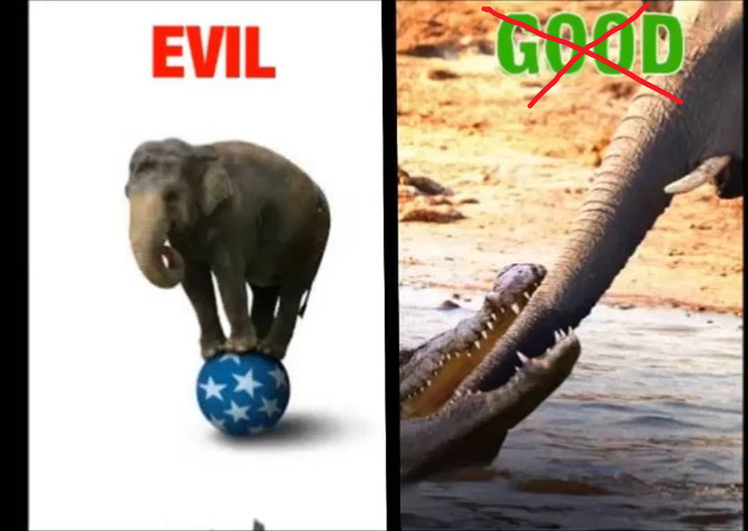
Here even many animal rights supporters are indeed complete hypocrites, they’re still suffering from a pro-nature and a pro-life bias, they don’t wish to interfere with nature to stop the suffering of wild animals or as much as with farmed animals, which already frequently becomes apparent when carnists ask them (though in that case most likely with dishonest intent) why it is ok for the lion to kill a zebra for flesh, but not for us to kill a pig for its flesh.

There is actually no great answer to this, the common rebuttal is that:

  • The lion doesn’t have the cognitive capacity to acknowledge it is harming others, humans are harming others intentionally, other animals don’t.

If that is the issue, then there would be no point in stopping a mentally retarded person on the IQ level of a lion from brutally raping someone, to make it more similar, let’s say it’s his mentally retarded sister on the IQ level of a zebra. But the intelligence level of the harm causer doesn’t diminish the harm they cause, the outcome, suffering, is still bad nonetheless.

Why don’t these nature apologists offer themselves to be eaten by lions then, if the fact that lions don’t understand what they’re doing makes what they’re doing not bad?

Intent is ultimately irrelevant, if a rapist with severe mental retardation, schizophrenia or multiple personalities raped you, you’d still want it to stop. If you were the one eaten by the bear, you’d still want it to stop. If you were tortured by a virus or machine with no intent, you’d want it to stop.

  • The lion is a carnivore by nature, needs the flesh of others for survival.

Then again, why don’t these nature apologists offer themselves to be eaten by lions, the lion needs (nutrients in) flesh to survive, so they should have no problem with being eaten by one, the lion derives nutrients from human just like from gazelle flesh.

There should be no problem with a hypothetical, physically stronger (than human) carnivorous alien species hunting or farming us for our flesh, because they’re naturally carnivorous, so that somehow makes the suffering we experience no longer relevant, as long as the aggressor is deriving nutrients from it, it’s acceptable.

Pain is not any less bad by it being caused or experienced by those that aren’t able to grasp what they are caught up in or just because someone is deriving nutrients from their victim, it’s in fact irresponsible of us not to interfere with this completely unfair game, we’re the only ones that can really do anything about it.

It’s the pain in and of itself that is the problem, not the intent to cause it. The only reason why we care about bad intent is because it tends to lead to a bad outcome later on, e.g. a serial rapist and killer in solitary confinement may have bad intent to cause harm to others, but it’s not a problem anymore, because he’s unable to do it, a virus has no intent to cause harm but you’d still try to prevent it from infecting you.

To a wild boar it doesn’t matter whether it is torn apart by a wild predator or tortured by some sociopathic factory farm worker, the suffering is just as bad, if not worse in many cases, torture in the wild has been going on for much longer than in factory farms and there’s no harm mitigation whatsoever, no rules against eating someone alive.

When it comes to wildlife suffering, all the arguments that they refute when carnists make them suddenly come out of the woodwork.

  • It is what it is.
  • That’s just nature, therefore it’s good.
  • That’s how it always has been.

Often times in discussions about what is done to non-human animals by human animals, hypotheticals involving mentally handicapped humans are utilized, as one of the great differences between humans and other animals are their different levels of intelligence, but obviously being less intelligent doesn’t make being harmed no longer bad, so if it’s bad to torture humans that are no more intelligent than pigs, then it’s bad to torture pigs as well.

A good way to demonstrate the horrors of the dairy industry would for instance be to just imagine I’m doing what they are doing with a mentally handicapped human female.

Forcefully impregnate her, steal her kids that are due to their young age no more intelligent than cows anyway, tie them up so they can’t move for their flesh to stay tender, then slaughter them all. Yes, they are all less intelligent, but it’d obviously still be bad if I did that, it would generate negative sensations.

  • The thought experiment for nature and wildlife suffering would just be leaving the severely intellectually disabled in a forest to fend for themselves.

Imagine we isolate all the severely intellectually disabled into an asylum into an abandoned forest somewhere, cut off by a wall or some such object from our general public.

They desperately search for berries in the forest, try to cannibalize each other when food resources are scarce, they die of all sorts of accidents or infectious diseases in said forest they don’t know how to prevent, and once in a while they manage to get on top of another and produce more having the overall same legacy.

This would almost certainly be seen as a problem, the same thing essentially happens in the wild, which is by most not acknowledged as a problem at all, even as something to be preserved, frequently justified by simply pointing to the fact that this is mother nature, therefore it must go on as it is, which is no better than justifying the forest experiment by simply pointing out that it is indeed the abandoned retard forest, so therefore, it must be good because it exists.

That’s just an is-ought fallacy – it’s like you discovered the torture chamber of a serial killer and didn’t call the police because the torture chamber exists, so you figured that what’s taking place inside it must be good, otherwise the torture chamber wouldn’t exist, it exists so it must be fine.

This is a faulty conclusion, because just because something exists, that doesn’t mean that it generates good outcomes for sentient organisms.

It exists, therefore it should keep existing, that’s the assumption.

The blinding difference here is human DNA again, but the suffering endured in the wild is the same as suffering endured in the abandoned retard forest, human DNA alone doesn’t determine your capacity to suffer, human fetuses prior to reaching consciousness and braindead human vegetables being the greatest examples of this, so there’s no reason why we should interfere with the forest experiment for such an insignificant reason but not nature in general.

Both contain tremendous amounts of suffering in the same way and no one is harmed by not being brought into existence, so we should interfere with both the abandoned retard forest and the jungle.

If any of these nature apologists had parasites in their assholes, they would insist on removing them. If we dumped them into the location they are defending, the wild, and they would still have parasites in their assholes, they would still insist on removing them, so in what exact location suffering is happening is rather irrelevant, it’s the suffering part itself that is the problem, regardless of its location.

If the big, strong, 6’5 tall, tiger IQ human sexually assaulted everyone the nature defenders would see it as a problem, even if he doesn’t know any better than to sexually assault everyone, even if he only assaults mentally handicapped girls that aren’t much more intelligent than zebras, you wouldn’t insist on creating more individuals like that because you understand the negative consequences of doing so.

When they a see a tiger causing harm, they get a big boner because it looks so majestic and has pretty tiger stripes too, so that’s different when the tiger is torturing a zebra to death, so we shouldn’t stop this from happening.

Conservation efforts focused on keeping these animals breeding forever are simply misguided (when we’re talking about something directly related to the welfare of already existent animals it’s a different story of course), wild animals will go through much more suffering if we try to preserve them at all costs, first off because they’ll be born which always results in suffering, need, want, desire, just as with humans, the global antinatalist argument based on antifrustrationism applies to both, secondly because of the particularly faulty and destructive manners they are wired to act.

Extinction is benign and should be seen as the end goal, there is no tiger or elephant right now in the unborn (non-human) animal purgatory lamenting the absence of more tigers and elephants roaming planet earth, you wouldn’t be doing these animals a favor by breeding more of them.

These animals first and foremost want to avoid suffering, just like humans by the way, it’s just that they don’t have any of the emotional complications and delusions going on that humans developed as a way to deal with suffering.

A wildebeast with its entrails ripped out of its asshole by a hyena isn’t laying around in the grass, hoping that no one comes to euthanize it because that would violate its religious belief that getting your entrails ripped out of your asshole by a hyena is god’s test and you must endure it to go to wildebeast heaven one day, these are idiotic coping mechanisms and rationalizations only humans come up with to justify all the suffering that surrounds them in life.

How one should go on about preventing all the other animals from reproducing as peacefully as possible for everyone involved is of course a different and more complicated question, but the first step certainly is to at least recognize that negative sensations aren’t suddenly less negative just because they’re being produced in a different location in the wild.

That seems frequently to be the attitude of both carnists and some number of vegans that seem to think non-human animal suffering is somehow only bad if it’s happening at the hands of humans, or worse, anthropocentric antinatalists, vhemt (voluntary human extinction movement) types that think somehow the other animals would be better off if just humans went extinct, which is about as idiotically irresponsible as thinking it’s a good idea to leave a severely mentally retarded person in a forest somewhere and move to a different country forever.

On life and reproduction.

(Sentient) life is a problem state demanding of constant fixing. What you do when you create life is essentially to throw something into a state of deprivation, struggling to constantly tame/fulfill their needs/wants/desires, accumulation of urges and compulsions you have imposed on it by having created it.

Imagine it as being trapped in a hole, the further you sink, the more you suffer, the closer you get to the surface, the more you feel relieved of it again, but you cannot climb out of the hole, you’ll always sink down again and have to keep struggling to remain as close to the surface of the hole as possible until you are dead.

Now that the organism has been created, it is constantly suffering, experiencing desire, deprivation. Hunger, thirst, constipation, sexual frustration, fatigue every single day to differing degrees, and proneness to worse future suffering, e.g. all sorts of accidents, drug addiction, loneliness, cancer, paralysis, the list goes on and on.

You fulfill a desire, then either a new desire pops up (e.g. appetite after hunger) or the old desire comes back in time and you’ll have to fulfill that initial desire again to avoid more suffering.

You must eat or you suffer hunger, you must drink or you suffer thirst, you must defecate or you constipate, you must breathe or you suffer suffocation, you must masturbate/have sex or you are sexually frustrated and tense, you must sleep or you fatigue, you must socialize or you feel lonely, etc.

We can use pretty much whatever example we want, we must obtain pleasure or we suffer, that’s the deal of sentient life.

Of course getting higher to the surface of the deprivation hole feels good, but would it really be an important priority to climb to the surface of the hole if you were never thrown into it in the first place? I don’t think so, I may enjoy a fresh breath of air, but I know that before I existed, there was no suffocating version of me trapped in an unborn purgatory, waiting to be brought to earth so that I can finally breathe clearly.

  • Creating a problem because mitigating and/or solving it is good.

Considering there was no kind of desire problem prior to the existence of an individual that demanded for some kind of happy moment to distract the individual, justifying reproduction on grounds of some kind of good in life is akin to justifying setting someone’s house on fire because extinguishing the fire again is good, giving someone AIDS because AIDS treatment is good, breaking someone’s leg because painkillers are good, throwing someone into the ocean because saving them from drowning is good, breaking the vase because halfway repairing it again is good, shitting on someone’s carpet because cleaning it off afterwards is good.

It’s an irrational idea, creating a (light to severe) torture mechanism just for the sake of sometimes stopping the suffering for the victim to appreciate what it’s like to not be burdened, for which they had absolutely no use prior to being burdened with it anyway, all the suffering could be prevented by abstaining from creating sentient life in the first place and no unborn child would miss out on anything, there is no child right now being tormented in the unborn purgatory waiting to be released, suffering from a need to be suffering from needs, procreators create all need.

It might be good to clean shit off of the carpet when there is already shit on it, but you wouldn’t think I’d be doing you a favor if I defecated onto your carpet for the good of cleaning it off again, most likely incompletely. It might be good to repair the vase when it is already broken, but you wouldn’t think I’d be doing you a favor if I broke it for the good of trying to repair it again, most likely incompletely.

  • To create sentient life in and of itself is to harm, you cannot reproduce without breaking the do-no-harm principle.

Let’s say I could bestow desire by snapping my fingers, or there were desire serum, so I could inject different desires into lifeforms, inject you with a substance in your sleep that makes it so that unless you stare at a red painted wall at least once a day and ejaculate into a purple cupboard, you won’t be able to fall asleep anymore.

The reason why everyone would most likely look at me as an asshole for doing that, but not their parents for giving all them all sorts of burning needs for:

  • food
  • taste satisfaction
  • shelter
  • resources you’ll have to do possibly dissatisfying work for
  • constant entertainment
  • acceptance, reassurance
  • affection
  • sex

with this need mechanism perhaps even leading to needs that are hard or nearly impossible to fulfill, which a good chunk of individuals are suffering from, like for example the need to:

  • stay healthy and simultaneously be an alcoholic or eat greasy, salty, sugary foods
  • copulate with more females than you have opportunity to copulate with
  • go back into the past you may feel more attached to than the present
  • not decompose and die, although you inevitably will anyway
  • be someone else that you are not

or perhaps even needs of which the fulfillment will directly necessitate the frustration of someone else’s needs, like for example the need to:

  • rape others for your sexual relief
  • make yourself feel superior to others by subjugating them

is because every sentient being in existence has been harmed in this way, with the evidence being that they currently exist, so you most likely assume it must be this way and take it for granted without ever questioning it, as opposed to me injecting someone with desire serum. It is simply impossible to create a sentient lifeform with the main function to suffer for constant need fulfillment without causing suffering, to create a sentient life is by itself to create suffering, it’s directly entailed.

It’s the creation of preferences that demand constant satisfaction, needing is a problem, you are in need of something, it is a deficit that if not alleviated in time will only intensify. And this is the act breeders engage in, they put you in need, similar to injecting you with heroin, except they bestow not one little deprivation by snapping fingers or using hypothetical desire serum, they create numerous desire wounds without lifelong, failsafe guarantee of bandaid supply.

In that sense, the more frustration is experienced by the victim, or the more frustration would be experienced by others if they were satisfied, the crueler the act of reproducing them – and you don’t know what the victim will win in the suffering lottery beforehand, someone is going to pull the brain tumor ticket, someone is going to pull the ”you can only orgasm if you set little kittens on fire” ticket.

You create an addiction, for example, a dependency on sex. Now perhaps the organism will always be able to find a hole to stick their penis in just in time, before the suffering gets out of hand, perhaps you’ll create an ugly elephant man experiencing lifelong loneliness though. You create an addiction, for example, a dependency on air. Now perhaps the organism will always be able to breathe in and out clearly just fine, perhaps you’ll create a child with cystic fibrosis or lung cancer though.

Every sentient organism experiences needs, wants, desires, every sentient organism is being harmed. Some victims are lucky enough to always get a painkiller just in time, others are not.

I would say that considering that if you were never put into this situation in the first place, you would not be suffering from not having your needs/wants/desires fulfilled (because you wouldn’t exist in the first place), the suffering of the ones unlucky enough to not receive painkillers is not justified.

The ugly elephant man’s unfulfilled sexual need to cum inside a hot pussy is not justified by someone else cumming inside hot pussy for him, because that happy individual would not be trapped in an unborn purgatory missing hot pussy if no one ever took the risk of creating either of these two individuals.

The dissatisfied child with leukemia isn’t justified by the happy child without leukemia, because that happy child would not be trapped in an unborn purgatory missing their life if no one ever took the risk of creating either of these two individuals.

You’re creating a problem, i.e the sentient organism needs to be pumped full of pleasure or else perhaps tragic suffering will ensue, and you created the sentient organism…with no guarantee that they can even be pumped full of sufficient pleasure at all times.

  • Our conditions of suffering may not only be impossible to alleviate sometimes, they also demand one to make others suffer in the process of alleviating your suffering, so perhaps your desire machine will also harm others.

Sometimes in this game, the relief of pain will depend on the pain of another organism. Perhaps you’ll create some organism that can only get off if they brutally rape and subjugate someone else, perhaps the organism will be an animal abuser their entire life, then in the metaphor, you basically created a fire that can only be extinguished by setting someone else on fire, you can only give the one organism the painkiller if you stab the other organism and let them bleed out on the road.

Childhood bullying is an almost instinctive, natural occurence, it’s a good example of sentient organisms being naturally in such a shitty insecure condition that they’re always aching to get a relief, even by making others suffer, in this case alleviating the suffering to be in control and feel powerful, this bad instinct comes naturally, civilized behavior on the other hand may take hard work.

It’s arguably a harm, you are creating states of deprivation, bestowing the itch that then demands to constantly be scratched, with no 100% guarantee that the itch can even be successfully scratched all of the time, possibly creating itches that can’t be scratched adequately or itches that can only be scratched by giving someone else the itch.

  • But let’s even assume we established some sort of as close to utopian scenario as possible where every suffering/need could be immediately alleviated, all itches scratched in due time.

At that point I’d be less concerned about procreation but I still wouldn’t say that it’s obligatory, because likewise, you still wouldn’t be able to miss being here if no one ever brings you into existence, so it doesn’t seem like a big deal.

It’s completely solving a problem (no life at all) vs. alleviating it as greatly as possible (utopia). If we exist in the utopia, we still have needs/wants/desires that if left unattended would lead to greater and greater suffering, but it’s just always being alleviated just in time.

Good without suffering seems impossible because pleasure and suffering exist in comparison to each other similar to bright and dark or wet and dry, when you take away suffering aou have pleasure and when you take away pleasure you have more suffering again, I don’t see any kind of neutral point in between where it’s clearly divided and then we just cut off suffering and have solved the suffering problem once and for all.

If you have more pleasure, you have less pain. If you have less pain, you have more pleasure, so I think the closest we’d get to a utopia would be perfectly alleviating the problem, always putting a bandaid on the problem just in time.

So we might create pain still, but then we always perfectly alleviate it. We have AIDS, but we also have the perfect cure for AIDS on hand. We create fires, but we also have the perfect fire extinguishing technology in place.

But if there’s no problem to fix anymore because life wouldn’t exist anymore, then I don’t think that having no utopia would be a problem either of course.

The endless orgasm utopia would be a great tool to have in place in a case someone is brought into existence and feels frustrated, but it certainly wouldn’t be a reason to create it in the first place, just like I would say that the existence of the cure for AIDS wouldn’t be a reason to infect someone with it in the first place just to then perfectly cure them of it afterwards.

The perfect problem solving means don’t obligate us to create a new problem, there is no need for desire fulfillment before desire is created, it doesn’t follow that the suffering of desire must be created merely because the perfect means to alleviate it would exist.

  • Perfectly alleviated suffering > suffering left to fester and intensify in our current world where desire fires are set with no guarantee of extinguishing

but

  • zero suffering > perfectly alleviated suffering.

And of course, on a more practical level, it simply also isn’t an argument for causing suffering by reproduction right now, just because of the possibility of a utopia in the distant future, that’d be like setting the forest on fire before the water hose was even invented.

On abortion.

  • What does it mean to create life?

When you create life, you make someone addicted to pleasure/relief, and if they don’t obtain it, they will be exposed to suffering, life entails constantly facing series of suffering, like hunger, thirst, constipation, sexual frustration, fatigue, etc.

You have deprivations imposed on you, and if you fail to alleviate deprivation, you will suffer more intensely as a result of that. At its core, you are presented with the task to alleviate deprivation, if you fail to do so, it intensifies. If you alleviate it, A. another deprivation will pop up (like appetite after hunger, now you need to eat just to avoid suffering boredom) or B. the initial deprivation (hunger) is going to return in time, and you’ll have to eat again.

You have to chase pleasure your entire life or you are subjected to harm, and the relief from harm is not guaranteed before you procreate.

  • Eat or hunger.
  • Drink or thirst.
  • Defecate or constipate.
  • Ejaculate or become tense.
  • Sleep or fatigue.
  • Breathe or suffocate.

So on and so forth.

I think it is therefore the responsible thing to do to kill a fetus. You prevent all future suffering by doing so instead of irresponsibly creating an addiction to pleasure that you cannot guarantee will be properly satisfied, and while there won’t be any pleasure, again, it won’t be a problem either, because there won’t be an addict craving for more pleasure in the first place.

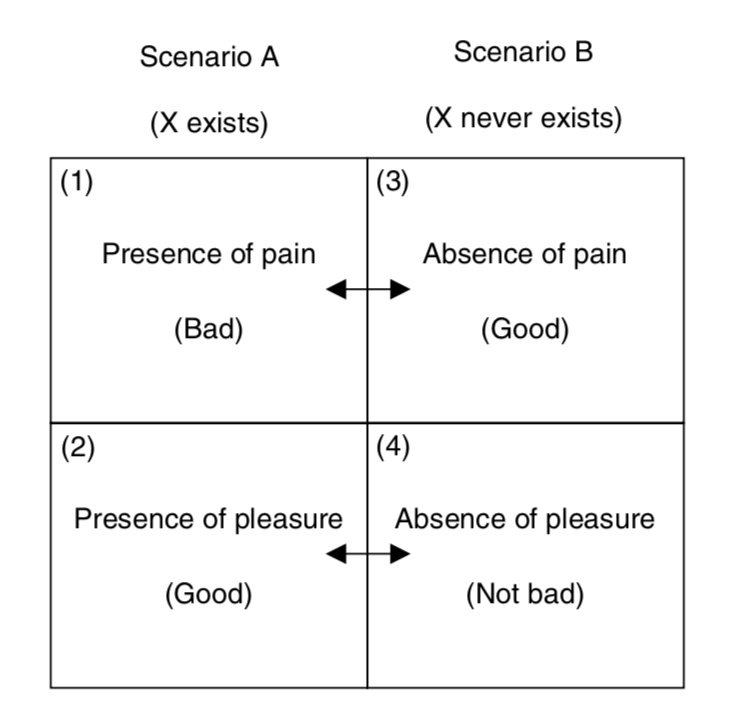
Here I’d like to bring up the concept of Benatar’s asymmetry:

  • Benatar’s asymmetry:

Is the absence of pleasure really an issue if there is no one to experience it and suffer from it? Imagine this, I have both hypothetical pleasure and pain serum, if I inject said liquids into inanimate objects, they will turn conscious and either experience intense pleasure or intense pain, depending on which liquid I choose obviously.

Is injecting the pain liquid into my chair problematic? I would say yes.

Is not injecting the pleasure liquid into my chair problematic? I would say no.

  • Sentience is the only important characteristic.

Badness is necessarily something that is happening in feeling organisms, the capacity to have sensations that can either be of negative or positive value, this function is enabled by a brain and nerves that have to be developed to a certain degree. A rock cannot produce badness, neither can a fertilized egg or human fetus until a certain point.

Sentience is the capacity to feel, perceive, or experience subjectively. Eighteenth-century philosophers used the concept to distinguish the ability to think (reason) from the ability to feel (sentience). In modern Western philosophy, sentience is the ability to experience sensations (known in philosophy of mind as “qualia“).

https://en.wikipedia.org/wiki/Sentience

Sentience is arguably the trait that makes it most important to avoid having certain things happen to you, such as getting run over by a car, having a knife stuck in your throat or being burned, it opens the door to very negative sensations, it’s the only thing that could make it an important priority for you to avoid it.

A tree doesn’t care if it’s being burned down, it could only generate negative sensations in the sentient organisms that may in some way care about the tree, not in the tree itself. If an asteroid hits and destroys the entire planet, that can only be bad if there are sentient organisms on said planet, otherwise it is a completely insignificant event.

The reason why it’s bad when I’m harmed is not because I contain human DNA, it is bad because I have a functioning central nervous system generating a pain response, enabling me to even be harmed, it is the only reason why I am even capable of experiencing harm in the first place.

  • I think the common question of: ”Is it a human life?” is simply completely misguided to begin with, being human is not why I try to avoid being squashed.

It doesn’t matter whether or not something contains human DNA or is alive, a braindead human contains human DNA, a head of broccoli is alive too, that doesn’t make it bad to destroy a thing, many pro-lifers are simply speciesists.

If they knew they had to experience the life of a factory farmed pig getting its nuts hacked off with no anesthesia tomorrow, they wouldn’t agree to that based on their entirely misguided notion that the thing that makes not having a knife stuck in your throat important is the trait human DNA. Human life by itself is absolutely worthless, life only has extrinsic value to sentience.

It’s similar to a white slave owner accepting the torture of black slaves because they don’t contain white skin color, but having qualms about pulling the plug on his braindead white grandmother because she contains white skin color, neither white skin color nor human DNA are the characteristic that make it important to avoid torture.

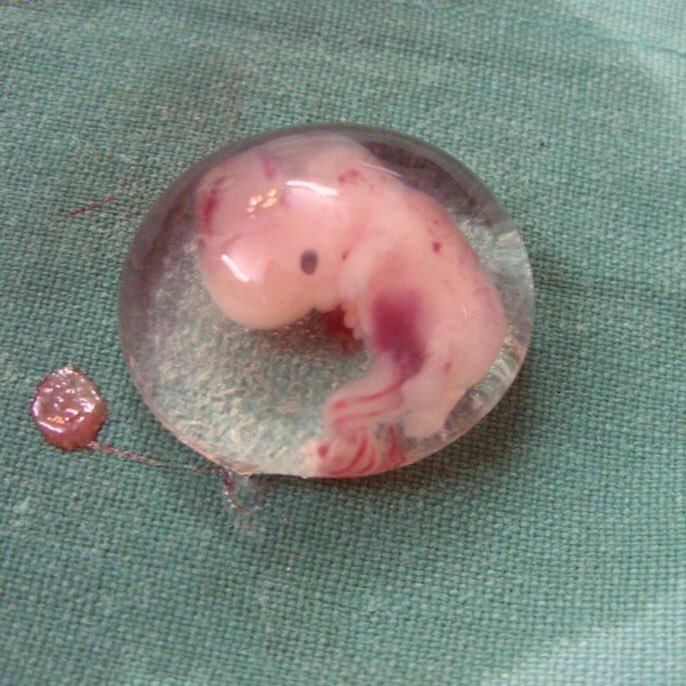
Pre-sentience abortion for the ”victim” is essentially just like it’s for tomatoes when you turn them into tomato soup, it cannot matter to them.

Tomato isolated on white background

The only two common objections I consistently hear to this type of argumentation are that:

  • The fetus could become sentient in the future.

This is true of every potent sperm sample, if you don’t impede the process by flushing it down the toilet, I’m in full agreement that life starts in the testicles. Sperm lives, sperm dies, new sperm comes to life, sperm can survive in a moist environment up to 5 days.

If that argument is rejected because sperm could not ”on its own” grow into a sentient child (i.e by leeching off of a female’s body for 9 months, so not really on its own), only the morning after pill, not ejaculation would have to be a crime, as it prevents the sperm from fertilizing the egg on its own once it has been successfully ejaculated into a vagina, then realizing its potential to grow into a sentient child later on, on its own.

  • The effect is the same – no suffering.

It still cannot matter to the ”subject”, so there’s no rational reason for concern because of the aforementioned point I made, I don’t think the absence of pleasure is a problem if it doesn’t result in suffering. The fact that the fetus could become sentient doesn’t matter to the fetus right now when it’s not sentient, so it can’t possibly hurt it to be aborted, if you’re purely asexual, you can’t be deprived of sex.

I like the hypothetical of sentient grassblades. Let’s say if I let grassblades grow for 9 months, they would become sentient. Would it be a problem to mow them down before they have grown for 9 months? I’d say no, because they’re not sentient yet, so they won’t even care about never becoming sentient in the future.

If I took life away from a sentient organism, it could result in some badness as their sentience enables them feel distress in response to their life being taken away, sure, the arguably living organism that is not sentient yet cannot miss anything on the other hand.

So even if there were a hypothetical tomato that could become sentient tomorrow, if I turned it into tomato soup today, it could not possibly matter.

  • Coma patients are temporarily unconscious, but we don’t put them down either.

It doesn’t necessarily harm the coma patient to just not wake up again either, what could worry people though is to know that they could be legally euthanized if they were to fall into a coma one day, before they fall into that coma, because they have some kind of delusional death anxiety that they’re going to miss being alive once they’re dead.

So it doesn’t lead to badness to kill a sufficiently unconscious organism, but it could produce some suffering to legalize doing it, worrying others that they may not wake up again if they were to fall into a coma, that’s the slight distinction.

The fertilized egg/embryo/fetus was never conscious before, when it was a sperm, it never worried that if it were to fertilize an egg one day, it may be aborted by some evil, uncaring monster although it wished to become a fully conscious child one day, so in the case of an abortion as opposed to coma patients, we don’t have this whole problem.

And again, some organisms that live outside of wombs also have utility to helping others, I could argue it’s bad to pull the plug on someone who has to take care of a child, or a scientist who is about to find the cure for AIDS. We don’t live in a vacuum, the fetus kind of does.

  • What if the fetus is already sentient though?

If the fetus is unfortunately already able to suffer, without any great debate now about when exactly that happens, just presupposing the fetus is, then the same goes as for every other organism, if it’s killed entirely painlessly, without any suffering involved, it still wouldn’t be bad. It cannot be intrinsically harmful, it could only be extrinsically harmful, as in:

  • Family members and acquaintances might miss the painlessly killed person.
  • If we legalized this act of painless killing, you may scare others they’re next in line.
  • You prevented the person from reducing more suffering in other organisms.

Death is not an intrinsic harm, it can only be an extrinsic harm. This goes for late term abortion, infanticide, really any death. It’s only a problem in practice, there’s no problem with a theoretically completely painless death in principle, it prevents all future pain/suffering/harm/negative qualia.

Believing in the badness of death itself almost requires the subconscious or conscious delusion of some sort of afterlife. Even if you know that once you’re dead, it’s over, you can still be delusionally scared of things that aren’t a threat to you, arachnophobia, fear of even little spiders that you know to be harmless would be an example, and similarly irrational is fear of being dead.

Obviously, if you are dead, you no longer experience needs, wants, desires just like you didn’t before you were born, so the only thing that could be bad is your departure, you’re not going to wake up afterwards as a ghost and feel the need to come back but being unable to.

  • The general utility of the right to bodily autonomy.

Another thing to point out in general is also that even if the fetus is already sentient, that doesn’t automatically mean that the harm of the abortion outweighs the harm of forced birth.

Of course, anyone’s right to bodily autonomy isn’t absolute.

It matters like anything, only because of the existence of pain. You don’t want to get raped, generally there’s no worse harm to prevent by raping you, as in, we have to rape you or otherwise we all go to hell and burn for all eternity for example, so we write on a piece of paper that person x now has a legal entitlement not to get raped for no great reason randomly.

Fair deal, if you want to violate it, it’d be good to show evidence that you’re actually going to prevent a worse harm by doing so, and this is where pro-lifers fail.

Two organisms are connected to each other here, so if the pregnancy is unwanted by the hostess (which ideally, would be all pregnancies to begin with), we are automatically forced into a situation of having to harm one by abortion or the other one by forced birth. So if the only two options are:

  1. harm the more sentient
  2. harm the less sentient

then it’s still the lesser of two sufferings to abort than to force birthing – the fetus should be sufficiently sedated though if there’s a chance that it can suffer to some degree at that point, there’s still no adequate justification to cause unnecessary (to prevent greater) harm.

Just as when you leave the door open and an uninvited intruder comes in and refuses to leave your house, you have a right to shoot them, not torture them to death over the course of three days, that’d be doing unnecessary harm to prevent the threat.

Here pro-lifers will frequently say but the fetus is innocent, the intruder chooses to harm you, therefore it’s different. This is irrelevant, a rapist with severe mental retardation, multiple personalities or schizophrenic delusions who thinks he must rape to cure world hunger and cancer is also innocent and has a good motive in mind, that doesn’t diminish the harm caused, so it’s probably still better to defend yourself.

Sometimes two organisms are connected to each other and you have to harm one either way, e.g. a cat has an ixodid tick or a tapeworm. All suffering is bad, perhaps you’ll cause some suffering to the slightly sentient tick or tapeworm, but certainly much less than if you let the parasite inside the cat’s asshole, causing worse suffering to the cat.

Pro-lifers would have more of a point if they demonstrated the suffering of the fetus to be worse, more intense than the suffering of the hostess, if pro-lifers could legitimately prove that the fetus has a soul and its soul is after the abortion forever suffering in a purgatory for aborted fetuses, getting raped by demons with pitchforks, then of course it’d be better to take that mother’s right to bodily autonomy away.

In that case, the forced-birth rhetoric would indeed start to make a lot more sense, granting bodily autonomy in that scenario would lead to a much worse outcome, but that is what makes the forced-birth view so absurd in our reality, because abortion does not lead to the more suffering producing outcome, to the contrary, it greatly prevents and reduces suffering.

UPDATE:

What if the fetus is already sentient?

That’s indeed a more complicated question, I have no qualms with anything non-sentient being killed, and technically I don’t think the painless killing of a sentient organism is a problem either.

If the non-existence before existence isn’t harmful, neither is the non-existence after you died harmful, it’s the same non-existence, and the organism won’t miss pleasure. If I’m not sad about my non-existent sibling that was never born not experiencing happiness, and I’m not upset about a potato not being able to experience happiness, why would it bother me that a corpse cannot experience happiness? They all have in common that they don’t miss it.

So what I’m saying is that all that can actually be harmful is the process of you dying and its external consequences (sad family members, friends, etc).

However, in practice I still don’t take the view that you should just walk around trying to euthanize as many people as possible, there would be practical issues with that, it would have lots of negative side effects, so it seems to me I would think this is simply a case by case kind of thing if it can be done rather painlessly, admittedly I’m not an expert on that subject – so I can’t really comment that much at what point a fetus is sentient and it might be ethically problematic to squash it, I won’t declare it’s always right.